

|
TL;DR
|
Short Answer
AI translation quality assurance is the structured process of reviewing and correcting machine-generated translations before publication. It relies on post-editing — human reviewers fixing what AI misses — to combine machine speed with the judgment that only context-aware review can provide.
Why it matters: Unreviewed AI translation published at scale doesn’t fail loudly — it fails through confused customers, support tickets, and brand damage that accumulates quietly. A structured post-editing workflow is what separates translation that works from translation that represents your brand well.
What post-editing is and why it matters for AI translation quality assurance
Post-editing is the process of reviewing and correcting machine-generated translations to meet quality standards. Unlike translating from scratch, post-editors start with AI output and focus on fixing errors, improving fluency, and adapting cultural references. The business case is straightforward. Human translation from scratch takes longer and costs more per word. Unedited machine translation is faster but quality varies unpredictably. Post-editing splits the difference: AI handles the heavy lifting, humans fix what machines miss. Human review in machine translation addresses specific weaknesses. AI struggles with idioms and colloquial expressions, cultural context and local references, brand voice consistency, ambiguous pronouns and unclear antecedents, domain-specific terminology, and subtle tone shifts. A post-editor catches these issues while accepting correct translations that don’t need changes.
The efficiency gain depends on AI quality. When machine output is 70–80% correct, post-editing can be 30–50% faster than translating from scratch (TAUS, Post-Editing in Practice, 2022). When quality drops below 60%, post-editing takes as long as human translation because reviewers spend more time fixing than accepting.
Different content types need different post-editing approaches. Light post-editing fixes critical errors — meaning changes, grammar mistakes, terminology issues — but accepts awkward phrasing if meaning is clear. It works well for internal documents, support tickets, and content where speed matters more than polish. Full post-editing produces publication-quality translations matching human standards, refining style, fluency, and cultural appropriateness beyond basic accuracy. It’s the right choice for marketing content, legal documents, customer-facing materials, and anything representing your brand publicly.
The distinction matters for AI translation quality assurance because editing depth affects both timeline and cost. Trying to achieve publication quality on content that only needs basic comprehension wastes reviewer time. Applying light editing to customer-facing content produces translations that technically work but feel machine-generated.
A useful test: if the translation would represent your brand to a customer, it needs human review. If it’s for internal comprehension only, light editing or no editing may be acceptable.
Human review in machine translation addresses specific weaknesses. AI struggles with idioms and colloquial expressions, cultural context and local references, brand voice consistency, ambiguous pronouns and unclear antecedents, domain-specific terminology, and subtle tone shifts. A post-editor catches these issues while accepting correct translations that don’t need changes.
The efficiency gain depends on AI quality. When machine output is 70–80% correct, post-editing can be 30–50% faster than translating from scratch (TAUS, Post-Editing in Practice, 2022). When quality drops below 60%, post-editing takes as long as human translation because reviewers spend more time fixing than accepting.
Different content types need different post-editing approaches. Light post-editing fixes critical errors — meaning changes, grammar mistakes, terminology issues — but accepts awkward phrasing if meaning is clear. It works well for internal documents, support tickets, and content where speed matters more than polish. Full post-editing produces publication-quality translations matching human standards, refining style, fluency, and cultural appropriateness beyond basic accuracy. It’s the right choice for marketing content, legal documents, customer-facing materials, and anything representing your brand publicly.
The distinction matters for AI translation quality assurance because editing depth affects both timeline and cost. Trying to achieve publication quality on content that only needs basic comprehension wastes reviewer time. Applying light editing to customer-facing content produces translations that technically work but feel machine-generated.
A useful test: if the translation would represent your brand to a customer, it needs human review. If it’s for internal comprehension only, light editing or no editing may be acceptable.
Common quality issues in AI translation output
Understanding typical AI translation errors helps post-editors work systematically rather than reading every word from scratch. Most errors fall into predictable categories — and knowing the pattern is half the fix. Terminology inconsistency happens when AI translates the same term differently across a document. “Dashboard” becomes “tableau de bord” in one paragraph and “panneau de contrôle” in another. Both are technically correct, but inconsistency confuses readers and signals machine origin immediately. The fix is creating and enforcing glossaries that define approved translations for key terms. Modern platforms accept glossaries as input so AI applies consistent terminology automatically. Literal translations that miss idioms occur when AI translates phrases word-for-word without understanding cultural meaning. “Kick the bucket” becomes “donner un coup de pied au seau” in French instead of “mourir.” Native speakers recognize these as machine-generated immediately. Simplifying source text where possible — or flagging idioms for human review before translation — prevents this pattern from repeating.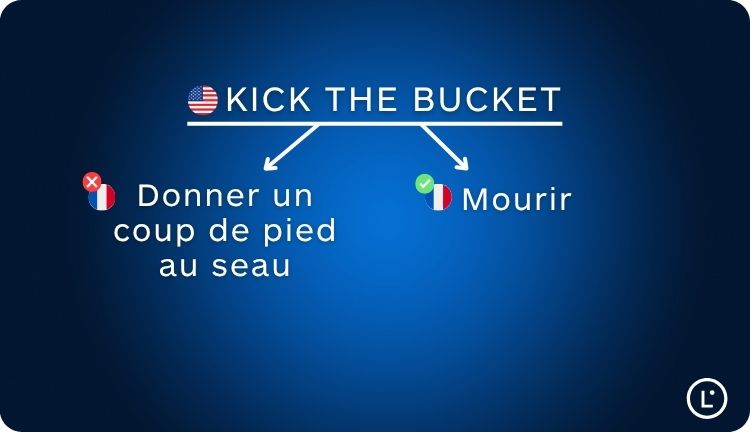 Gender and pronoun errors show up in languages with grammatical gender. AI might assign the wrong gender to job titles, use formal “vous” where informal “tu” fits better, or misinterpret ambiguous pronouns in English. Style guides specifying formality levels, combined with audience context, help AI make better initial choices.
Missing context for ambiguous words causes problems when English terms carry multiple meanings. “Bank” means financial institution or riverbank. “Pitcher” means container or baseball player. “Lead” means metal or guide. AI without sufficient context picks the wrong meaning. Systems that analyze document-level context rather than sentence-by-sentence reduce these errors significantly — see how context instructions work in Lara Translate.
Cultural references that don’t transfer create disconnects when direct translation preserves the reference but loses meaning. American football metaphors, Thanksgiving traditions, and specific cultural touchpoints don’t resonate in markets without those traditions. Identify cultural references during source content review and either remove them or provide cultural equivalents during post-editing.
Gender and pronoun errors show up in languages with grammatical gender. AI might assign the wrong gender to job titles, use formal “vous” where informal “tu” fits better, or misinterpret ambiguous pronouns in English. Style guides specifying formality levels, combined with audience context, help AI make better initial choices.
Missing context for ambiguous words causes problems when English terms carry multiple meanings. “Bank” means financial institution or riverbank. “Pitcher” means container or baseball player. “Lead” means metal or guide. AI without sufficient context picks the wrong meaning. Systems that analyze document-level context rather than sentence-by-sentence reduce these errors significantly — see how context instructions work in Lara Translate.
Cultural references that don’t transfer create disconnects when direct translation preserves the reference but loses meaning. American football metaphors, Thanksgiving traditions, and specific cultural touchpoints don’t resonate in markets without those traditions. Identify cultural references during source content review and either remove them or provide cultural equivalents during post-editing.
Post-editing best practices that improve AI translation quality assurance
Effective post-editing follows systematic approaches rather than ad-hoc corrections. The difference between a good reviewer and a fast one is usually method, not speed. Start by reading the target text without looking at the source. Does it flow naturally in the target language? Would a native speaker phrase it this way? Fluency problems are easier to catch before your eye gets anchored to source structure. This two-pass approach produces more natural translations and is often faster than line-by-line comparison. Once you’ve identified awkward sections, check source text to understand intent — but only then. Constant back-and-forth between source and target wastes time and encourages literal translations over natural phrasing. Skip checking source for segments that read naturally and convey clear meaning. Always prioritize meaning errors before style issues. A mistranslated number or inverted yes/no costs more to fix after publication than slightly awkward phrasing does. Sort edits into critical errors — meaning changes, terminology mistakes, grammar problems — and non-critical issues like minor fluency improvements. Address high-priority items first.
When you catch a repeated error, search the entire document for other instances. If “user account” was mistranslated once, it’s probably wrong elsewhere too. Fixing systematically saves time and improves consistency. Track these patterns in error logs and share them across your review team — they’re the data that improves future translations through glossary updates or source content adjustments.
Post-editing also means making sure translations match brand voice and tone requirements. Reference style guides specifying formality levels, preferred terminology, and cultural adaptation rules. For marketing content, maintaining brand voice across languages requires additional attention to persuasive impact and cultural resonance beyond basic linguistic accuracy. You can learn more about what to consider when evaluating translation quality to build a consistent internal review standard.
Always prioritize meaning errors before style issues. A mistranslated number or inverted yes/no costs more to fix after publication than slightly awkward phrasing does. Sort edits into critical errors — meaning changes, terminology mistakes, grammar problems — and non-critical issues like minor fluency improvements. Address high-priority items first.
When you catch a repeated error, search the entire document for other instances. If “user account” was mistranslated once, it’s probably wrong elsewhere too. Fixing systematically saves time and improves consistency. Track these patterns in error logs and share them across your review team — they’re the data that improves future translations through glossary updates or source content adjustments.
Post-editing also means making sure translations match brand voice and tone requirements. Reference style guides specifying formality levels, preferred terminology, and cultural adaptation rules. For marketing content, maintaining brand voice across languages requires additional attention to persuasive impact and cultural resonance beyond basic linguistic accuracy. You can learn more about what to consider when evaluating translation quality to build a consistent internal review standard.
Quality check workflows for AI translation that catch errors before publication
A structured quality check workflow for AI translation combines automated checks with human review at strategic points. The design depends on content type, risk level, and available resources. Pre-translation quality checks focus on source content preparation. Review source content quality before translation — clear, well-structured source text produces better machine output and requires less post-editing. Check for consistent terminology: if English uses three different terms for the same concept, AI will translate all three differently. Verify that formatting is clean, since extra spaces, inconsistent capitalization, and broken tags in source files cause formatting issues that waste reviewer time.
Automated linguistic checks run immediately after AI translation. Configure translation management systems to flag common errors automatically: spelling errors, inconsistent glossary usage, missing numbers or placeholders, formatting mismatches between source and target, and segments with no translation. These checks filter out mechanical errors before human reviewers see content. They don’t replace human review, but they catch obvious issues that would otherwise waste reviewer time.
Human linguistic review addresses what automated checks miss. Post-editors review for accuracy (does the translation convey source meaning correctly), fluency (does target text read naturally), terminology (are glossary terms applied correctly), and style (does the translation match brand voice requirements). Internal documentation gets light review catching critical errors. Customer-facing marketing gets full review producing publication-quality translations.
Subject matter expert validation becomes essential for specialized content. For technical, legal, or medical content, domain experts verify that specialized terminology is correct, complex concepts are explained accurately, and regulatory requirements are met. This step is non-negotiable for high-stakes content where translation errors create legal liability or safety risks.
Final formatting and layout checks catch issues that break during publication. Verify that translated text fits layouts correctly, formatting tags are applied properly, links and references are updated for the target market, and visual elements are culturally appropriate.
Pre-translation quality checks focus on source content preparation. Review source content quality before translation — clear, well-structured source text produces better machine output and requires less post-editing. Check for consistent terminology: if English uses three different terms for the same concept, AI will translate all three differently. Verify that formatting is clean, since extra spaces, inconsistent capitalization, and broken tags in source files cause formatting issues that waste reviewer time.
Automated linguistic checks run immediately after AI translation. Configure translation management systems to flag common errors automatically: spelling errors, inconsistent glossary usage, missing numbers or placeholders, formatting mismatches between source and target, and segments with no translation. These checks filter out mechanical errors before human reviewers see content. They don’t replace human review, but they catch obvious issues that would otherwise waste reviewer time.
Human linguistic review addresses what automated checks miss. Post-editors review for accuracy (does the translation convey source meaning correctly), fluency (does target text read naturally), terminology (are glossary terms applied correctly), and style (does the translation match brand voice requirements). Internal documentation gets light review catching critical errors. Customer-facing marketing gets full review producing publication-quality translations.
Subject matter expert validation becomes essential for specialized content. For technical, legal, or medical content, domain experts verify that specialized terminology is correct, complex concepts are explained accurately, and regulatory requirements are met. This step is non-negotiable for high-stakes content where translation errors create legal liability or safety risks.
Final formatting and layout checks catch issues that break during publication. Verify that translated text fits layouts correctly, formatting tags are applied properly, links and references are updated for the target market, and visual elements are culturally appropriate.
Try Lara Translate in your own workflow
Test Lara Translate on a real piece of content and see how it handles your terminology, context, and file formatting — before your reviewers ever see it.
How to improve AI translation quality before post-editing
The single fastest way to reduce post-editing workload has nothing to do with your reviewers. It’s the source content. AI translates what you give it — complex clauses, inconsistent terminology, and ambiguous pronouns all compound downstream. Use simple sentence structures with one main idea per sentence. Avoid complex clauses and nested phrases. Active voice translates more reliably than passive voice. Define ambiguous terms explicitly — instead of “the solution addresses their concerns,” specify “the software solution addresses customer concerns about data security.” Use the same term for the same concept throughout source documents. If you call something “user dashboard” in one place, don’t call it “control panel” elsewhere. Consistency in source content produces consistency in translations without requiring manual correction during post-editing. Feed AI systems with glossaries defining key terminology, translation memories showing previously approved translations, and style guides specifying brand voice requirements. This context helps AI make better initial choices, reducing the number of corrections needed during post-editing. Different content also needs different translation approaches — technical documentation prioritizes accuracy over natural phrasing, while marketing content prioritizes persuasive impact and cultural resonance. Configure AI systems to match content requirements. Test before you scale. Run sample content through your AI translation workflow and measure post-editing effort required. Track how many edits reviewers make per 100 words. High edit rates suggest source content needs improvement or AI configuration needs adjustment — optimize the approach before processing large volumes.How Lara Translate supports AI translation quality assurance workflows
Lara Translate is built for teams where translation quality isn’t optional. Trained on 25 million human-translated documents with expert annotations, it supports 207 languages across 42,000+ language pairs — the coverage global content workflows need, with the controls that let reviewers focus on high-value corrections rather than chasing terminology errors or contextually wrong output.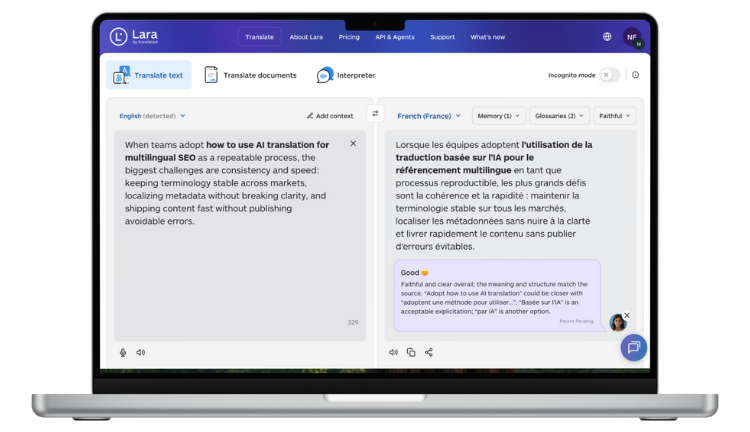
Three translation styles matched to content type
Most AI translation platforms give you one approach for everything. Lara offers three styles you can switch per job. Faithful is for technical specifications, legal contracts, and compliance documentation where precise meaning outweighs natural flow. Fluid is the default for business communications and product documentation where both correctness and natural phrasing matter. Creative handles marketing campaigns and promotional content where a literal translation would kill the persuasive intent — post-editors working on ad copy or brand content can focus on voice alignment rather than fixing sentences that are technically correct but tonally flat. Matching the style to the content type means your compliance documents don’t read like ad copy — and initial machine output starts closer to what reviewers need, which narrows the gap they have to bridge.Glossaries and context instructions
Custom glossaries enforce specific translations for product terminology, brand names, and domain terms across every job. If “user dashboard” translates three different ways across 200 help articles, post-editors waste time making the same correction repeatedly. Glossaries apply automatically and can be managed centrally across teams and languages. Context instructions let you define audience, register, and domain for any translation job. A B2B SaaS platform sounds different from a consumer app, even when both translate the same feature. Lara also explains its translation choices and flags ambiguous terms as you work, giving teams clarity and control over meaning and tone before post-editing even begins.AI + human review, in one place
When the content is too important for AI alone, Lara Translate lets you add a professional human review on top of AI translation. This is the direct product expression of everything this article argues for: machine speed as the starting point, human expertise as the quality gate. Legal documents, marketing campaigns, and anything representing your brand publicly benefit from this two-step approach — and having both layers available in a single platform removes the workflow friction of coordinating separate tools.File format support and batch processing
Post-editing workflows rarely involve single Word documents. Lara supports exactly 70 file formats — including CSV, XML, XLIFF, PO, and SRT files. Batch translation lets you process multiple files across multiple languages in a single session, maintaining consistent quality standards across the entire batch.Speed that makes iteration practical
With 99% of translations completed in 1.2 seconds, teams can translate sample content, review for common issues, adjust glossaries or context based on findings, and retranslate — before processing full volumes. That turnaround makes iterative quality improvement realistic rather than a theoretical best practice. GDPR compliance and Incognito Mode (zero data retention, immediate deletion) address concerns when processing sensitive content through AI systems.AI translation + professional human review
Get machine speed and human expertise in one workflow. Lara Translate combines AI translation with professional review for content that represents your brand.
Editing techniques that elevate machine translation quality
Machine translations often preserve source sentence structure even when the target language prefers different phrasing. Post-editors need to recognize when grammatically correct translations still sound unnatural. The question is simple: would a native speaker phrase it this way? If not, rewrite for natural target-language structure rather than preserving source patterns. Direct translation preserves surface meaning but misses cultural resonance. Examples and metaphors that work in one culture might confuse target audiences entirely. Replace culture-specific references with local equivalents or neutral alternatives — “as easy as apple pie” might become “as easy as breathing” in cultures without the same culinary traditions. The goal is making sure target audiences understand and respond appropriately, not matching source text word-for-word. For teams building post-editing skills or onboarding new reviewers, comparing multiple translations of the same source text helps develop judgment. Seeing different approaches to the same content helps reviewers recognize patterns — and learn when to accept machine output and when to revise significantly. As you post-edit, document the patterns you notice: which terms AI consistently mistranslates, which grammatical structures need restructuring. These notes become reference material that speeds future editing and can inform glossary updates. For high-stakes content, two-tier review works well. One reviewer post-edits for linguistic accuracy and fluency. A second focuses on brand voice, cultural appropriateness, and business objectives. The separation helps reviewers focus rather than getting lost in linguistic details while missing higher-level issues. Monitor how long post-editing takes relative to translating from scratch. If you’re making extensive changes to most segments, the machine output quality may be too low to justify post-editing over human translation. Track metrics to identify when AI configuration or source content needs improvement.FAQs
What is the difference between light and full post-editing?
Light post-editing fixes critical errors affecting meaning — mistranslations, grammar mistakes, terminology issues — but accepts awkward phrasing if comprehensible. Full post-editing produces publication-quality translations matching human standards, refining style, fluency, and cultural appropriateness beyond basic accuracy. Match the approach to the content’s audience and risk level.How much faster is post-editing compared to translating from scratch?
When machine output is 70–80% correct, post-editing can be 30–50% faster than human translation from scratch (TAUS, Post-Editing in Practice, 2022). When AI quality drops below 60% accuracy, post-editing often takes as long as full human translation because reviewers spend more time fixing than accepting.What tools help with AI translation quality assurance workflows?
Translation management systems with built-in QA checks, automated spell-checking and formatting validation, glossary and translation memory integration, and error tracking. Many TMS platforms support post-editing workflows with side-by-side source and target view, edit tracking, and productivity metrics. Lara Translate supports all these through its API and CAT tool integrations.Should all AI translated content go through human post-editing?
No. Low-risk internal communications might use unedited machine translation without issue. Customer-facing content, legal documents, marketing materials, and anything representing your brand publicly should receive appropriate post-editing. A useful test: if the translation would represent your brand to a customer, it needs human review. If it’s for internal comprehension only, light editing or no editing may be acceptable.How do you measure post-editing quality and productivity?
Track edit distance (how many changes reviewers make per segment), time per word for post-editing vs translation from scratch, error rates in post-edited content compared to quality standards, and business outcomes like reduced support tickets or improved engagement in target markets. High edit rates per segment are a signal to revisit source content quality or AI configuration.This article is about
- Implementing AI translation quality assurance through systematic post-editing workflows that combine machine efficiency with human expertise
- Post-editing best practices including reading target text first, prioritizing meaning errors, and using consistent terminology fixes
- Common machine translation error types (terminology inconsistency, literal idiom translations, cultural references, context misinterpretation) and how to address them
- Quality check workflows for AI translation that layer automated checks, human linguistic review, subject matter validation, and final formatting verification
- Tips for improving machine translation output through clear source writing, consistent terminology, proper AI configuration, and iterative testing
Have a valuable tool, resource, or insight that could enhance one of our articles? Submit your suggestion
We’ll be happy to review it and consider it for inclusion to enrich our content for our readers! ✍️
Useful articles
- How do AI translation services handle slang and informal language?
- How secure AI translation services protect data