

How to use AI translation for multilingual SEO is a practical question many teams face when they want to scale internationally without losing rankings. AI can help you translate and localize content faster, but multilingual SEO only works when your pages still match local search intent, use a clean URL structure, and send clear signals to search engines about which language version to show.
In other words, the winning approach is not “translate everything.” It is building a multilingual SEO translation workflow: localized keyword mapping, translated meta tags that fit real character limits, consistent internal linking, and correct hreflang implementation across regions.
TL;DR
|
This guide explains how to use AI translation for multilingual SEO with concrete technical and content steps. You will learn how AI supports international SEO at scale while still keeping language natural for real users in each market.
How do you use AI translation for multilingual SEO without losing rankings?
You can use AI translation successfully for multilingual SEO when you treat it as SEO-friendly localization, not as a bulk text conversion. The core is simple: translate with context, localize keywords, preserve page structure, and validate technical signals like hreflang and canonicals before you publish.
AI helps most in high-volume workflows: drafting localized versions faster, keeping consistent terminology, and accelerating translated metadata optimization. The pages still need to sound human and match what people actually search for in each country, not what you searched for in your source language.
Why is international SEO harder than “just translating”?
International SEO adds complexity that goes beyond language. You are optimizing for different markets, different competitive landscapes, and often different interpretations of the same concept. A direct translation can be accurate and still miss the query a local user types.
AI translation supports this work by speeding up localization tasks and reducing bottlenecks, especially when you have many pages and many markets. The best results come when AI translation is paired with localized SEO keywords and consistent on-page structure.
Localized keyword research becomes more efficient when supported by AI-assisted analysis and fast iteration. Instead of translating keywords literally, teams can map each page to what local users search and how they describe the same need in their language.
What technical setup do you need for multilingual SEO (URLs, hreflang, indexing)?
Strong multilingual SEO starts with technical clarity. Search engines need to understand which pages belong together as language or regional variants and which version to show to each user.
Translated metadata optimization is part of this: title tags, meta descriptions, and heading structure should be localized, not just translated. Titles and descriptions should still be readable and compelling in the target language, not stuffed with unnatural keywords.
The correct implementation of hreflang and translation requires validation. AI can help generate hreflang mappings, but you should still QA them to avoid missing links between variants or incorrect language-region combinations.
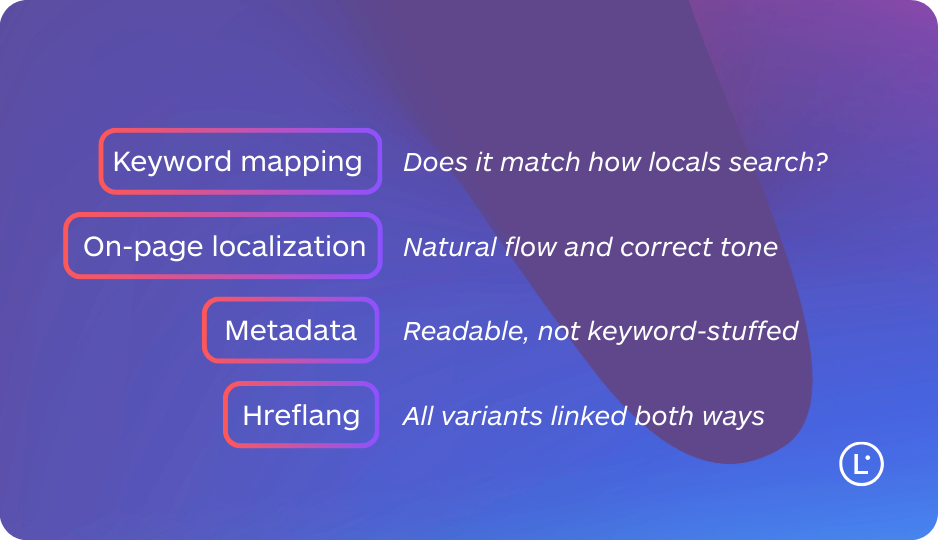
Below is a compact checklist you can use as a repeatable SEO translation workflow across locales.
| Step | What to do | AI helps with | QA check |
|---|---|---|---|
| Keyword mapping | Map each page to localized intent and primary query | Fast drafts and semantic variants | Does it match how locals search? |
| On-page localization | Localize H1/H2, body, CTAs, and entities | Consistent terminology with glossaries/TMs | Natural flow and correct tone |
| Metadata | Localize titles and meta descriptions to fit the language | Drafting multiple options quickly | Readable, not keyword-stuffed |
| Hreflang | Add hreflang relationships across variants | Generating mappings and labels | All variants linked both ways |
How do you localize keywords without ruining relevance?
Localized keyword research goes beyond translating terms. It includes understanding regional search behavior, local synonyms, and how users describe the problem in their own words. A literal translation can be accurate and still miss the opportunity to rank.
A practical method is to start from intent. Identify what the page solves, then validate how users search for that solution in each market. AI translation can speed up ideation, but the final mapping should be anchored to real localized queries.
How do you translate titles and meta descriptions for clicks and rankings?
Translated metadata optimization works when the localized title and meta description feel native and reflect what users want. Keep the core meaning, but adapt phrasing, word order, and common local terms to improve click-through rate.
Effective SEO-friendly translation also preserves semantic structure: clear headings, scannable sections, and consistent terminology across the page. This supports search relevance and improves user experience.
How do you scale multilingual SEO with automation without losing quality?
 AI improves workflow efficiency when you integrate it into your publishing process. Instead of translating first and optimizing later, use an approach where SEO translation and localization happen together.
If your team manages many pages, automation is most useful for first drafts, repeated structures, and consistent terminology. Quality stays high when you reserve human review for high-impact pages, brand voice, and culturally sensitive messaging.
Understanding the role of multilingual SEO helps when you design a workflow that scales without multiplying manual work for every market.
How do you QA translations and monitor performance per locale?
 International SEO depends on measurement systems that track performance across languages and regions. Monitor both visibility metrics and quality indicators such as engagement and conversion signals per locale.
Evaluating SEO-friendly translation requires looking at the localized SERP performance and user behavior on the localized page. If a translated page has impressions but low clicks, your metadata might not match local expectations. If it has clicks but low engagement, the translation may not sound natural or may not answer the query clearly.
Assessing localized keyword research effectiveness requires continuous refinement based on real data. Use performance insights to adjust keyword mapping, headings, and metadata over time.
What advanced strategies help multilingual SEO scale across many markets?
Advanced scaling is about repeatability. Define templates for page types, create language-specific style rules, and standardize your localization QA checks so every new locale follows the same high-quality process.
Scaling localized keyword research across many regions also means identifying content gaps and prioritizing markets where your offer has demand. AI can help analyze large volumes of content and propose localized variants, but your strategy should remain anchored to business goals and search intent.
Implementing multilingual SEO at scale becomes more manageable when AI translation supports both content production and structured optimization workflows.
How does Lara Translate support a multilingual SEO workflow?
When teams adopt how to use AI translation for multilingual SEO as a repeatable process, the biggest challenges are consistency and speed: keeping terminology stable across markets, localizing metadata without breaking clarity, and shipping content fast without publishing avoidable errors.
Lara Translate is built for professional workflows where context and consistency matter. For multilingual SEO, that means you can translate faster while still keeping control over the details that affect rankings and user trust.
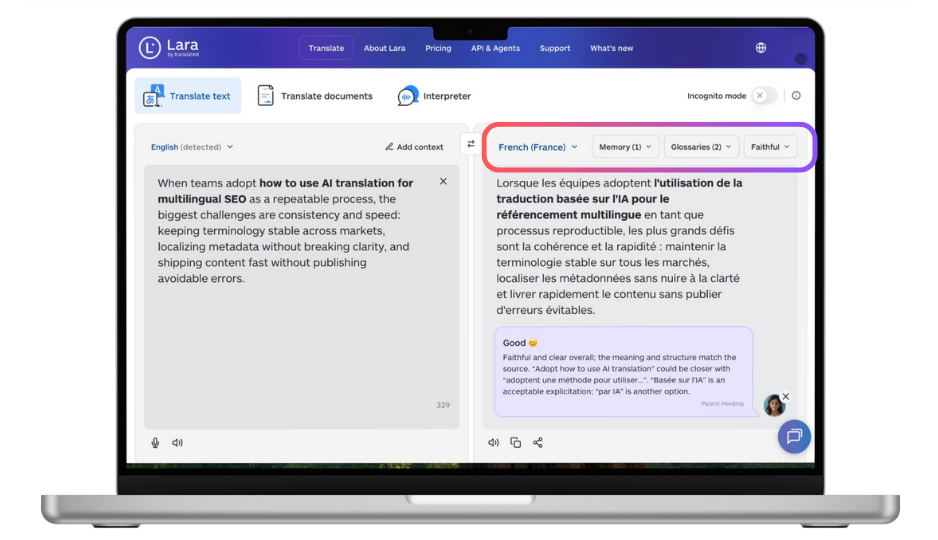
- Context control: Provide page context and instructions so translations stay aligned with intent and audience.
- Consistency at scale: Use glossaries and translation memories to keep product terms, entities, and brand wording consistent across locales.
- Safer publishing: Use “explain choices” and ambiguity flags to spot risky terms and improve accuracy before pages go live.
- Output ready for teams: Translate content and documents across 55+ formats, and integrate into existing workflows to reduce tool switching.
This combination helps international SEO teams keep translated metadata optimization consistent, speed up localization cycles, and improve quality control as content volume grows.
Try Lara Translate in your own workflow
Test Lara Translate and see how it supports search visibility, terminology consistency, and SEO-ready formatting.
What best practices keep multilingual SEO performance stable over time?
Sustainable growth comes from combining automation with guardrails. Define your localization rules (tone, terminology, formatting), standardize your QA checks, and continuously refine keyword mapping based on performance data.
Build effective localized keyword research cycles by monitoring changes in demand and SERP language patterns. AI translation can accelerate updates, but the direction should come from market feedback and analytics.
Finally, validate the technical layer consistently. Hreflang implementation should be tested after major releases, migrations, or CMS changes to avoid silent errors that impact indexing and targeting.
Thank you for reading 💜
As a thank you, here’s a special coupon just for you:
IREADLARA26.
Redeem it and get 10% off Lara PRO for 6 months.
If you already have a Lara account, log in here to apply your coupon.
If you are new to Lara Translate, sign up here and activate your discount.
FAQs
How does AI translation for multilingual SEO differ from regular translation?
AI translation for multilingual SEO is not just about accuracy. It also supports international SEO goals by helping localize keywords, headings, internal links, and translated meta tags so pages can rank and earn clicks in each market.
Can AI tools help with localized keyword research across multiple languages?
AI can speed up keyword localization by proposing semantic variants and helping teams iterate faster. The best practice is still to validate final localized SEO keywords against real search intent and regional phrasing, instead of relying on literal translations.
What role do hreflang and translation play in multilingual SEO success?
Hreflang and translation help search engines understand relationships between language versions and serve the right page to the right audience. AI can assist with generating mappings, but you should QA hreflang for missing links and incorrect language-region combinations.
How important is translated metadata optimization for search rankings?
Translated metadata optimization affects visibility and clicks by helping search engines and users interpret relevance in each language. Strong titles and meta descriptions should be localized for clarity and intent, not rewritten as unnatural keyword lists.
What are the main advantages of using AI translation tools for international SEO campaigns?
The biggest advantages are speed, consistency, and repeatability. AI helps teams scale multilingual SEO translation workflows, keep terminology consistent with glossaries and translation memories, and produce SEO-ready drafts faster so you can test, learn, and improve across multiple markets.
This article is about
- How to use AI translation for multilingual SEO to scale international search strategies without losing relevance.
- Why international SEO needs keyword localization, not literal translation.
- Technical essentials like URL structure and hreflang implementation for multilingual sites.
- How translated metadata optimization improves clicks and clarity across locales.
- A repeatable SEO translation workflow with QA and performance monitoring per market.
Have a valuable tool, resource, or insight that could enhance one of our articles?
Submit your suggestion
We’ll be happy to review it and consider it for inclusion to enrich our content for our readers! ✍️