

If you are preparing a USCIS application and one of your documents is not in English, you cannot simply submit the original document and a machine-translated copy. USCIS requires a complete English translation accompanied by a translator’s certification. The confusing part is knowing what “certified” actually means. You generally do not need a government-approved translator or a notarized translation just because the document is being filed with USCIS. What matters is whether the translation is complete and accurate and whether the translator has properly certified their work.
This guide explains when you need a certified translation for USCIS, what the certification must include, whether notarization is required, how much translation can cost, and how to prepare the documents correctly. It also includes a certification template you can use as a reference.
|
TL;DR
|
What is a USCIS Certified Translation
A USCIS-certified translation is a complete English translation of a foreign-language document accompanied by a certification from the translator stating that the translation is complete and accurate and that the translator is competent to translate from the foreign language into English. USCIS itself does not issue translator certifications or maintain a general roster of USCIS-approved translators.
The certification comes from the translator, not from USCIS or another government agency. This distinction can be confusing for first-time filers who are searching for a “USCIS-approved” translation service.
The underlying requirement is established in the federal regulations. 8 CFR § 103.2(b)(3) provides that a document containing a foreign language submitted to USCIS must be accompanied by a full English translation that the translator certifies is complete and accurate, together with the translator’s certification of competence to translate from the foreign language into English.
This requirement also applies when foreign-language documents are submitted as evidence in adjustment-of-status cases. USCIS decisions have specifically addressed foreign birth certificates that were submitted with certified English translations. In one USCIS decision involving a Form I-485 adjustment application, for example, the agency discussed a foreign birth certificate that was not initially accompanied by a certified English translation and cited 8 CFR § 103.2(b)(3) in addressing the translation requirement.
The USCIS Policy Manual‘s adjustment-of-status guidance also addresses the evidence required to establish birth and the applicable documentation for particular countries. However, the specific Volume 7, Part A, Chapter 4 page should not be described as expressly stating, in a standalone sentence, that “a foreign birth certificate must include a certified English translation.” The stronger and more accurate statement is that the translation requirement comes from 8 CFR § 103.2(b)(3) and is applied by USCIS when reviewing foreign-language evidence, including foreign birth certificates.
Accordingly, the certified-translation requirement is not a step invented by a private translation company. It is a federal regulatory requirement that USCIS applies when foreign-language documents are submitted as part of an immigration filing.
When Does USCIS Require A Certified Translation
USCIS requires a certified English translation for any supporting document that contains foreign language text, regardless of which form you are filling. The rule does not carve out exceptions by petition type. If the evidence is in a language other than English and it supports your case, it needs translation for USCIS before you submit it.
The documents that show up most often in immigration filings include:
- Birth certificates, needed to establish identity, citizenship, and family relationships across nearly every benefit type.
- Marriage certificate translations are required for USCIS spousal petitions, adjustment applications, and naturalization cases involving a foreign marriage.
- Divorce documents are required whenever a prior marriage must be shown as legally terminated.
- Educational documents, including diplomas and transcripts for employment-based student categories.
- Police/court documents covering clearance, judgment, and criminal history documentation.
- Other supporting evidence, such as employment letters, financial records, or adoption papers, whenever the original is not in English.
This standard applies to all form types, including I-130, I-485, I-751, I-129F, N-400, and asylum-related filings. If a document supports your case and is not in English, you should generally include a certified English translation with your USCIS application.
What are the USCIS Translation Requirements
A USCIS-certified translation must satisfy the core requirements in 8 CFR § 103.2(b)(3): the translation must be complete and accurate, and the translator must certify their competence to translate from the foreign language into English.
- Complete: Complete means all elements of the source document, including stamps, seals, letterhead, and handwritten annotations, must be translated into English. A USCIS translator who skips a seal because it does not say anything important has produced a partial translation, and USCIS treats partial translations the same way it treats a missing one.
- Accurate: Accuracy means the English version reflects what the original document actually says, with names, dates, and numbers transcribed exactly as they appear on the source. A translator who paraphrases a document fluently is not performing a USCIS certified translation. They are producing something closer to a summary, and summaries do not satisfy the regulation.
- Competence: It is a self-certification rather than a credential that USCIS checks against a database. The translator states, in writing, that they are competent to translate from the source language into English. This statement carries legal weight because it is what makes the translation admissible.
Identification as a best practice: Identifying the document covered by the certification is a useful best practice, but it is not a separate requirement listed in 8 CFR § 103.2(b)(3). The certification can identify the document type, the name appearing on it, and other details that make it clear which document the certification covers.

A lot of confusion around USCIS translation certificates comes from advice that sounds official but is not grounded in the actual rule. Here is what the regulation says versus what commonly gets repeated:
| The myth | What the regulation requires |
| The translation must be notarized | 8 CFR 103.2(b)(3) requires the translator’s certification. It does not list notarization as part of this requirement. |
| Only ATA-certified translators qualify | Any translator competent in both languages can certify the work. The rule does not name a credentialing body. |
| You need a government-licensed translator | No licensing requirement exists in the text. USCIS does not maintain an approved-vendor list. |
| A summary translation is enough | The translation must be full and complete, covering every part of the source document. |
Here are some common questions that come to mind when looking for USCIS certified document translation services:
Do you need the original document too? Yes, USCIS expects a copy of the source-language document alongside its English translation. Submitting only the translated version, without the original for comparison, is a common and avoidable mistake. The USCIS Policy Manual confirms that officers verify foreign birth certificates against the certified translation on file. Keep the original document and the certified copy together in your submission.
Can a family member translate the document? The regulation does not expressly prohibit an applicant or petitioner from translating their own document. It requires the translator to certify that they are competent to translate from the foreign language into English and that the translation is complete and accurate. Using an independent translator can nevertheless be a practical choice when dealing with important immigration documents. A relative who is fluent in both languages is not automatically barred, but officers can and do question a translation’s neutrality when the translator has a personal stake in the outcome, and that scrutiny raises your odds of an RFE. An independent translator, someone with no interest in your case, sidesteps that risk from the start.
How Much Does a USCIS Certified Translation Cost
USCIS does not set a standard price for translation services. As a typical U.S. market range, personal documents such as birth or marriage certificates may cost approximately $20–$55 per page. Actual prices vary by provider, language pair, document length, complexity, and turnaround time. Rush requests and less common language pairs may cost more.
These figures are typical market estimates, not fixed USCIS fees or requirements.
| Pricing Model | Typical Range | Best For |
| Per page | $20–$55 per page | Short personal documents like birth or marriage certificates |
| Per word | $0.10–$0.25 per word | Longer documents such as transcripts or court records |
| Minimum charge | $20–$40 flat | Any single short document, even under a full page |
| Rush fee | 25%–100% surcharge | Filings with an approaching deadline |
| Notarization fee | $0–$20 add-on | Only when a specific receiving office requests it |
| Rare-language premium | 20%–40% surcharge | Languages with fewer available translators, such as Amharic or Khmer |
There are two things that drive most of the variation in these prices. The first is the document length, and the second is the language pair. A one-page civil registry document usually costs less than a multi-page court file with dense legal terminology. Similarly, common language pairs like Spanish-to-English tend to cost less because more translators are available, while less common languages can cost more because fewer qualified translators work in those languages.
Lara Translate takes a different approach to pricing. Instead of charging per page or per word, it uses a character-based subscription model, which can make the total cost more predictable when you have multiple documents to translate.
| Lara Translate Plan | Price | Included Usage | Best For |
| Free | $0/month | 60,000 characters/month | Translating 1–3 short personal documents |
| Pro | $9.99/month when billed annually | 500,000 characters/month | Individuals translating documents regularly |
| Team | Starting at $29.99/month when billed annually | Shared character quota across unlimited users | Small teams or legal practices |
Where Lara Translate differs from a traditional per-document translation vendor is in the workflow itself. The AI produces the complete, accurately formatted draft instantly in 200+ supported languages and across 70+ file formats, including scanned PDFs.
How to Get a Document Certified for USCIS
Getting a document ready for USCIS filing comes down to six steps, and skipping any one of them is where most delays start:
Step 1: Identify the Document That Needs Translation
Pull together every foreign-language document your filing requires: birth certificate, marriage certificate, divorce decree, police clearance, whatever your form instructions call for. Confirm the source language and note any stamps, seals, or handwritten additions on each page, since those need translation too.
Step 2: Choose a Translator/Service
You can hire an independent human translator, work with a traditional translation agency, or use an AI-first platform built for document translation. A human translator working alone can take days for a single certificate and often charges a flat per-page fee regardless of how short the document is.
This is where Lara Translate fills a practical gap: it combines instant AI drafting in 200+ languages with the option of professional human review for documents that require certified accuracy, at a fraction of the cost and turnaround time of a traditional agency, without sacrificing the accountability an official document requires.
Translate a document without losing accuracy or formatting
Upload a birth certificate, marriage certificate, or any other USCIS document and get a complete, formatted draft back in minutes, ready for certification.
Step 3: Translate the Entire Document
Here is how the process looks in practice. Imagine Minji, a South Korean parent preparing documents for a US immigration application. She has a Korean-language certificate that needs to be translated into English.
Example Step 1: Prepare the Document
Minji scans the complete certificate as a clear PDF. She checks that every page, stamp, seal, handwritten entry, and registration number is visible before uploading it.
Example Step 2: Upload the Document to Lara Translate
She opens Lara Translate’s document translation tool and uploads the PDF. She selects Korean as the source language and English as the target language.
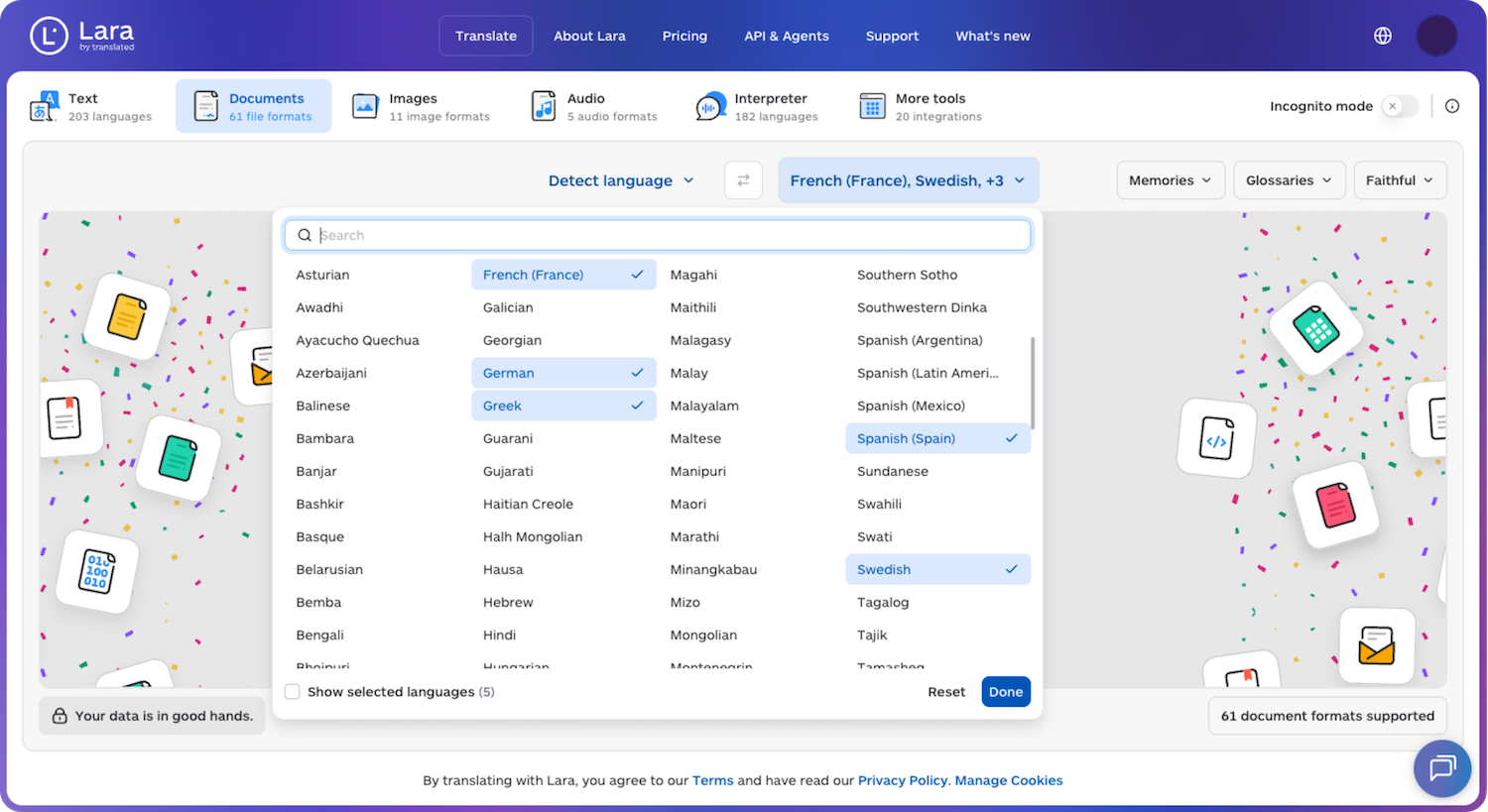
Example Step 3: Choose the Faithful Translation Style
Because this is an official document, Minji selects the Faithful translation style rather than the Fluid or Creative styles. This keeps names, dates, numbers, and official terminology close to the original rather than rewriting them in more natural-sounding English.
Example Step 4: Download the AI Translation
Lara Translate generates the English translation while preserving the document’s original structure and formatting. Minji can then download the translated file and keep it ready for the next step, where she can request expert human review.
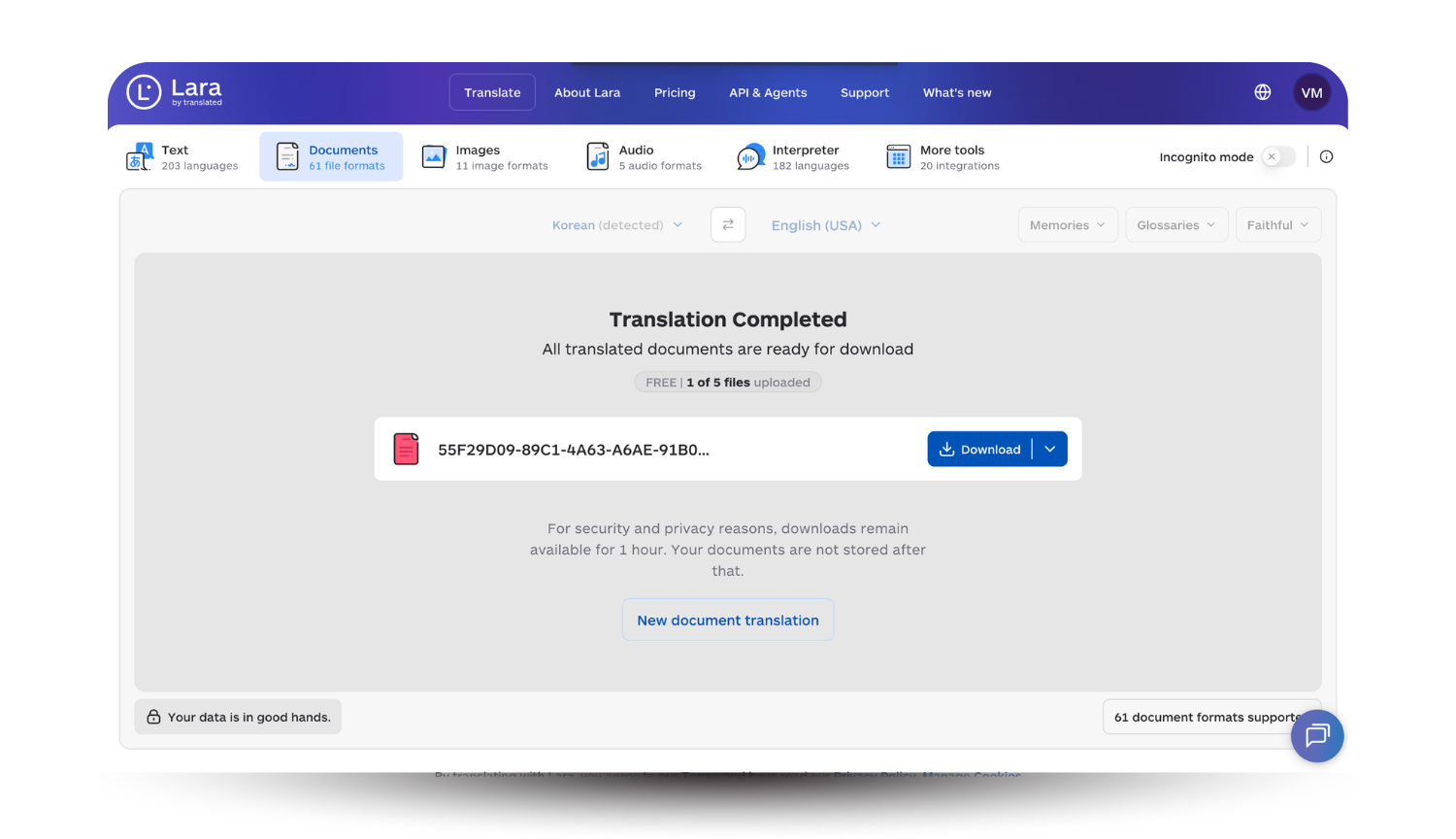
Example Step 5: Purchase Expert Human Review
The AI translation itself is not the USCIS certified translation. If Minji needs the document for a USCIS filing, she needs to purchase Lara Translate’s Expert Human Review add-on. A professional linguist then reviews the AI-generated translation against the original document.
Step 4: Add the Certification Statement
Attach a signed statement identifying the document, the languages involved, and the translator’s certification of completeness, accuracy, and competence. The next section gives you a filled-in example and a blank template you can adapt.
Step 5: Review Names, Dates, Numbers, and Stamps
Before you submit anything, check every proper noun, date, and number against the original document character by character. This is also the point to confirm that seals, stamps, and any handwritten notes appear in the English version, since these details are the most common omissions in an incomplete translation.
Step 6: Submit the Required Documents to USCIS
File the original foreign language document, the complete English translation, and the signed certification statement together, following whatever assembly order your specific form instructions require.
USCIS Translation Certification Template
A USCIS translation certification should clearly identify the translator, the languages involved, the document being translated, and the translator’s signature and contact information. A completed example makes it easier to see how each field should look before you fill in the blank template.
For this fictional example, imagine that Maria is submitting her daughter’s Spanish-language birth certificate from Guadalajara, Jalisco, Mexico, as part of a U.S. immigration application. A completed certification could look like this:
Spanish-to-English example
| Certification of Translation
I, Carla Jiménez, certify that I am competent to translate from Spanish into English and that the foregoing is a complete and accurate translation of the birth certificate of Mateo Hernández Ruiz, issued by the Civil Registry of Guadalajara, Jalisco, Mexico, and dated March 14, 2019. Signature: Carla Jiménez Printed name: Carla Jiménez Address: 214 Maple Street, Austin, TX 78701 Date: August 12, 2026 |
Korean-to-English example
For a South Korean birth certificate, the same basic certification structure can be used, with the source language and document details changed:
| Certification of Translation
I, Daniel Park, certify that I am competent to translate from Korean into English and that the foregoing is a complete and accurate translation of the birth certificate of Seo-jun Kim, issued by the Seoul Metropolitan Government, Republic of Korea, and dated May 22, 2020. Signature: Daniel Park Printed name: Daniel Park Address: 1450 Oak Street, Los Angeles, CA 90015 Date: August 12, 2026 |
CERTIFICATION OF TRANSLATION
| I, [translator’s full name], certify that I am competent to translate from [source language] into English and that the foregoing is a complete and accurate translation of the [document type] of [name on document], issued by [issuing authority], and dated [date on original document].
Signature: [translator’s signature] Printed name: [translator’s full name] Address: [translator’s mailing address] Date: [date of certification] |
Keep the certification with the corresponding translation either on the same page or directly behind it. This makes it clear which certification belongs to which translated document during USCIS review of the filing.
What Happens When USCIS Rejects Your Application
If USCIS finds your translation incomplete, uncertified, or otherwise deficient, the most common outcome is a Request for Evidence, known as an RFE, rather than an outright denial. An RFE is a formal notice, delivered on Form I-797E, telling you that the officer needs additional or corrected evidence before a decision can be made. Receiving one does not mean your case has been denied. It means your filing is still active and you have been given a defined window to fix the gap.
Under 8 CFR 103.2(b)(8)(iv), an RFE response period cannot exceed twelve weeks, and a Notice of Intent to Deny cannot give you more than thirty days to respond. Extensions beyond that window are not available, which is exactly why a translation-related RFE is best avoided at the filing stage rather than fixed after the fact.
Three translation defects account for most of the RFEs tied to this issue:
- An incomplete translation, most often one that leaves out stamps, seals, or handwritten notes because the translator judged them unimportant
- A missing or defective certification statement, where the translation is accurate but nobody signed off on its completeness and the translator’s competence
- A translation with no accompanying original document, leaving the officer nothing to verify the translated version
Fixing a translation-related RFE typically means resubmitting a corrected USCIS certified translation, which costs the time you already spent plus the processing delay of the RFE cycle itself. Building the certification correctly the first time, using the checklist in the sections above, is the cheaper path by a wide margin.
What are the Common USCIS Translation Mistakes You Should Avoid
A USCIS certified translation for immigration is more than an English version of a foreign-language document. USCIS expects the translation to be complete and accompanied by a proper translator certification. Most problems arise when applicants focus on translating the words but overlook the details that make the document usable for an immigration filing.
Here are the mistakes worth checking before you submit your certified translation for USCIS:
Leaving out seals, stamps, or handwritten notes
A translation should cover the entire document. Government seals, stamps, marginal notes, signatures, handwritten entries, and other visible information should not be silently omitted because they appear unimportant.
The easy fix: Upload the complete document rather than typing only the main text into a translator. Lara Translate can process the full file while preserving its structure, making it easier to see whether every section has been translated. Still, review the output against the original before using it in your filing.
Forgetting the translator’s certification
An accurate translation is not enough on its own. For USCIS filing translations, the translator must provide a certification confirming competence to translate and that the translation is complete and accurate.
The easy fix: Treat the certification as part of the translation workflow. If you use Lara Translate’s AI + Human Translation service, the translated document can undergo professional human review and certification, rather than leaving you with uncertified AI output.
Submitting raw machine translation
Copying a document into a free machine translator and submitting the resulting English text as your certified translation to USCIS is not the same as obtaining a USCIS certified translation. Machine output can also mishandle names, dates, government terminology, or text contained in seals and scanned sections.
The easy fix: Use AI for speed, but add human review where the filing requires it. Lara Translate can generate the initial translation quickly, while its AI + Human Translation option sends the work to a professional linguist for review and certification.
Translating names and dates inconsistently
A small discrepancy can create unnecessary questions. For example, a person’s name may appear one way on a birth certificate and another way on the translation or immigration forms. Dates can also become confusing when the source document uses a different date format.
The easy fix: Compare names, dates, places, and registration numbers across the original document, translation, and immigration forms before submitting. A faithful translation style can help keep these details aligned with the source rather than unnecessarily rewriting them.
Uploading an incomplete or poor-quality scan
Even a good translator cannot reliably translate information that is missing, cut off, blurred, or hidden by a poor scan. This is especially important for certificates containing stamps, seals, handwritten entries, or text near the edges of the page.
The easy fix: Scan every page at a readable quality and check the PDF before uploading it. If the document is scanned, Lara Translate’s document workflow can work with scanned PDFs, but you should still verify that the original is legible before translation.
Separating the certification from the wrong document
When several documents are being submitted together, it can become unclear which certification belongs to which translation. This is particularly easy to overlook when translating multiple birth certificates, marriage certificates, or other civil records.
The easy fix: Keep each certification with its corresponding translation and source document. For a multi-document filing, review each translation as its own evidence package before assembling the final submission.
Get Your USCIS Translation Right with Lara Translate
Lara Translate can be useful when you need to turn a foreign-language document into an English draft before professional review. Lara Translate supports document translation across 70+ file formats and translation across 200+ supported languages, according to the current Lara Translate product information.
For an official immigration document, the important distinction is that an AI-generated draft is not the same thing as a USCIS certified translation. The USCIS requirement is about the final English translation and the translator’s certification.
Lara Translate also offers an AI + Human Translation workflow in which a professional linguist from Translated reviews the AI output. The client brief specifically positions this service for sensitive or business-critical content, including legal and official documents.
Privacy can also matter when you are uploading an immigration document. Lara Translate’s Incognito mode is described by the company as a mode in which translation content is not stored, logged, or used for training. Check the current data security documentation before uploading particularly sensitive documents so you can choose the appropriate mode.
The practical workflow is therefore straightforward: use Lara Translate to create the translation draft, review it against the source document, and use the AI + Human Translation service when professional review and certification are required for the filing.
Translate your immigration documents without handing over your data
Turn on Incognito Mode before you upload a birth certificate, marriage certificate, or any other personal record, and Lara Translate discards the content once your translation is delivered.
Conclusion
A USCIS certified translation does not need to be complicated, but it must meet the actual requirement. For a foreign-language document submitted to USCIS, prepare a complete English translation and make sure the translator provides the required certification of completeness, accuracy, and competence.
Before filing, compare the translation with the original document and check names, dates, numbers, stamps, seals, and handwritten information. Also check the current instructions for the specific USCIS form or benefit you are applying for.
AI translation can help with the first draft, but the final filing still needs to meet the certification requirement. For documents that need professional review, an AI plus human workflow can separate the speed of the draft from the review and certification step.
Have a valuable tool, resource, or insight that could enhance one of our articles?
Send us an email at press@laratranslate.com
We’ll be happy to review it and consider it for inclusion to enrich our content for our readers! ✍️
FAQs
Can I use an AI translation for USCIS documents?
No, an AI-generated draft alone does not satisfy the certification requirement, as the regulation requires a translator’s signed statement. Pairing AI translation with human review and certification closes that gap. Lara Translate’s AI + Human Translation service works this way by design: the AI produces the draft, and a professional linguist reviews and certifies it, so the document that reaches USCIS meets the standard rather than arriving as uncertified machine output.
Does USCIS require a notarized translation?
No, 8 CFR 103.2(b)(3) asks for a signed certification statement from the translator, and a notary seal is not part of that requirement. Paying for notarization on top of certification is a common unnecessary expense unless a specific receiving office requests it.
Does a birth certificate need a certified translation for a green card application?
Yes, a foreign-language birth certificate submitted as evidence in a green card application needs a complete English translation. USCIS requires the translation to include a translator’s certification confirming that it is complete and accurate.
Can the same certified translation be reused for multiple USCIS filings?
Yes, the same certified translation can be reused for multiple USCIS filings, provided the original document has not changed since the translation was prepared and the certification still meets current requirements. A birth certificate translated for an I-130 petition, for example, can generally support a later I-485 filing, as long as the source document itself was not reissued or amended in the interim.
Does USCIS accept Google Translate for documents?
No, a machine-translated document without a certification statement and no human review does not meet the regulatory standard, regardless of how accurate the wording is. USCIS is checking for a signed attestation of completeness, accuracy, and translator competence, and free translation tools do not provide such an attestation.
Do you need to translate the entire document or only the relevant parts?
You need to translate the entire document. USCIS requires a full translation, which includes stamps, seals, letterhead, and handwritten notes. Omitting a seal because it seems unimportant is one of the most common reasons a translation is flagged as incomplete.
How long does a USCIS certified translation stay valid?
USCIS does not attach an expiration date to a certified translation. It stays valid as long as it remains complete and accurate and the underlying document has not been reissued, amended, or replaced since the translation was prepared. If the source document changes, such as a name update on a reissued certificate, the translation needs to be redone to match.
The Article is About
- The USCIS translation requirements under 8 CFR 103.2(b)(3)
- Which documents need a certified English translation
- What a USCIS translation certification statement must contain
- Whether notarization is required
- Realistic 2026 USCIS translation costs
- A six-step process for getting a document translated and certified
- A completed USCIS translation certification template
- What can trigger a translation-related Request for Evidence (RFE)
- Common translation mistakes that can delay a filing
- How Lara Translate’s AI + human review workflow fits into the USCIS translation process
Sources