

Startup localization represents one of the most critical scaling challenges facing growth-stage companies today. You’ve successfully validated market demand with your initial startup localization efforts, users are responding positively to your multilingual MVP, and now you’re facing the inevitable question: how do you transform this promising test into a robust, scalable system without letting costs and complexity spiral out of control?
When you move from experimental startup localization to systematic international expansion, you face different constraints than in your validation phase. While your MVP focused on speed and validation, scaling may require attention to process optimization, quality consistency, and operational efficiency. This shift can challenge startups because the strategies that worked for rapid market testing may become less efficient at scale.
Understanding this evolution helps you keep quality high while costs and complexity stay under control as you grow. You quickly face mounting translation costs, inconsistent quality across markets, and growing operational complexity if you scale without a plan. Conversely, startups that thoughtfully navigate this transition may create advantages in international markets while maintaining operational agility.
TL;DR
|
How do you scale startup localization from MVP to a scalable AI system
To scale startup localization beyond a multilingual MVP, you need to 1) focus on the markets your data validates, 2) evolve your architecture so translation, review, and release are repeatable, 3) use context aware AI translation to handle volume, 4) layer human review where impact is highest, and 5) track cost and performance per market so you only double down where the numbers work.
Step 1: Turn your multilingual MVP into a lean localization strategy
Lean localization principles are essential when you move from MVP to scale. Rather than attempting comprehensive market coverage from the start, lean localization focuses on systematic optimization based on validated learning from your initial market tests.
Start by analyzing the data from your multilingual MVP experiments. Which markets generated the highest engagement rates? Where did users provide the most constructive feedback? Which languages produced the strongest conversion metrics? This analysis forms the foundation of your lean localization strategy, ensuring you’re investing resources in markets with proven potential rather than theoretical opportunities.

Lean localization can involve establishing clear decision frameworks for market progression. Consider creating tiered investment levels based on market performance: high-performing markets receive professional translation review and dedicated customer support, moderate performers continue with AI-powered approaches while you collect additional data, and underperforming markets are deprioritized or abandoned. This approach helps you avoid spreading resources too thin across too many markets.
The key to lean localization can involve maintaining your startup’s experimental mindset while adding systematic processes. Continue testing new markets and approaches, but consider doing so within structured frameworks that capture learnings and enable rapid iteration. This balance between experimentation and systematization may support effective startup localization scaling.
Step 2: Evolve your multilingual MVP architecture for scale
Your multilingual MVP served its purpose for market validation, but scaling may benefit from architectural evolution. The systems that enabled rapid testing can sometimes become constraints when handling increased translation volumes, multiple market requirements, and growing operational complexity.
Begin by evaluating your current multilingual MVP infrastructure for scalability bottlenecks. Can your translation management system handle 10x the current volume? Does your content management workflow support multiple reviewers and approval processes? Are your quality assurance mechanisms robust enough for production-scale operations?
Content optimization may become more important during this architectural evolution. Your multilingual MVP may have relied on quick translations without optimizing source content for AI systems. At scale, implementing content optimization strategies can help prevent quality issues while improving translation efficiency.
Consider implementing modular architecture that can grow with your startup localization needs. Separating your translation engine from your content management system can enable independent scaling of each component. This modular approach lets you experiment with different translation providers, quality tools, and workflows without breaking the rest of your stack.
Consider planning for integration complexity as you scale beyond your multilingual MVP. Each new market may require connections to local payment systems, compliance tools, or customer support platforms. Designing flexible integration architectures from the beginning may help avoid technical debt that could slow down international expansion efforts.
Step 3: Integrate advanced AI translation into your startup localization stack
Moving beyond basic AI translation may involve understanding how advanced AI capabilities can support startup localization at scale. While your MVP may have used simple text translation, scaling might benefit from more sophisticated AI integration that can handle context preservation, terminology consistency, and quality optimization across multiple markets simultaneously.
Context-aware translation may be valuable for startup localization scaling. AI systems that understand your business domain, product terminology, and brand voice may produce better results than generic translation tools. This contextual understanding can potentially reduce the need for extensive human review while maintaining translation quality that reflects your brand consistently across markets.
Advanced AI integration may also enable dynamic quality optimization based on market performance. Some AI systems can learn from user feedback, engagement metrics, and conversion data to improve translation quality for your most valuable markets while maintaining efficiency for testing new opportunities.
Consider exploring AI-powered global presence optimization that goes beyond simple translation. Some modern AI systems can adapt content for cultural preferences, optimize messaging for local market conditions, and suggest market-specific feature prioritization based on user behavior patterns. This level of AI integration may transform startup localization from a cost center into a strategic growth driver.
Consider implementing AI capabilities that can scale with your business rather than requiring constant manual intervention. Look for AI solutions that can automatically adapt to new markets, learn from your specific use patterns, and integrate seamlessly with your existing development workflows.
Step 4: Use enterprise grade AI like Lara Translate to support scaling
At this point, you need an AI translation system that behaves like enterprise infrastructure but stays fast and flexible enough for startup speed. This is where Lara Translate comes in.
For example, you can use Lara Translate to test ten new markets with AI only workflows, then feed human edits in your top three markets back into translation memories so quality improves where revenue justifies it.
As startups transition from MVP validation to systematic scaling, Lara Translate‘s comprehensive AI platform addresses the limitations of basic translation tools with both speed and enterprise-level reliability. Lara translates into more than 200 languages, providing unprecedented global reach through user interface and API access. This coverage enables startups to test previously cost-prohibitive markets, supporting over 6.5 billion speakers worldwide (discover the most current list of supported languages).
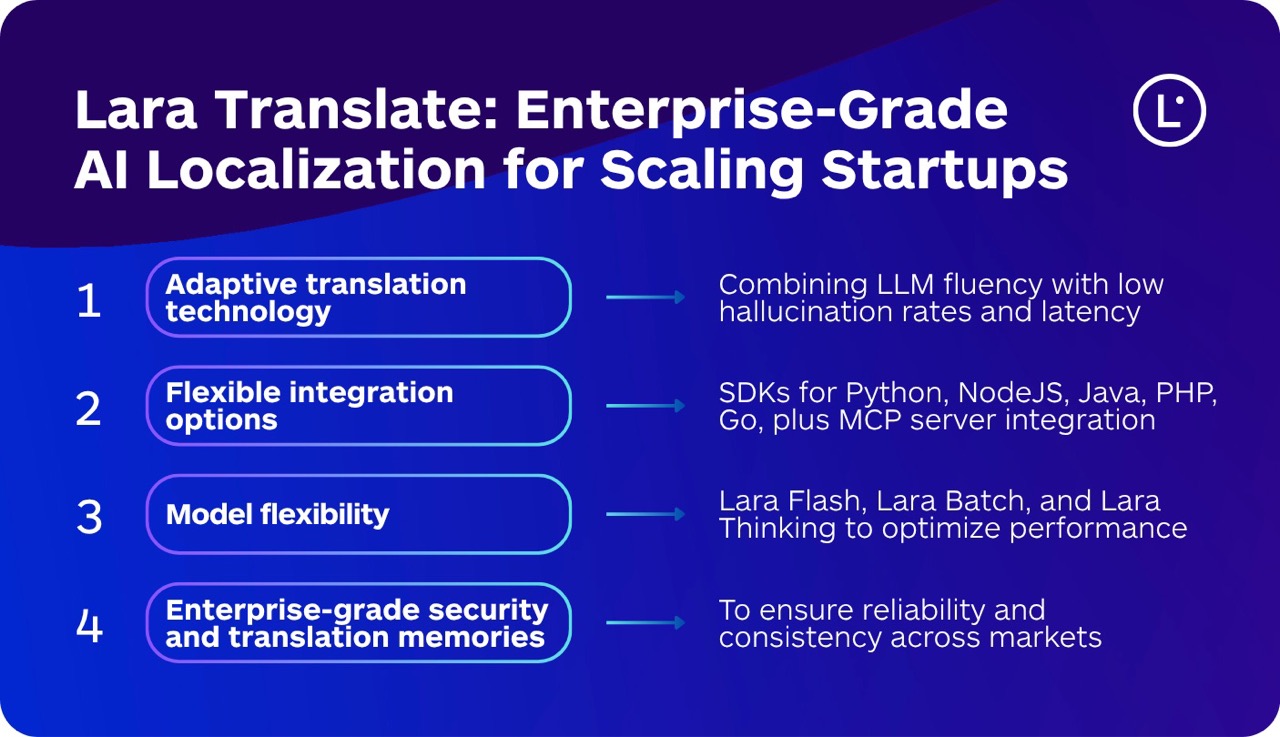
What distinguishes Lara is its adaptive translation technology that combines LLM fluency and reasoning with the low hallucination rates and latency of traditional machine translation. Unlike systems requiring extensive training, Lara adapts to any domain instantly, leveraging previously translated content and context for consistently high-quality results.
The platform offers flexible integration options with SDK support for Python, NodeJS, Java, PHP, and Go. For LLM-powered startups, Lara’s MCP server integration provides specialized translation capabilities that plug directly into AI workflows without disrupting the user experience.
Lara’s model flexibility supports different scaling needs: Lara Flash (50ms median latency), Lara Batch (up to 10x cost reduction), and Lara Thinking (half the error rate) enable startups to optimize performance and cost depending on requirements.

Enterprise-grade security features and translation memories provide the reliability and consistency scaling startups need when handling sensitive data across multiple markets while preserving brand voice as teams grow.
Step 5: Systematize localization quality control at scale
Quality control may evolve from periodic reviews to more systematic processes when scaling startup localization. Your MVP approach of manual review and user feedback may benefit from evolution into automated quality assurance systems that can maintain consistency across growing translation volumes and market complexity.
Implement multi-layered quality control that combines AI-powered pre-checks with human oversight for critical content. Automated systems can catch technical errors, terminology inconsistencies, and formatting issues before human reviewers focus on cultural appropriateness, brand voice alignment, and market-specific optimization requirements.
Language prioritization strategies can be valuable for quality control resource allocation. Not every market may require the same level of quality investment, and strategic language prioritization can help startups focus quality control efforts where they will have the greatest business impact. High-value markets might receive comprehensive quality control, while experimental markets could use automated quality checks with human review only for critical user-facing content.
Create feedback loops that connect user behavior data with quality control processes. Markets showing declining engagement may signal quality issues that require immediate attention, while markets with growing user adoption can justify increased quality investment. This data-driven approach to quality control helps your startup localization efforts continuously improve based on real user experience rather than theoretical quality standards.
Document quality standards and processes to enable team scaling without quality degradation. As your localization team grows, clear quality guidelines can help prevent inconsistencies that might damage brand perception in international markets. These documented processes also enable efficient onboarding of new team members and external partners.
Step 6: Scale localization operations without a complexity explosion
Startup localization scaling can face challenges when operational complexity grows faster than revenue, potentially creating unsustainable cost structures. Effective scaling may benefit from intentional operational design that maintains efficiency while expanding market reach.
Consider standardizing workflows before adding markets or team members. Inconsistent processes can become more problematic as you scale, potentially creating coordination overhead that slows down localization efforts. Establishing clear workflows for content creation, translation review, quality assurance, and market launch before expanding operations may help maintain efficiency.
Consider implementing role specialization gradually based on volume and complexity requirements. Early-stage startup localization may rely on generalists handling multiple responsibilities, but scaling might benefit from specialized roles for maximum efficiency. Creating clear progression paths from generalist to specialist roles can help team members grow with the expanding operation.
Consider geographic distribution of your localization team to optimize for time zone coverage and local market expertise. Remote team members in target markets can provide real-time support and cultural insights that improve both quality and customer satisfaction, but may require structured communication processes to prevent coordination challenges.
Multilingual SEO optimization may become a distinct operational discipline that can benefit from specialized knowledge and tools. Implementing comprehensive multilingual SEO strategies may benefit from coordination between content creators, translators, and technical SEO specialists to help localized content rank effectively in target markets while maintaining technical website performance.
Automate administrative tasks wherever possible to prevent operational overhead from consuming resources better invested in quality improvement or market expansion. Translation project management, quality metrics tracking, and performance reporting can often be automated, freeing team members to focus on strategic decisions and creative problem-solving.
Step 7: Optimize costs and measurement to sustain global growth
Cost optimization strategies
Scaling startup localization sustainably may benefit from sophisticated cost optimization that maintains quality while preventing budget explosion. Simple cost-cutting can sometimes damage quality or slow growth, while uncontrolled spending might create unsustainable unit economics.
Implement variable cost structures that align spending with market performance. High-performing markets justify increased investment in professional translation, cultural adaptation, and market-specific customer support. Experimental markets use AI-powered translation with minimal human oversight until they demonstrate sufficient potential to warrant additional investment.
Negotiate volume discounts and establish preferred vendor relationships as translation volumes increase. Many translation services offer significant discounts for committed volumes, but may require minimum guarantees that could be appropriate for scaling startups with predictable localization needs.

Consider hybrid approaches that combine AI translation with human expertise for optimal cost-quality balance. AI systems handle initial translation and routine content updates, while human translators focus on high-impact content like marketing materials, product descriptions, and customer support documentation.
Track cost-per-market metrics to identify optimization opportunities and guide resource allocation decisions. Understanding the true cost of entering and maintaining each market enables data-driven decisions about market prioritization, investment levels, and growth strategies.
Plan for hidden costs that may become significant at scale, including technical integration expenses, compliance requirements, customer support infrastructure, and market-specific payment processing fees. These costs may exceed translation expenses but receive insufficient planning attention during scaling phases.
Build measurement systems that guide localization decisions
Effective measurement can be valuable for startup localization scaling because the complexity of multiple markets may make intuitive decision-making less reliable. Comprehensive measurement systems can provide the data foundation for strategic decisions about market prioritization, resource allocation, and operational optimization.
Establish market-specific KPIs that reflect both business outcomes and localization quality. Revenue metrics indicate market viability, but engagement metrics, customer satisfaction scores, and retention rates provide insights into localization effectiveness that pure revenue data might obscure.
Implement cohort analysis to understand how localization quality affects customer lifetime value across different markets. Markets with higher-quality localization may show different long-term customer economics that could justify increased investment despite potentially higher initial costs.
Track leading indicators that predict market potential before full revenue materialization. User engagement with localized content, organic social sharing, and customer support ticket themes can signal market trajectory months before revenue metrics reflect changing market conditions.
Consider creating dashboards that enable rapid decision-making based on real-time data rather than periodic reports. Scaling startup localization may benefit from agile responses to market changes, competitive actions, and user feedback, which can be supported by immediate access to relevant performance data.
Benchmark your localization performance against market standards and competitor activities to identify improvement opportunities and validate strategic decisions. Understanding relative performance provides context for absolute metrics and guides investment prioritization across markets and improvement initiatives.
Future proof your startup localization infrastructure
Building startup localization systems that can evolve with changing business needs may help avoid costly reconstruction as markets mature and requirements become more sophisticated. Future-proofing can involve balancing current efficiency with adaptability for anticipated growth and change.
Design APIs and integrations that can accommodate new translation providers, quality assurance tools, and market-specific requirements without requiring complete system reconstruction. Flexible architecture enables experimentation with new tools and approaches while maintaining operational stability for existing markets.
Plan for regulatory compliance requirements that may emerge as markets mature or regulations evolve. GDPR compliance, data residency requirements, and market-specific content regulations can become mandatory after initial market entry, requiring infrastructure that can adapt to changing legal requirements.
Consider emerging technologies like real-time translation, voice localization, and visual content adaptation that may become important for maintaining competitive advantages as markets mature. Building infrastructure that can integrate these capabilities may help avoid future disruption to existing operations.
Consider investing in team development and knowledge management systems that preserve institutional knowledge as teams grow and change. Startup localization expertise may reside in individual team members, creating potential vulnerability when key personnel leave or change roles. Systematic knowledge capture can help avoid costly relearning as organizations scale.
Monitor industry trends and emerging market opportunities that may require new localization capabilities or market entry strategies. Effective startup localization scaling can benefit from anticipating market changes rather than only reacting to them, enabling proactive adaptation rather than costly pivots.

Why it matters
Scaling startup localization is usually where things break: quality drops, release cycles slow down, and costs quietly spiral. By turning localization into a lean, AI powered system with clear steps, roles, and metrics, you can test more markets, fail cheaper where you must, and invest seriously only where the data proves long term potential.
FAQs
How do I know when my startup localization is ready to scale beyond MVP?
Scale when you have at least 2-3 markets showing consistent positive engagement metrics, sustainable unit economics in your best-performing market, and operational processes that can handle 3x current volume. Startup localization scaling before these indicators often leads to unsustainable cost structures.
What is the biggest risk when evolving from a multilingual MVP to a scalable localization system?
Complexity explosion that outpaces revenue growth. Many startups try to scale too many markets simultaneously, creating operational overhead that consumes resources without generating proportional returns. Lean localization principles help prevent this common scaling trap.
How should startups prioritize markets when scaling localization?
Focus on markets showing the strongest combination of engagement metrics, conversion rates, and customer lifetime value from your multilingual MVP testing. Avoid prioritizing based solely on market size or theoretical potential rather than validated user behavior.
What AI translation capabilities matter most for startup localization at scale?
Context preservation, terminology consistency, and quality optimization based on user feedback. Basic translation works for MVP testing, but scaling requires AI that understands your business domain and maintains brand voice across markets while adapting to user behavior patterns.
How can startups optimize localization costs without hurting quality?
Implement tiered investment strategies based on market performance, combining AI translation for routine content with human expertise for high-impact materials. Track cost-per-market metrics and establish volume-based vendor relationships to optimize spending efficiency.
This article is about
- Startup localization scaling strategies from MVP to systematic international expansion
- Lean localization principles for sustainable growth without complexity explosion
- Multilingual MVP architecture evolution for scalable international operations
- Advanced AI integration techniques for enterprise-grade translation at startup speed
- Cost optimization and measurement systems for data-driven localization decisions
 Have a valuable tool, resource, or insight that could enhance one of our articles? Submit your suggestion