

TL;DR
|
Why it matters
Most support teams don’t have a translation problem. They have a capacity problem that looks like one. When a ticket in German or Thai waits hours for the right agent, that isn’t a staffing failure; it’s a routing failure that translation technology solves at the infrastructure level. Getting this right means you can enter new markets without building new regional teams.
What real-time translation actually means for support operations
Real-time translation for customer support means incoming messages are converted to the agent’s working language the moment they arrive, and outgoing responses are translated back to the customer’s language before delivery. No queue. No wait for a bilingual colleague. The conversation flows at normal support speed. Several channel implementations exist. Live chat systems translate bidirectionally as both sides type, which lets the conversation feel natural despite the language gap. Email ticketing platforms translate on ingestion, routing tickets to any available agent rather than queuing for a language specialist. Voice support can provide near-simultaneous interpretation during calls, though text-based systems are more reliable and far easier to deploy. The technology runs on neural machine translation models trained on large multilingual datasets. Modern systems do more than swap words; they read sentence structure, handle idiomatic phrases, and adapt to domain-specific terminology when you give them the right context. That last point matters for support specifically. A generic model handles “I can’t log in” fine. A model with your product glossary and a context instruction set to “SaaS B2B, technical users, formal register” handles “the SSO integration is returning a 403 on the SCIM endpoint” far better.
Integration depth varies. Surface-level translation widgets sit on top of existing tools and translate in isolation. Deeper integrations embed translation directly into the CRM interface, preserving context across the entire customer lifecycle and connecting to your knowledge base and glossary. The deeper the integration, the more consistent the experience across touchpoints.
The technology runs on neural machine translation models trained on large multilingual datasets. Modern systems do more than swap words; they read sentence structure, handle idiomatic phrases, and adapt to domain-specific terminology when you give them the right context. That last point matters for support specifically. A generic model handles “I can’t log in” fine. A model with your product glossary and a context instruction set to “SaaS B2B, technical users, formal register” handles “the SSO integration is returning a 403 on the SCIM endpoint” far better.
Integration depth varies. Surface-level translation widgets sit on top of existing tools and translate in isolation. Deeper integrations embed translation directly into the CRM interface, preserving context across the entire customer lifecycle and connecting to your knowledge base and glossary. The deeper the integration, the more consistent the experience across touchpoints.
The operational benefits worth measuring
The headline benefit is obvious: your team can serve customers in languages no one on the team speaks. But the downstream effects are where real-time translation pays for itself.| Benefit | What it means operationally |
|---|---|
| Faster first response | Language stops being a routing constraint. Any available agent handles any ticket immediately. The queue for French-speaking customers no longer depends on whether your one French-speaking agent is online. |
| Scalable capacity | A centralized team covers multiple language markets without proportional headcount growth. Recruitment, onboarding, and management overhead all shrink. Bilingual staff stays valuable for complex edge cases, not routine volume. |
| Lower-risk expansion | You can enter a new geography without first committing to local support infrastructure. If the market performs, language support is already there. If it doesn’t, no sunk costs in regional offices or specialized hires. |
| Higher resolution rates | When customers explain problems in their own language, they give more context. Agents can ask clarifying questions without a communication breakdown. The information exchange is cleaner, and resolutions follow more directly. |
How customers experience the difference
Writing a support message in a language you don’t speak well is genuinely stressful. Did I explain the issue clearly? Will they understand what I actually need? That anxiety is a source of abandonment before tickets are even submitted. Immediate native-language support removes the hesitation entirely. Trust builds faster when customers feel met rather than accommodated. There’s a meaningful difference between a company that requires you to work in its language and one that meets you in yours. That perception matters especially in regulated industries, where precise communication about terms, conditions, and technical specifications carries legal weight.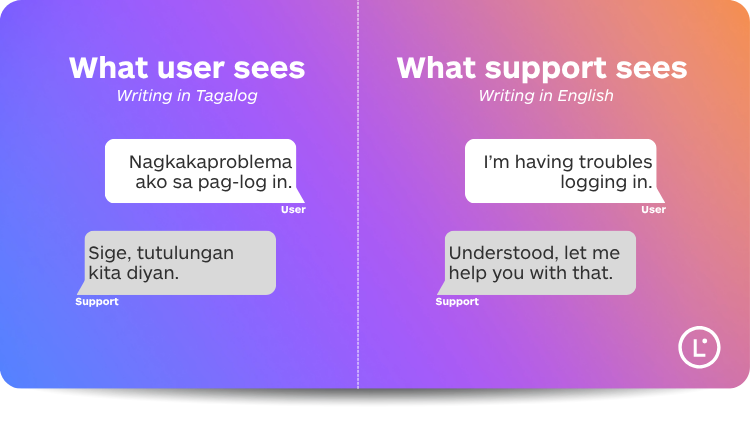 Cultural register is where technically correct translation can still fail. A polite decline in one language maps to something that reads as cold or dismissive in another. Formal address varies dramatically across European languages and doesn’t transfer automatically. The best implementations pair translation technology with short cultural awareness guidelines for agents, so responses don’t just say the right thing but feel right to the recipient.
Accessibility is worth naming explicitly. For customers in regions where bandwidth limits video calls, or for customers who communicate more clearly in writing than in speech, text-based multilingual support is often the only viable channel. Real time translation for helpdesk tickets and chatbots ensures those customers aren’t structurally excluded from support that others take for granted.
Cultural register is where technically correct translation can still fail. A polite decline in one language maps to something that reads as cold or dismissive in another. Formal address varies dramatically across European languages and doesn’t transfer automatically. The best implementations pair translation technology with short cultural awareness guidelines for agents, so responses don’t just say the right thing but feel right to the recipient.
Accessibility is worth naming explicitly. For customers in regions where bandwidth limits video calls, or for customers who communicate more clearly in writing than in speech, text-based multilingual support is often the only viable channel. Real time translation for helpdesk tickets and chatbots ensures those customers aren’t structurally excluded from support that others take for granted.
Challenges to address before you scale
None of these are reasons to delay deployment. They are operational decisions you need to make explicitly before go-live, because the translation system won’t surface them automatically.How to evaluate translation technology for support
Most vendor demos show best-case single-message translations in English-to-Spanish. That’s not your real scenario. Here’s what to test and what to ask before you commit.| Criterion | What to ask | Why it matters |
|---|---|---|
| Model recency | How often are models updated? On what data? | Translation quality between major pairs has improved significantly in two years. Older models are a meaningful quality disadvantage, not just a feature gap. |
| Multichannel coverage | Does translation work across email, live chat, and your ticketing system from a single configuration? | Channel-specific translation forces parallel workflows and creates inconsistency in glossaries and context settings across touchpoints. |
| Compliance documentation | Can you provide GDPR, SOC 2, and EU data residency certification? Where exactly is data processed? | General “enterprise-grade security” claims are not documentation. Regional processing location matters for GDPR compliance, not just a checkbox. |
| Agent experience | Does translation happen automatically, or does it require manual steps in the agent interface? | Tools that add friction get worked around. Test with actual support agents during evaluation, not just technical staff. |
| Integration fit | Is there a native connector for your support stack (Zendesk, Intercom, Salesforce Service Cloud)? | Pre-built integrations reduce time-to-value significantly. API availability matters for custom setups, but shouldn’t be your first option when a connector exists. |
| Context retention | Test a multi-message conversation, not just isolated messages. Does the system carry thread context across follow-ups? | Context loss causes disconnected responses and forces customers to repeat themselves. Single-message demos don’t surface this failure mode. |
How Lara Translate handles customer support use cases
Most translation tools are built for document workflows or general-purpose text. Customer support has different requirements: speed, context continuity, terminology consistency, and strict data privacy. Lara Translate is purpose-built to handle all four.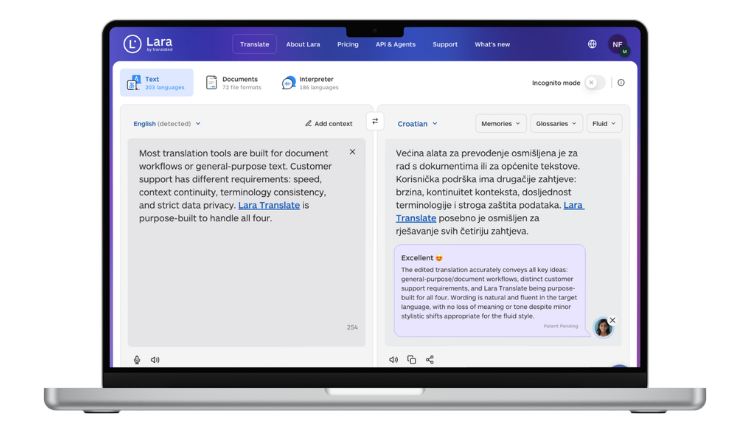
99% of translations complete in 1.2 seconds. Conversation pace stays natural; no pauses that signal to customers that something is being processed in the background.
Full language coverage across 42,230+ pairs, with iOS and Android apps for agents working across time zones without desktop access.
Custom glossaries enforce your product vocabulary across every translation. Set Faithful style for technical support content, and the model prioritizes precision over fluency. Product names and compliance-sensitive phrases stay exact.
Incognito Mode prevents customer conversation data from being stored or used for model training. Nothing from the session is retained after the translation is delivered.
The Model Context Protocol integration connects real time translation directly to existing AI systems and support platforms without replacing current tooling. Lara Translate enhances what’s already there. See the full integrations overview for how it fits into broader support ecosystems.
Try Lara Translate in your own workflow
Test it on a real support conversation and see how context instructions and glossaries handle your product terminology.
Implementation strategies for different team sizes
Small teams should start with email and ticket translation before adding real-time channels. Written formats give agents time to catch translation issues before they reach the customer. Once your team is comfortable reading and responding to translated content, add live chat where pace matters more than polish. Enterprise rollouts require phased deployment by region or product line. Piloting in one market before full deployment reveals terminology gaps, integration issues, and agent workflow friction that specs don’t surface. Collect specific feedback on translation quality for your product category and support scenarios, not just general accuracy scores. Training programs need to cover both how to use the tools and how to work with translated content effectively. Agents need to write in ways that translate cleanly: short sentences, no idioms, explicit references rather than pronouns. They also need to recognize when a translated customer message might have lost nuance, and when to ask a clarifying question rather than assume they understood. That judgment doesn’t develop automatically. Quality assurance should include periodic sampling of translated conversations by bilingual reviewers. This isn’t a translation audit; it’s a feedback loop. You’re looking for systematic errors in product terminology, register mismatches, or context loss patterns that can be fixed through glossary updates or better context instructions. Measuring success means tracking more than ticket volume. Monitor satisfaction scores by language segment to catch translation quality issues that aggregate metrics mask. Track resolution times per language. Analyze escalation rates to see if certain languages or content types consistently require human intervention above baseline. Those signals tell you where to invest next.Thank you for reading 💜
As a thank you, here’s a special coupon just for you: IREADLARA26.
Redeem it and get 10% off Lara PRO for 6 months.
If you already have a Lara account, log in here to apply your coupon. If you are new to Lara Translate, sign up here and activate your discount.
FAQs
How accurate is real time translation for customer support compared to human translation?
For routine inquiries in major language pairs, current neural machine translation reaches professional-level accuracy. Accuracy drops with rare language pairs, highly specialized technical terminology, legal language, and culturally specific references. The practical approach is not to treat this as a binary. Routine requests work well without review. Complex technical or compliance-sensitive content should have a human verification step built into the escalation path. Custom glossaries meaningfully improve accuracy for business-specific terminology, because the model stops guessing what your product names and internal terms mean and uses the definitions you provide.Can real time translation handle multiple customer channels simultaneously?
Yes. Modern platforms support email, live chat, ticketing systems, social media, and in some cases voice calls. Text-based channels are more reliable and easier to deploy than voice translation, which still carries meaningful latency and accuracy trade-offs. Most teams deploy across text channels first and add voice capabilities as a second phase. The more important question is whether the translation system maintains a unified configuration layer across those channels, because managing separate glossaries and context settings per channel creates inconsistency at scale.What security measures protect customer data during translation?
Enterprise-grade translation systems encrypt data in transit and at rest, and process translations without storing customer content beyond the immediate transaction. Compliance certifications to verify include GDPR, SOC 2, and any industry-specific requirements for your sector. For European customer data specifically, confirm that processing occurs within EU infrastructure, not just that the vendor claims GDPR compliance. Features like Incognito Mode prevent customer conversation data from being used in model training. Ask for compliance documentation and verify it against your own data governance requirements rather than accepting general claims.How does real time translation for helpdesk tickets and chatbots reduce response times?
The mechanism is simple: language stops being a routing constraint. Without translation, tickets in languages your agents don’t speak queue until a specialist is available. With real time translation, any available agent picks up any ticket immediately. First response times for non-English inquiries improve because the wait for a language-matched agent disappears entirely. Overall team utilization improves because capacity is no longer segmented by language. The biggest gains are usually visible in first response time and in queue depth during off-hours when specialist coverage is thinnest.What costs should businesses expect when implementing translation for customer support?
Costs break down across platform subscription, integration development, training, and ongoing quality assurance. Platform pricing typically varies by feature tier and translation volume. Integration costs depend on whether pre-built connectors exist for your support stack or whether custom API work is required. Most businesses find total translation technology costs lower than the fully loaded cost of hiring dedicated multilingual staff for each new market, but that calculation depends heavily on your current language coverage and target volume. Run the comparison against your actual per-market support headcount, not just the platform subscription fee.Have a valuable tool, resource, or insight that could enhance one of our articles? Submit your suggestion
We’ll be happy to review it and consider it for inclusion to enrich our content for our readers! ✍️
Useful articles
- The Emerging Revolution in Automated Translation
- Google Translate vs other free translation tools: a complete 2025 comparison