

An industry glossary for translation means an approved terminology list for a specific sector. It standardizes how key concepts are translated so your content stays credible and consistent across languages.
If you translate industry content at scale, you have seen the problem: two reviewers approve two different terms for the same concept, and your website, docs, and support articles stop matching. An industry glossary prevents that by locking the preferred term every time it appears.
Want your industry terms to stay consistent in every language?
Pick an industry glossary, add your business terminology, and translate a real file. Lara Translate prioritizes your approved terms so reviews turn into approvals, not rework.
Short answer
Start with an industry glossary to standardize sector terms (legal, banking, medical, IT, manufacturing). Then add your business-specific terms (product names, UI labels, brand phrases) to avoid drift across files, channels, and teams.
Why it matters: In industry content, terminology drift is not just “inconsistent style.” It can reduce trust, slow approvals, and create misunderstandings in high-stakes contexts. A sector glossary makes translation more predictable, faster to review, and easier to scale.
|
TL;DR
|
What is an industry glossary for translation?
An industry translation glossary is a terminology list designed for one sector, with approved translations for recurring concepts. It is the fastest way to keep translation terminology by industry consistent across languages, files, and reviewers.
Industry glossary vs business glossary vs translation memory: what is the difference?
These three tools solve different problems. The best setup is usually industry glossary + business glossary, supported by a TM for repeat segments.
| Tool | Controls | Best for |
| Industry glossary | Sector terminology | Credibility and consistency in industry language |
| Business glossary | Your product, UI, brand terms | Preventing drift in names and conversion-critical wording |
| Translation Memory (TM) | Approved full segments | Reusing repeated sentences, paragraphs, and standard replies |
What problems do industry glossaries solve in real workflows?
Industry translation is full of terms that are “almost right” but not approved. The problem is that “almost right” becomes inconsistent across teams and files. A glossary turns recurring debates into a rule.
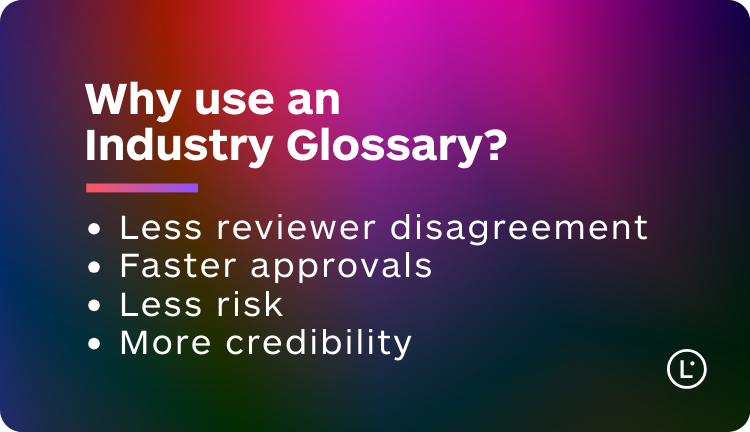
- Less reviewer disagreement: the approved term is already decided.
- Faster approvals: fewer comments like “can we use the other wording?”
- Less risk: high-stakes terms do not drift between versions.
- More credibility: your content sounds like it was written in the industry, not translated into it.
| Workflow | Typical content | Risk if inconsistent | Glossary focus |
| Regulated approvals | Policies, contracts, compliance docs | Ambiguity, re-approvals, delays | Exact approved legal terms |
| Technical documentation | Manuals, specs, SOPs, datasheets | Wrong meaning, wrong usage | One concept, one term |
| High-volume customer journeys | Product pages, onboarding, help center | Confusion, tickets, lower conversion | Conversion-critical terms |
What are example industry terms you should lock?
Even when translators do a good job, a few “repeat terms” cause most of the review work. A sector terminology glossary should start with terms that are frequent, high-stakes, or approval-sensitive.
| Industry | Term (source) | Why it drifts | Glossary approach |
| Legal | “Terms of Service” | Multiple close equivalents | Choose one approved variant per locale |
| Banking | “Chargeback” | Loanword vs translated term | Lock the preferred customer-facing wording |
| Medical | “Adverse event” | High-stakes phrasing | Use the approved regulatory wording |
| IT | “Downtime” | Several “almost right” options | Standardize for status pages + help center |
| Manufacturing | “Tolerance” | Domain meaning vs general meaning | Lock the domain-correct term |
| eCommerce | “Returns policy” | Policy pages drift from support wording | Keep policy + help center aligned |
What are the main glossary benefits by industry?
Below are practical benefits by sector, mapped to the industries included in the Lara Translate industry glossary library.
 Legal
Legal
- Locks defined terms: if a term appears in a definition clause, it stays stable everywhere else.
- Reduces interpretation risk: fewer “similar but not identical” variants.
- Speeds up review: legal stakeholders spend time on meaning, not terminology debates.
 Banking and Finance
- Standardizes product language: the same account, fee, or rate concept gets the same term.
- Improves compliance clarity: sensitive wording stays aligned across markets.
- Reduces rework: fewer revisions across recurring reports and customer comms.
 Medical and Pharmaceutical
- Controls high-stakes terminology: procedures, conditions, and documentation language.
- Improves consistency across materials: leaflets, instructions, support content.
- Accelerates approvals: fewer back-and-forths on term choices.
 Information Technology
- Aligns UI and documentation: product terms match help center and support macros.
- Reduces support friction: fewer tickets caused by mismatched labels.
- Stabilizes platform vocabulary: key concepts remain consistent release after release.
 Mechanical and Manufacturing
- Standardizes parts and process terms: manuals and SOPs stay consistent.
- Improves safety clarity: critical terms do not drift in translated instructions.
- Reduces costly revisions: fewer last-minute changes before publishing.
 Internet and eCommerce
- Locks conversion-critical terms: shipping, returns, payments, promos.
- Improves trust: checkout wording stays stable across languages and channels.
- Reduces “almost right” drift: fewer mismatches between ads, product pages, and support.
 Marketing, Advertising and PR
- Protects brand language: positioning terms and campaign phrases remain recognizable.
- Reduces inconsistent CTAs: the same action is described the same way.
- Keeps tone more stable: especially when paired with style control.
 Energy, Oil and Gas
- Stabilizes operational language: processes and procedures remain consistent.
- Improves safety communication: fewer ambiguous alternatives.
- Supports stakeholder clarity: reports and updates align across markets.
 Cosmetics and Fashion
- Standardizes product terminology: categories, materials, ingredients, claims.
- Reduces confusion: fewer “two names for the same thing” across catalog and campaigns.
- Improves brand consistency: naming stays aligned across packaging, eCommerce, and ads.
 Travel and Tourism
- Standardizes service language: guest communications stay consistent.
- Improves clarity: fewer awkward or misleading term choices.
- Supports brand voice: tone remains stable across markets and seasons.
How do you choose the right industry glossary?
- Start from the approver: choose the glossary that matches who signs off (legal, compliance, clinical, engineering, product).
- Match the channel: docs need precision, UI needs consistency, marketing needs both terminology and voice.
- Separate regions when needed: if terms differ by locale, keep separate glossaries or separate target columns by locale.
How do you apply industry glossaries in Lara Translate?
Use an industry glossary as your baseline, then tighten it with business-specific terms. For best results, add context (what the content is, who it is for, what to avoid) and choose a style (Faithful, Fluid, or Creative) to keep both terminology and voice consistent.
- Pick the industry glossary: start with the closest sector baseline.
- Add business terms: product names, UI labels, brand phrases, “do not translate” entries.
- Add context and choose a style: align tone and intent, not just terminology.
- Promote reviewer comments into rules: if a term gets corrected twice, it belongs in the glossary.
Helpful guide: How glossaries work in Lara Translate
What are common industry glossary mistakes (and how do you fix them)?
- Using only industry terms: add your product names, UI labels, and branded phrases to remove edge cases.
- Mixing regions: if a market needs different approved terminology, separate by target locale or keep separate glossaries.
- Overloading with rare terms: prioritize what repeats and what carries risk, then expand gradually.
- Skipping review ownership: assign one owner so terms do not drift back over time.
Make your industry terminology consistent in every language
Pick an industry glossary, add your business terminology, and translate a real file. Lara Translate will prioritize your approved terms so naming stays stable across docs, UI, and marketing.
Try Lara Translate with industry glossaries
▼ Or download your industry-specific glossary ▼
Get your Free Industry Glossaries
Thanks to Lara Translate, you can get access to 10,000 professionally curated, ready-to-use terms
designed for the most common use cases across multiple industries.
- Get your free Accounting & Finance glossaries here.
- Get your free Automotive glossaries here.
- Get your free Banking glossaries here.
- Get your free Certificates, Diplomas, Licenses & CV glossaries here.
- Get your free Chemical glossaries here.
- Get your free Cosmetics glossaries here.
- Get your free Culinary glossaries here.
- Get your free Electronics & Electrical Engineering glossaries here.
- Get your free Energy, Oil & Gas glossaries here.
- Get your free Environment glossaries here.
- Get your free Fashion glossaries here.
- Get your free Information Technology glossaries here.
- Get your free Internet & E-commerce glossaries here.
- Get your free Legal glossaries here.
- Get your free Marketing, Advertising & PR glossaries here.
- Get your free Mechanical & Manufacturing glossaries here.
- Get your free Medical & Pharmaceutical glossaries here.
- Get your free Music glossaries here.
- Get your free Social Science glossaries here.
- Get your free Travel & Tourism glossary here.
FAQ
Do industry glossaries replace business glossaries?
No. Industry glossaries standardize sector language. Business glossaries lock your product, UI, and brand terms. The best setup is industry plus business, supported by a TM for repeat segments.
Which industries benefit most from glossaries?
Any workflow with approvals, risk, or technical content. Legal, banking, medical, IT, and manufacturing tend to see the fastest payoff.
How do I keep an industry glossary maintainable?
Start small, focus on repeated terms, assign an owner, and review periodically. Expand only when a term causes real review work.
This article is about:
- Explaining what an industry glossary for translation is and why it matters in real workflows.
- Showing the main benefits of glossaries by sector, from legal and banking to IT and eCommerce.
- Sharing a simple comparison of industry glossary vs business glossary vs translation memory.
- Providing mini examples of industry terms that commonly drift and should be standardized.
- Helping you apply industry glossaries in Lara Translate with context and style control.