

Most online stores expand internationally by switching the language and adding a currency selector. That is translation, not localization. Shoppers in Tokyo, São Paulo, and Berlin are not the same audience with different words on the page. They expect different payment methods, different size charts, different units, different return policies, and different reassurance signals at checkout.
E-commerce localization is the full-stack adaptation of an online store for each target market. It touches product data, navigation, search, pricing, payment, shipping, legal pages, customer support, marketing copy, and post-purchase communications. Skip any of these layers and the conversion rate suffers in ways analytics rarely surface clearly. The fix is to treat localization as a system, not a translation project, and to apply it market by market with measurable goals.
This playbook walks through the parts of the store that need real adaptation, the order to tackle them in, and the trade-offs you will face along the way. If you are still deciding which translation engine to pair with your platform, the deeper guide on how to choose AI translation for e-commerce websites is useful.
TL;DR
|
Translating product catalogs at scale
Product catalogs are the largest, most repetitive, and most commercially sensitive content in any online store. They are also where bad translation hurts the most, because product descriptions are read at the moment of decision.

There are four things a catalog translation workflow needs to get right. Miss any of them and you’ll either slow down at scale or end up with inconsistencies that erode trust.
- Structured product data first. Titles, attributes, variants, and specifications should be translated as discrete fields, not as flowing prose. This keeps faceted search, filters, and feeds clean across languages. Pass each field separately to your translation engine and store it back in the same structured slot.
- A glossary that protects brand and category terms. Product names, collection names, technical specs, and category labels need a shared bilingual glossary so they translate the same way every time. Without it, the same SKU drifts between five different names across the site.
- Translation memory for variants and reused copy. Catalogs are full of recurring phrases: care instructions, warranty terms, shipping notes, ingredient lists. A Translation Memory captures those once and reuses them, cutting cost and turning around updates in hours instead of weeks.
- Style control per content type. Marketing copy should not read like a manual. Choose a translation style that matches the brand voice of the original, and adjust per category if needed. Beauty copy is not industrial copy.
For stores with thousands of SKUs, automation here is not optional. The point of e-commerce localization at catalog scale is to translate consistently, fast, and with the right voice across every product page in the store.
Adapting payments, currencies, and units
Localization breaks down most often where money and measurements meet. A shopper who sees an unfamiliar currency, an unfamiliar payment method, or a size in the wrong system reaches for the back button.
 Local payment methods. Local payment methods are a localization decision, not a finance one. They directly move checkout completion rates. Brazilian shoppers expect Pix and installment options. Dutch shoppers expect iDEAL. German shoppers reach for SEPA direct debit and invoice payment. Japanese shoppers want konbini and digital wallets. Picking the right local payment mix per market is one of the fastest conversion levers available to an international store.
- Currency and pricing. Display prices in the local currency, with the local thousands and decimal separators, and round to a price point that feels right in that market. Auto-converting from a base currency at the daily exchange rate produces ugly numbers and erodes margin discipline. Set local price points instead.
- Units and sizes. Convert measurements to what each market uses: metric in most of the world, imperial in the United States, shoe and clothing sizes mapped to local conventions. Show both systems if you are unsure, and always include a size chart with measurements in the local unit.
- Tax, duties, and shipping. Quote prices inclusive of VAT where customers expect it (most of Europe), and exclusive where they do not (United States). Be transparent about duties on cross-border orders before checkout, not after. This single change reduces abandonment more than almost any other localization fix.
Localized checkout and global UX
Checkout is where e-commerce localization is won or lost. A translated product page can carry a slightly imperfect phrase and still convert. A checkout that feels foreign rarely does.

A localized checkout is more than a translated form. It adapts to local expectations on five fronts.
- Address formats. Japan uses prefectures, the United Kingdom uses postcodes with a specific structure, the United States uses ZIP plus state, Brazil uses CEP. Hard-coded American address forms turn international shoppers away at the last step. Use dynamic address validation per country.
- Field order and labels. Family name first or given name first depends on the market. Phone number formats vary. Email is universal, but the way users expect to confirm it is not. Translate labels and reorder fields to match local norms.
- Trust signals. Local payment logos, recognizable security badges, local return policies, and a customer service phone number with a local prefix all reduce friction at checkout. Generic English trust signals do not transfer.
- Reassurance copy. A short line about delivery time in local days, return policy in local language, and customer support hours in local time zone closes the confidence gap that converts browsers into buyers.
- Mobile-first behavior. In many markets, mobile commerce is the default, not a fallback. The localized checkout must be designed mobile-first for those audiences, with one-tap payment options and minimal typing.
A clean localized checkout removes friction the customer cannot quite name but feels at every step. The lift in conversion from getting it right is often the single biggest payoff in the entire e-commerce localization program.
Localize your store with Lara Translate
AI-powered translation across 200+ languages, built for product catalogs, marketing copy, and the moments that matter at checkout.
Multilingual ecommerce SEO that drives qualified traffic
Localized pages need to be found. Multilingual ecommerce SEO is the discipline of making each language and country version of the store discoverable in the right local search engine, by the right shoppers, in the right language.
The fundamentals are well established and consistently underdone.
 Hreflang implementation. Every localized page needs hreflang tags pointing to its other-language equivalents. This tells search engines which version to serve in which market and prevents duplicate content issues across regions. Mistakes here are common and costly: missing return tags, wrong language codes, or pointing to the wrong canonical version.
- URL structure per market. Subdirectories (example.com/de/), subdomains (de.example.com), or country-code top-level domains (example.de) all work, but pick one and apply it consistently. Subdirectories are usually the simplest path for multilingual ecommerce SEO because they consolidate authority on a single domain.
- Localized keyword research. Direct translation of English keywords almost always misses the way people actually search in another language. Run local keyword research with native search behavior in mind. Category names, product attributes, and intent modifiers all change. The Spanish word a shopper uses for “sneakers” varies between Spain, Mexico, and Argentina, and your multilingual ecommerce SEO has to reflect that.
- Translated metadata, slugs, and structured data. Title tags, meta descriptions, image alt text, breadcrumbs, and product schema all need to be localized. Search engines read structured data in the page language, and getting it right improves rich results in local SERPs.
- Local content and link signals. A localized blog, local landing pages for high-intent queries, and links from local sites all reinforce relevance. Multilingual ecommerce SEO is not just translation of the on-page elements. It is a content and authority strategy run per market.
For a deeper view of the commercial upside of getting these layers right, the article on multilingual e-commerce store benefits and global growth lays out the numbers that justify the investment.
Boosting conversions globally
Once catalog, checkout, and search are in place, conversion lift comes from the smaller details that compound.
Localized email and post-purchase communications keep the experience consistent after the sale. Order confirmations, shipping updates, returns instructions, and review requests in the local language signal that the brand is present in that market, not parachuted in.
Customer support in local language reduces returns and lifts repeat purchase. Even partial coverage during local business hours makes a difference. Lara Translate in the support workflow lets a small team handle more languages without adding a hire for every market you enter.
Reviews and user-generated content matter more across borders than at home. New shoppers in a new market trust other local shoppers. Surface local reviews where possible, and translate top reviews from the home market while the local pool grows.
Promotions need adaptation too. Black Friday and Cyber Monday are American constructs; Singles’ Day is bigger in China; Boxing Day matters in the United Kingdom and Commonwealth markets. The e-commerce localization calendar should reflect what each market actually shops around.
How Lara Translate fits into an e-commerce localization stack
Lara Translate is an AI-powered translation platform designed for the volume and variety that online stores generate every day. For e-commerce localization specifically, three capabilities tend to do the heavy lifting.
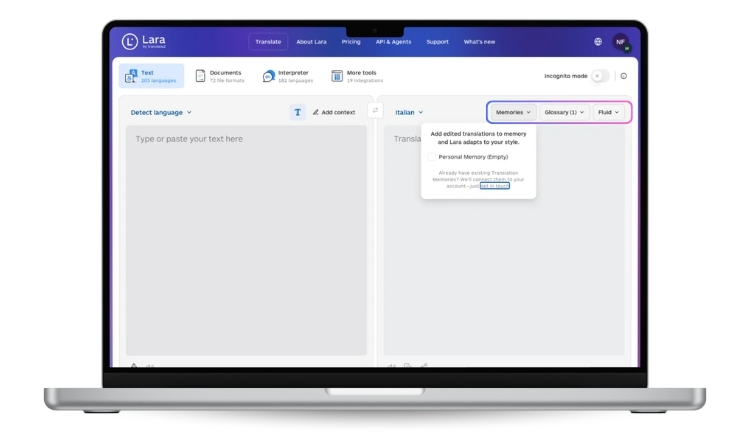
The platform offers three translation styles, Faithful, Fluid and Creative, so teams can match the right tone to the right content. Faithful keeps technical specs and policy pages accurate. Fluid handles category pages and product descriptions naturally. Creative is built for marketing campaigns and brand-led copy. The four models, Base, Think, Flash, and Batch, let teams trade speed for depth: Flash for live storefront updates, Batch for full catalog runs, Think when nuanced product pages need the extra linguistic analysis.
Lara covers 200+ languages and 42,000+ language pairs, with 99% of translations completing in 1.2 seconds, making it suitable for both interactive use and large-scale catalog work.
The Learning Mode keeps a Translation Memory updated as the team works, so terminology stays consistent across thousands of SKUs and updates flow through faster on the next run. Combined with API access, Lara plugs into most commerce platforms and PIM systems through standard developer integrations, available in the official Lara Translate documentation.
Sequencing the program for measurable results
Tools matter, but sequencing matters more. The teams that get e-commerce localization right tend to follow the same pattern.
Pick the top two or three markets by either revenue potential or strategic priority, and resist the temptation to launch in ten at once. Localize the full funnel for those markets first, from category landing pages through to post-purchase email, before adding more languages. Set clear baseline metrics per market: conversion rate, average order value, return rate, and net promoter score, then review them quarterly.
The boring work moves the numbers most: hreflang implementation, dynamic address validation, local payment methods, return policy translation. These are not the glamorous parts of a localization project. They are the ones that show up in the conversion report.
A program built this way compounds. Each new market launches faster than the last because the catalog Translation Memory, the localized checkout components, the multilingual ecommerce SEO templates, and the support workflows are already in place. By the time the program reaches market five or six, the marginal cost of adding a language is a fraction of the first launch, and the conversion uplift across the existing markets keeps growing as the localization gets sharper.
FAQs
What is e-commerce localization, and how is it different from translation?
E-commerce localization adapts the entire store, including prices, payments, units, checkout, copy, and SEO, to each target market. Translation is only the language layer of that work. A store can be fully translated into French and still fail in France if it shows prices in dollars, uses American address fields, and hides the preferred local payment method. Localization is what closes that gap: the full commercial and UX adaptation that makes a store feel like it belongs in a market.
Which markets should I prioritize for e-commerce localization?
Start with the two or three markets with the strongest revenue signal or strategic fit, and localize the full funnel there first before expanding. Good signals include existing organic traffic from a region, a high proportion of international sessions with a low conversion rate, or direct market research pointing to unmet demand. Localizing one market well teaches you more than launching five markets partially, and the assets you build carry directly into the next expansion.
Why is a localized checkout so important for international conversion rates?
Checkout is where shoppers commit, and it is the layer most stores localize last. Local payment methods, address formats, currencies, and trust signals remove last-minute friction, which is where most cross-border carts are lost. A shopper who has navigated a fully translated product page and added items to cart will still abandon if the checkout form expects a ZIP code when they live in a country that uses postcodes differently, or if their preferred payment method is not offered. That friction is invisible in most analytics dashboards but shows up clearly in international conversion rate gaps.
How does multilingual ecommerce SEO differ from standard SEO?
It adds hreflang tags, localized URL structure, native keyword research, translated metadata, and a per-market content and authority strategy. Direct translation of an English SEO plan rarely performs in a new market because people search differently across languages, and the competitive landscape in each country SERP is distinct. A store ranking well in English for “running shoes” may need to target different phrase structures and intent modifiers in German, Japanese, or Portuguese to reach the same buyer intent.
How long does an e-commerce localization project usually take?
A first market launched well typically takes weeks to a few months, depending on catalog size, platform complexity, and the number of integrations involved. The bulk of the time goes into catalog preparation, checkout adaptation, and SEO groundwork rather than translation itself. Subsequent markets are meaningfully faster: the Translation Memory, glossaries, checkout components, and SEO templates built for market one carry forward and reduce the marginal effort for every market that follows.
This article is about
- What e-commerce localization actually means and why it goes beyond translation.
- How to translate large product catalogs consistently using glossaries, structured data, and Translation Memory.
- Adapting payments, currencies, units, taxes, and shipping for each target market.
- Designing a localized checkout and a UX that converts internationally.
- Running multilingual ecommerce SEO and post-purchase communications that lift global conversions.
Have a valuable tool, resource, or insight that could enhance one of our articles? Submit your suggestion
We’ll be happy to review it and consider it for inclusion to enrich our content for our readers! ✍️
Useful articles
- Top AI Tools for E-Commerce and Online Business
- Lara Translate integrated with Blackbird.io: Translate Your E-commerce Content at Scale