

As organizations expand across markets, languages, and regulatory environments, translation becomes more than a support function. It turns into a strategic capability that directly affects data protection, compliance, operational continuity, and internal efficiency. In this context, the cloud vs on-premise AI translation decision is no longer purely technical. It shapes how information moves inside and outside the organization.
TL;DR
|
Direct answer: If your priority is speed, collaboration, and fast rollout, cloud AI translation is usually the simplest option. If your priority is tight data control, auditability, and predictable operations, on-premise or offline translation is often a better fit. Most enterprises get the best results with a hybrid translation workflow that routes content by risk level.
| Choose cloud Collaboration, quick deployment, elastic scale, minimal IT overhead. |
Choose on-prem / offline Stricter compliance, audit needs, data boundary control, predictable uptime. |
Choose hybrid Mixed content risk. Keep sensitive data inside and send low-risk content to cloud. |
Definitions: cloud vs on-prem vs offline vs hybrid

- Cloud AI translation (SaaS): Content is processed on the vendor’s infrastructure and requires internet access.
- On-premise AI translation: Translation software runs in your environment (your network boundary), typically managed by your IT team.
- Offline translation: Translation runs without internet connectivity. This can be essential in restricted networks or field environments.
- Hybrid translation workflow: Policies route content to different environments based on sensitivity, compliance, or performance needs.
Businesses increasingly face a fundamental tension. On one side, cloud-based translation services promise accessibility, scalability, and fast deployment. On the other, on-premise and offline systems offer tighter control over data, greater predictability, and reduced exposure to external dependencies. Evaluating cloud vs on-premise AI translation options therefore means balancing security, performance, and organizational constraints rather than choosing a “better” technology in absolute terms.
The landscape has evolved significantly in recent years. Stricter data regulations and more distributed work environments have challenged long-standing assumptions about deployment. As a result, companies now assess factors such as data sovereignty, connectivity reliability, and internal governance when defining a sustainable cloud translation vs on-premise translation strategy.
Security considerations: navigating the security vs convenience trade-off
Security remains one of the primary drivers behind enterprise translation decisions. The tension between security vs convenience becomes especially visible when translation workflows involve sensitive documents, regulated data, or confidential internal communications.
From a deployment perspective, on-premise vs SaaS translation models reflect different approaches to risk management. On-premise solutions keep data within organizational boundaries, offering greater oversight of information flows and enabling alignment with internal security policies. This model supports organizations that must demonstrate compliance through direct control over infrastructure and processes.
Cloud-based translation platforms change your risk model: content is processed outside your network boundary. That makes it critical to confirm retention rules, training policies, access controls, and where processing happens.

The acceptable balance between security vs convenience varies widely. Healthcare, legal, and financial institutions often prioritize control and auditability, while marketing or international sales teams may value accessibility and collaboration features. Understanding the broader ethical and legal implications of AI translation helps organizations define their risk tolerance with greater clarity.
Increasingly, enterprises adopt layered approaches. Highly sensitive content may be handled through on-premise or offline systems, while lower-risk material flows through cloud-based services. This hybrid logic helps manage risk without sacrificing operational flexibility.
Why it matters: Security failures in translation are rarely “just a translation issue.” They can create compliance exposure, contract risk, and incident response work that costs far more than the translation itself.
Performance and connectivity: online vs offline translator requirements
Operational performance is closely tied to connectivity. The choice between an online vs offline translator affects not only speed and latency, but also reliability under real-world conditions.
 True offline translation tools remove dependence on internet availability, enabling consistent operation in environments with unstable connectivity or strict network controls. This predictability is valuable in secure facilities, field operations, and scenarios where service interruptions are unacceptable.
Cloud-based systems benefit from centralized infrastructure and continuous model updates. However, they introduce latency variability linked to network quality and server load. On-premise systems can deliver more consistent response times, but rely on local hardware and capacity planning.
Processing capacity also differs. Cloud platforms can scale resources dynamically, accommodating spikes in translation demand. On-premise or offline solutions must be provisioned for peak usage in advance, which requires careful sizing and monitoring.
The performance question is therefore less about raw speed and more about operational fit. Organizations must assess whether reliability, scalability, or independence carries more weight for their specific use cases.
Why it matters: Translation often sits inside critical workflows (support, legal, product releases). If translation is blocked, your release cycle and customer experience can be blocked too.
Deployment models: local installation of translation software vs cloud platforms
Implementation choices extend beyond technology into organizational impact. The decision between local installation translation software and cloud platforms affects IT workloads, maintenance responsibilities, and internal workflows.
On-premise and offline deployments require upfront investment in hardware, configuration, and technical expertise. They offer deeper customization and tighter integration with internal systems, but also demand ongoing internal support for updates, monitoring, and troubleshooting.
 In contrast, SaaS platforms reduce operational overhead by shifting infrastructure management to the vendor. This on-premise vs SaaS translation distinction often determines how quickly organizations can deploy and adapt translation capabilities over time.
Integration plays a central role. Cloud solutions typically provide ready-to-use APIs and connectors, while on-premise deployments may require more internal development work. That additional effort can be justified when organizations need fine-grained control over workflows or data handling.
Change management also differs. Cloud platforms support incremental adoption, while on-premise rollouts usually require more structured planning before launch.
Cost structures and long-term financial impact
Financial evaluation is inseparable from deployment strategy. On-premise vs SaaS translation models follow different cost logics that affect total cost of ownership over time.
On-premise and offline solutions involve higher initial investment, covering servers, licenses, and internal resources. These costs can be offset by predictable long-term expenses, especially for organizations with stable, high-volume translation needs.
Cloud-based services lower entry barriers by eliminating infrastructure investment, but introduce recurring subscription or usage-based fees. For organizations with variable demand, this flexibility can be advantageous. For others, costs may rise as usage scales.
Hidden costs exist on both sides. On-premise systems require hardware maintenance and periodic upgrades, while cloud platforms may involve integration work, data transfer constraints, or premium feature tiers. A realistic comparison must account for these indirect factors.
Why it matters: Many teams choose cloud for speed, then discover cost surprises at scale. Others choose on-prem for control, then underestimate the long-term operational load. Make cost a governance decision, not a procurement afterthought.
Lara Translate: business-focused AI translation with two privacy modes
Within the cloud vs on-premise AI translation discussion, Lara Translate is designed to support real operational workflows, especially when teams need clarity, governance, and repeatability rather than generic language generation.
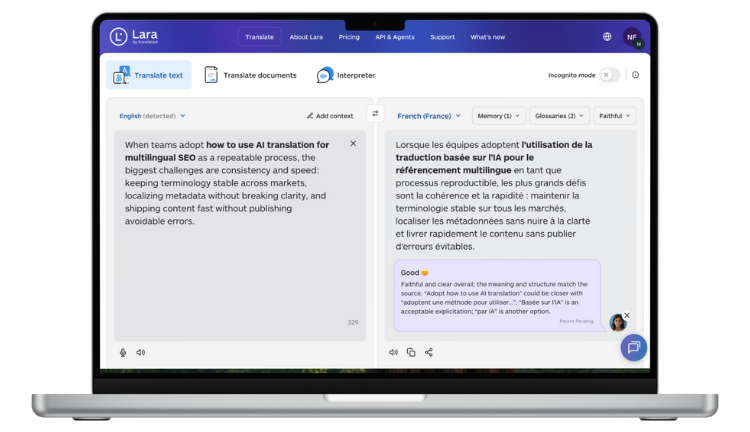
Lara Translate supports 200+ languages and thousands of translation combinations across the UI and API. It also supports 70+ file formats for document translation, including Office, PDF, iWork, localization formats, and images.
To help teams manage the security vs convenience trade-off, Lara Translate offers two privacy modes. In Learning Mode, translated content can be stored to improve the service. In Incognito Mode, translation content is not retained and is deleted after processing, which can be a better fit for sensitive materials.
For compliance workflows, Lara Translate provides a Data Processing Addendum (DPA) and additional privacy guidance in Privacy and Data Protection documentation.
Try Lara Translate in your own workflow
Test Lara Translate on a real client text and see how it handles your terminology, context, and formatting.
Access is also available across devices through iOS and Android apps, with the iOS version offering system-level integration as a default translator. This supports teams that need fast, consistent translation access across different working contexts.
Get Lara Translate on your phone
Download the app and keep translation ready when you need it.
 |
 |
Decision framework: choosing the right translation architecture
Selecting a translation deployment model requires a structured evaluation framework. Successful cloud vs on-premise AI translation decisions consider regulatory context, operational constraints, and long-term scalability.
- Start with content risk: classify what is sensitive (PII, contracts, financials, regulated data) vs low-risk (public marketing drafts).
- Confirm retention and governance: define what can be stored, for how long, and under what controls.
- Validate compliance artifacts: ensure you can rely on a DPA and clear privacy documentation.
- Model operations: who owns uptime, updates, access control, and incident response.
- Plan integration: API, connectors, and workflow adoption matter as much as translation quality.
Compliance obligations often guide early decisions. Regulated industries may require local installation translation software, while others can leverage cloud services without compromising governance. Scalability expectations further shape the choice between fixed-capacity on-premise systems and elastic cloud platforms.
Risk assessment must also account for dependency models. On-premise systems reduce reliance on external vendors but increase internal operational responsibility. Cloud platforms invert this relationship, trading internal complexity for vendor dependency.
Integration with existing infrastructure and user experience expectations ultimately determine adoption success. A technically sound solution that disrupts workflows or creates friction will struggle to deliver value.
Why it matters: A translation system that looks perfect in a demo can fail in production if it adds friction. Adoption is a security and cost issue, because users will bypass slow or hard tools.
Looking ahead: evolving cloud and offline translation models
The cloud vs on-premise AI translation landscape continues to evolve. Hybrid architectures increasingly combine controlled processing for sensitive content with cloud-based capabilities for collaboration and scale.
 Advances in model compression improve the feasibility of offline translation tools, while edge computing blurs traditional boundaries between cloud and on-premise systems. Privacy-preserving techniques may further reshape the security vs convenience equation in the future.
For organizations planning long-term translation strategies, understanding these trends is essential. Deployment choices made today should remain adaptable as technology, regulation, and business needs evolve.
Implementation best practices
Effective implementation depends on disciplined execution. Pilot programs allow organizations to compare online vs offline translator options using real workflows. Security alignment ensures that chosen systems fit existing governance frameworks. Performance monitoring establishes measurable benchmarks for quality, reliability, and user adoption.
Ultimately, the cloud vs on-premise AI translation decision reflects organizational priorities rather than technological superiority. Businesses that approach the choice strategically, balancing control, accessibility, and operational resilience, are better positioned to build translation workflows that support growth, compliance, and long-term efficiency.
Thank you for reading 💜
As a thank you, here’s a special coupon just for you:
IREADLARA26.
Redeem it and get 10% off Lara PRO for 6 months.
If you already have a Lara account, log in here to apply your coupon.
If you are new to Lara Translate, sign up here and activate your discount.
FAQs
What is the main difference between cloud vs on-premise AI translation?
The main difference is where translation is processed and who owns operations. Cloud translation runs on vendor infrastructure and depends on internet access. On-premise translation runs in your environment, giving you more control and auditability but requiring more internal ownership.
When should an organization choose an online vs offline translator?
Choose an online translator when you need fast rollout, easy collaboration, and elastic scale. Choose an offline translator when internet access is unreliable, prohibited, or a risk you cannot accept for sensitive workflows.
How does security vs convenience affect translation decisions?
Higher security usually means stricter control over retention, access, and processing location, which can add operational work. Greater convenience usually comes from cloud access and vendor-managed infrastructure. The best model depends on your data risk level and compliance requirements.
What role do offline translation tools play in enterprise workflows?
Offline translation tools support continuity in restricted or unstable connectivity environments and reduce dependency on external processing. They are often reserved for high-sensitivity or mission-critical use cases.
Why is on-premise vs SaaS translation still a relevant comparison?
Because it determines responsibility and control. On-premise solutions increase internal ownership of infrastructure and operations. SaaS shifts maintenance and scalability to the vendor, which can speed adoption but requires careful governance around privacy, retention, and compliance artifacts such as a DPA.
This article is about
- How enterprises evaluate cloud vs on-premise AI translation strategies in relation to security, performance, and operational requirements
- The practical implications of choosing an online vs offline translator across different business contexts and connectivity conditions
- Understanding the security vs convenience trade-off in AI translation for regulated and non-regulated industries
- Comparing on-premise vs SaaS translation models in terms of cost structure, control, and organizational impact
- The role of offline translation tools and local installation translation software in building resilient, compliant translation workflows
Have a valuable tool, resource, or insight that could enhance one of our articles?
Submit your suggestion
We’ll be happy to review it and consider it for inclusion to enrich our content for our readers! ✍️