

If you are searching for the best Google Translate alternatives, you are not alone. Google Translate expanded fast by adding 110 new languages (June 27, 2024), which raised the baseline for everyday translation.
But “more languages” does not automatically mean “best for your workflow.” If you translate business documents, need format fidelity, and want terminology control (glossaries, translation memory, review), some Google Translate alternatives fit better depending on content type, risk, and integrations.
TL;DR
|
Why it matters
Choosing an AI translator by habit is expensive. One wrong term in a contract, one inconsistent product name across a website, or one broken PDF layout can trigger delays and rework. A tool that matches your content type, terminology needs, and privacy requirements reduces total cost and speeds up global rollout.
What are the best Google Translate alternatives right now?
- Short answer: Lara Translate, DeepL, Microsoft Translator, Amazon Translate, and SYSTRAN are the most credible Google Translate alternatives for many professional use cases.
- Rule of thumb: Pick by workflow, not hype. If you translate business documents and need terminology governance and file fidelity, start with Lara Translate. If you need developer pipelines at scale, evaluate Amazon and Microsoft. If you need on-prem deployment and deep customization, evaluate SYSTRAN.
Why experienced teams look beyond Google Translate in 2026
Google Translate is excellent for fast understanding. Teams still look for alternatives when they need one or more of these:
- More governance: glossaries and translation memory that are easy to apply across teams, not just per user.
- Better file fidelity at scale: translating real business files (not just text snippets) while preserving structure.
- Workflow integration: API-first pipelines, connectors, and automation that fit existing content operations.
- Privacy controls: clear options for sensitive content handling, especially for regulated contexts.
Google Translate vs Lara Translate in 2026: what’s different
Google Translate: Best for quick understanding across a very wide set of languages (roughly 190). Great for snippets, web pages, and everyday use. Less built for governance across teams.
Lara Translate: Built for business-grade workflows where you need control across 200+ languages: context instructions, style options, glossary enforcement, translation memories, and privacy modes.
Important nuance: Google also offers Cloud Translation for developers, which supports enterprise features like glossaries and document translation workflows. If you like the Google ecosystem, that can be the “pro” path. While if you look for more custom and secure solutions, Lara Translate’s MCP & APIs offer a wide array of options.
5 Google Translate alternatives to evaluate (and when to use each)
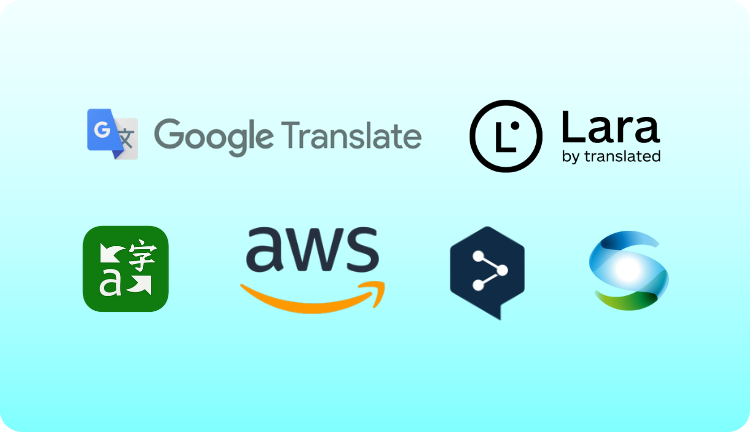
| Tool | Best for | Terminology control | Docs and formats | Notes |
|---|---|---|---|---|
| Lara Translate | Business documents, brand voice, team workflows | Glossaries + Translation Memories + “Add to Memory” from edits | 70+ formats; Office, PDF, iWork, DTP, localization, images | Learning vs Incognito modes for sensitive content |
| DeepL | Polished output for common business language pairs | Glossary features exist, but governance varies by plan | Strong for common document workflows | Great baseline, but not always best for complex team governance |
| Microsoft Translator | Microsoft-heavy environments and enterprise controls | Custom terminology via enterprise tooling | Strong in Microsoft-centric stacks | Practical when Teams and Microsoft 365 are central |
| Amazon Translate | Developer pipelines at scale on AWS | Terminology features exist, but require setup | Best when embedded in S3, Lambda, batch workflows | Great for volume, not a “simple UI” choice |
| SYSTRAN | Regulated orgs needing on-prem or heavy customization | Strong customization and domain dictionaries | Enterprise-focused deployments | Best fit when strict control beats convenience |
How to choose a Google Translate alternative
1) What are you translating? Business docs, marketing, support, code, subtitles, legal.
2) Do you need terminology governance? If yes, prioritize glossaries and translation memories.
3) Do files need to come back “ready to ship”? If layout matters, check document translation and supported formats.
4) What is the privacy requirement? For sensitive content, require clear privacy controls like Incognito Mode and deletion options.
5) How will this run in your workflow? UI, API, connectors, and automation decide adoption.
Why Lara Translate is often the best Google Translate alternative for business documents?
Lara Translate is built for professional workflows where quality, consistency, and control matter. It supports 200+ major languages and is designed to handle business-grade translation needs across that full set.
Try Lara Translate for business-grade documents
Drop in a real document and test terminology control (glossaries + translation memory), context, and formatting in minutes.
- 70+ supported formats: Office, PDF, iWork, DTP, localization files, code files, and images.
- Translation styles: Faithful, Fluid, and Creative for different content types.
- Glossaries: enforce product names and key terms across text and documents.
- Translation memory: save edits and reuse approved phrasing consistently.
- Privacy controls: Learning vs Incognito mode for sensitive content workflows.
- Human review option: add a human check for high-stakes content.
Pros and cons at a glance
- Breadth vs depth: more languages does not guarantee better terminology and tone.
- Speed vs governance: fast tools often lack glossary enforcement and TM workflows.
- Cloud vs control: for sensitive content, require explicit privacy modes and deletion paths.
FAQs
Is Google Translate good enough for professional use?
It depends. For quick understanding, it is excellent. For business documents where terminology, formatting, and governance matter, teams often choose a tool built for controlled workflows, or a developer-focused solution with glossary support.
Which Google Translate alternative is best for business document translation?
For business documents where terminology, tone, and file structure matter, Lara Translate is often the best starting point because it supports 200+ languages, 70+ formats, and built-in glossaries and translation memories.
What is the safest option for sensitive content?
Choose a platform with explicit privacy controls. For high-risk content, add human review on top.
Thank you for reading 💜
As a thank you, here’s a special coupon just for you:
IREADLARA26.
Redeem it and get 10% off Lara PRO for 6 months.
If you already have a Lara account, log in here to apply your coupon.
If you are new to Lara Translate, sign up here and activate your discount.
This article is about
- How to pick the best Google Translate alternatives by workflow, not brand.
- Google Translate’s major language expansion (110 new languages) and why language count alone does not solve business document workflows.
- Why Lara Translate is often the best choice for business documents: 200+ major languages, 70+ formats, glossaries, translation memories, and Incognito Mode.
Have a valuable tool, resource, or insight that could enhance one of our articles?
Submit your suggestion
We’ll be happy to review it and consider it for inclusion to enrich our content for our readers! ✍️