

Professional organizations require reliable translation solutions that deliver accuracy, speed, and seamless integration with existing workflows. The best AI translation tools for professional use have evolved beyond simple word conversion to provide contextual understanding, cultural adaptation, and enterprise-grade security. This guide evaluates the leading AI translation tools for professionals available in 2025, helping teams select solutions that align with their operational requirements and quality standards.
Modern professional translation software addresses critical business needs: maintaining brand consistency across markets, reducing time-to-market for multilingual content, and ensuring compliance with industry regulations. The choice between different AI translation for business platforms directly impacts productivity, cost efficiency, and global market reach.
TL;DR
|
What are the core requirements for professional translation software?
AI translation tools for professionals must meet specific criteria that consumer applications cannot address. Security protocols protect sensitive business information, while customization options help translations align with brand voice and industry terminology. Integration capabilities connect translation workflows with content management systems, marketing platforms, and collaboration tools.

Quality consistency becomes paramount when organizations scale their global operations. The best AI translation tools maintain accuracy across high-volume projects while supporting multiple file formats and preserving document layouts. These capabilities reduce manual intervention and accelerate content localization timelines.
Which AI translation tool fits your professional workflow?
Tip: use the table to jump directly to the tool you care about, then evaluate it against your content type, review process, and security requirements.
| Tool | Best for | Strengths | Watch-outs |
|---|---|---|---|
| Lara Translate | Brand voice + terminology + doc workflows | Context control, explain choices, ambiguity flags, 3 styles, 50+ formats | Best results with good context inputs and glossary setup |
| DeepL Pro | Document translation for business teams | Strong output in many EU pairs, file translation, API options | Language coverage varies by region and pair |
| Google Translate | Fast, broad coverage for everyday content | Huge language coverage, speed, accessibility | Quality can vary by domain and language pair |
| Reverso Context | Phrase checks and terminology validation | Usage examples, nuance, better phrasing confidence | Not meant for large-scale file translation |
| Smartling | Localization programs across CMS and tools | Workflow automation, connectors, governance | Requires process design and onboarding |
| Phrase | Scalable translation ops with QA workflows | Custom workflows, reporting, automation | Setup matters to avoid process friction |
| XTM | High-volume translation management | QA checks, orchestration, TM sharing | More value when volume and roles are defined |
| Maestra AI | Video localization | Subtitles and dubbing-oriented workflows | Not designed for doc localization at scale |
| HeyGen | Multilingual video output | Video-first workflow and scalable delivery | Not a terminology governance tool |
| ElevenLabs | Voiceover and dubbing pipelines | Voice synthesis for multilingual audio | Needs strong scripts and review for quality |
| Wordly AI | Live meetings and events | Real-time translation and captions | Not for long-form document translation |
| Interprefy | Conferences and enterprise meetings | Event-grade interpretation workflows | Not a doc localization platform |
| JotMe | Lightweight live interpretation | Meeting-first translation delivery | Depends on meeting requirements and languages |
| LILT | Adaptive translation with feedback loops | Human-in-the-loop improvement over time | Needs consistent review inputs to shine |
| Taia | Quality-sensitive AI + human workflows | QA gates and human validation structure | More relevant when QA and roles are defined |
| Numerous | Development-integrated localization | Reduces handoffs as apps evolve | Best for product teams, not one-off docs |
Which tools are best for text and document translation?
Lara Translate: explainable, context-aware translation for professional teams
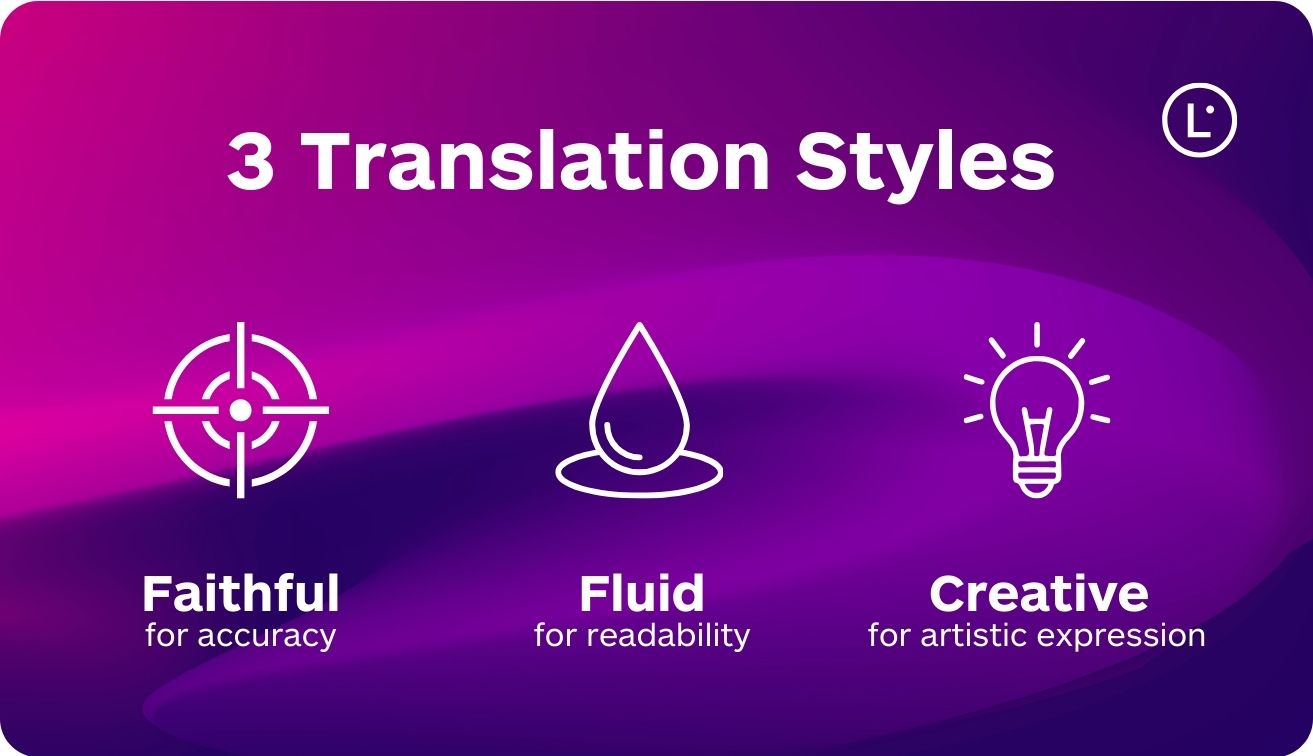
 Lara Translate is built for professional translation workflows where speed matters, but control matters more. Many tools can generate a draft. The difference is whether reviewers can trust what happened and why. Lara Translate explains translation choices and flags ambiguous terms, so teams can validate meaning, tone, and terminology before publishing. It also offers three translation styles, so you can keep legal and technical content precise while making marketing content feel local instead of literal.
- Best for: brand voice, terminology consistency, and reviewer-friendly control across professional documents
- Notable: explain choices, ambiguity flags, context specification, 3 styles, 50+ file formats
Try Lara Translate in your own workflow
Translate a real business file and see how Lara handles context, terminology, and formatting.
DeepL Pro: high-quality drafts for business documents
 DeepL Pro is commonly used by business teams who want clean translation drafts for documents without rebuilding formatting. It fits well when your workflow involves translating PDFs, presentations, or internal documents at speed. DeepL Pro is often considered particularly strong for many European language pairs and business communication.
- Best for: professional document translation, especially across many European languages
- Notable: file translation workflows and API options for automation
Google Translate: broad coverage for fast, everyday translation
 Google Translate is a go-to tool when the main constraint is speed and coverage. In professional settings it is often used for quick comprehension, internal communication, and early drafts. For customer-facing publishing, it works best as an acceleration layer combined with terminology checks and human review when accuracy, tone, or compliance requirements are strict.
- Best for: quick translations across many languages and high-velocity internal use
- Notable: broad language coverage and ease of access across devices
Reverso Context: better phrasing decisions through usage examples
 Reverso Context helps teams make stronger translation choices when nuance matters. It is commonly used as a support layer for terminology checks and phrasing confidence. It can be particularly useful for customer communications and marketing copy, where literal translations can sound unnatural.
- Best for: context checks, terminology validation, and improving phrasing quality
- Notable: usage-based examples that reduce awkward literal translations
Understanding when to combine AI efficiency with human expertise becomes crucial for quality outcomes. AI translation vs human translation decisions should consider content type, audience sensitivity, and regulatory requirements.
Which platforms are best for enterprise translation management?
Smartling: localization infrastructure for ongoing multilingual delivery
 Smartling is designed for teams that need translation to run continuously across multiple systems. If you manage a multilingual website, product content, help center, or recurring campaigns, the operational bottleneck is often routing, approvals, governance, and visibility.
- Best for: enterprise localization programs spanning CMS, e-commerce, and marketing stacks
- Notable: workflow automation, collaboration, and connectors for content ecosystems
Phrase: scalable operations with configurable workflows
 Phrase is a strong option when you need repeatable workflows that reflect how your organization publishes. Different content needs different governance. Marketing needs speed while protecting brand voice. Legal needs stricter review.
- Best for: teams that want customizable workflows and visibility across translation operations
- Notable: API-driven automation, QA workflows, and reporting to track delivery
XTM: cloud-based translation management for high-volume programs
 XTM is built for organizations with high translation volume and multiple stakeholders across locales. It becomes valuable when you need consistent QA checks, structured delivery, and reuse of approved language across projects.
- Best for: high-volume translation management with structured QA and multi-role workflows
- Notable: workflow orchestration, quality checks, and translation memory sharing
Which tools are best for video localization?
Maestra AI: video localization built around subtitles and dubbing
 Maestra AI is designed for teams whose localization output is a video asset, not a document. Video translation has constraints text tools do not solve well, like timing, subtitle readability, and voice alignment.
- Best for: subtitle generation and video localization workflows
- Notable: video-first workflow design compared to text-first translation tools
HeyGen: multilingual video delivery at scale
 HeyGen is often evaluated when teams want to scale multilingual video content and prioritize the spoken experience. For global campaigns, the goal is not only translating words but maintaining pacing, clarity, and a natural delivery.
- Best for: multilingual video output where spoken delivery and speed matter
- Notable: video-oriented workflows that support fast scaling across languages
ElevenLabs: voice synthesis for multilingual audio and dubbing
 ElevenLabs is a fit when the priority is voice output in multilingual workflows, such as dubbing, voiceovers, and audio versions of content. It is most useful when paired with strong script translation and review.
- Best for: voiceover and dubbing pipelines that require scalable spoken output
- Notable: voice synthesis capabilities for multilingual audio production
Which tools are best for real-time meeting translation?
Wordly AI: live meeting translation with real-time accessibility
 Wordly AI focuses on translating live speech in meetings and events, where time and accessibility are the main constraints. It is relevant when teams need real-time captions and multilingual participation without heavy logistics.
- Best for: live events, internal all-hands, webinars, and multilingual meeting participation
- Notable: real-time translation delivery with captions and event workflows
Interprefy: multilingual meetings and conference-grade workflows
 Interprefy is positioned for organizations running multilingual meetings and conferences where reliability and event-grade workflows matter. It can be relevant for external-facing sessions or high-impact internal communications.
- Best for: multilingual conferences and enterprise meeting setups
- Notable: event-oriented delivery that supports larger meeting scenarios
JotMe: lightweight live interpretation for recurring meetings
 JotMe is relevant when teams want real-time interpretation without building a complex infrastructure. It can be useful for recurring internal meetings and cross-border collaboration where the goal is immediate understanding across languages.
- Best for: recurring multilingual meetings and lightweight real-time interpretation
- Notable: meeting-first focus that supports faster multilingual collaboration
Modern translation workflows increasingly demonstrate how AI tools are empowering human translators rather than replacing their expertise, creating more efficient and accurate translation processes.
Which tools are best for adaptive and hybrid translation workflows?
LILT: learning-based translation technology
 LILT is often evaluated by teams that want translation quality to improve through feedback and consistent corrections. This is especially relevant for repeatable domains like product documentation, support content, or regulated materials.
- Best for: organizations that want translation workflows to improve through feedback loops
- Notable: adaptive approach that prioritizes domain alignment and consistent iteration
Taia: AI-human collaboration for quality-sensitive content
 Taia combines automated translation with human oversight, which fits teams that need speed without sacrificing quality gates. It can make sense when content must pass checks for completeness, terminology, and style before it goes live.
- Best for: technical and regulated content where human validation is part of the workflow
- Notable: structured QA checks and a process designed for AI plus human review
Numerous: development-integrated localization for constantly changing content
 Numerous focuses on product and engineering teams that ship updates frequently and need localization to stay in sync. Development-integrated localization approaches aim to reduce lag by connecting translation workflows to how teams ship changes.
- Best for: engineering-led teams that want continuous localization aligned with release cycles
- Notable: workflow style built to reduce manual handoffs and language drift
How should you compare AI translation tools for professional use?
Evaluating AI translation tools for professionals requires systematic assessment across multiple criteria. Translation accuracy varies by language pair, content type, and terminology density. Professional teams should test tools with representative samples before committing to a platform.
Integration capabilities determine how effectively translation tools connect with existing business systems. API functionality, file format support, and workflow automation features directly impact operational efficiency and adoption.
Security protocols become critical for organizations handling confidential information. Data retention policies, encryption standards, and compliance certifications should align with industry regulations and corporate security requirements.
Customization features enable organizations to adapt translation tools to specific requirements. Glossary management, style guide alignment, and workflow configuration provide necessary flexibility for professional environments.
How should teams implement AI translation tools at scale?
Successful deployment of AI translation tools for professionals requires structured planning and phased implementation. Start with a needs assessment to define quality standards, content types, security constraints, and integration priorities. Then run a pilot with real content to measure editing time, terminology consistency, and delivery speed.
Pilot programs help teams evaluate performance inside actual workflows before committing to full deployment. Testing should include diverse content types, multiple user groups, and measurable success criteria that reflect business objectives.
Training programs help teams use translation features effectively, especially terminology assets, style rules, and review practices. Performance monitoring then establishes metrics for accuracy, efficiency, and cost-effectiveness, enabling continuous improvement over time.
Why do many teams go deeper with Lara Translate after evaluating tools?
A shortlist of “good tools” is easy to build. The real question is which tool stays reliable when your translation volume grows and more stakeholders start reviewing content. That is where Lara Translate typically stands out in professional settings: it is built to reduce uncertainty and rework, not just generate output.
Unlike standard translation tools that behave like a black box, Lara Translate explains its translation choices so reviewers can quickly validate meaning and tone. It also flags ambiguous terms before they turn into brand or compliance issues across locales. For teams working with mixed content types, the three styles help avoid a one-size-fits-all approach: Faithful for precision, Fluid for clarity, and Creative for local impact.
How does Lara Translate support professional workflows end-to-end?
Lara Translate is designed to fit real business delivery constraints. It supports 50+ file formats and aims to preserve layout so teams can translate files without rebuilding structure. Glossaries and translation memories help keep terminology stable across projects and teams. Context specification helps the AI interpret purpose and audience, which reduces edits and improves consistency for content that gets updated often.
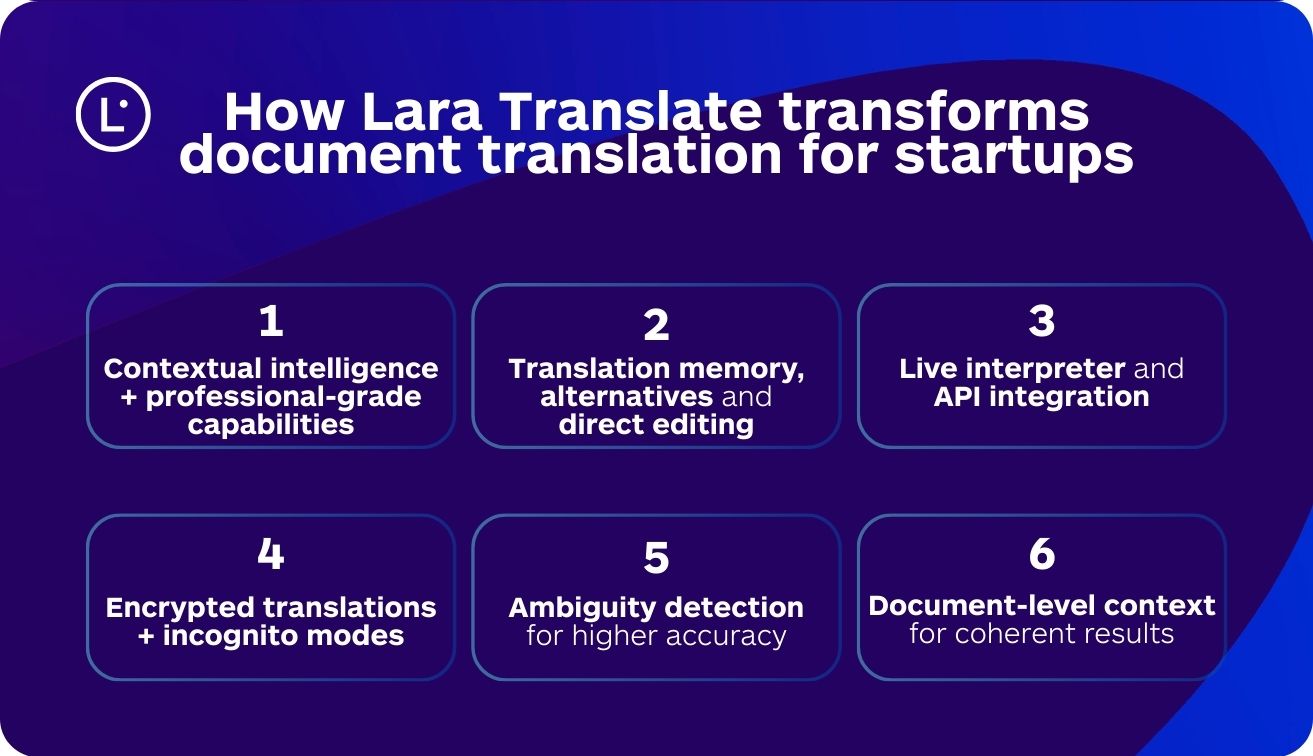
For sensitive content, Lara Translate supports Learning vs Incognito modes so teams can choose when translations should contribute to improvement workflows and when they should remain private for confidential handling.
Go deeper with Lara Translate
Try a full document workflow: add context, apply a glossary, and see the explanations and ambiguity flags in action.
FAQs
How do professional translation software solutions differ from consumer applications?
Professional translation software adds workflow capabilities consumer tools lack: security controls, terminology assets, integration options, file handling, and repeatable QA processes for business use.
What features should organizations prioritize when selecting AI translation tools for professionals?
Prioritize terminology control (glossaries, TMs), layout preservation, review workflows, integrations (API and connectors), security posture, and the ability to enforce tone and style across content types.
How do AI translation for business platforms handle industry-specific terminology?
They typically support glossaries and term databases, plus reusable language assets (like translation memories) to keep phrasing consistent across projects and teams.
What integration options do professional AI translation tools typically offer?
Most offer APIs and, in many cases, connectors for CMS platforms, marketing tools, repositories, and collaboration suites to automate ingestion, translation, and publishing.
How should organizations measure ROI from machine translation tools comparison investments?
Track editing time saved, throughput, terminology error rates, turnaround times, and the reduction of manual steps in your localization workflow.
Thank you for reading 💜
As a thank you, here’s a special coupon just for you:
IREADLARA26.
Redeem it and get 10% off Lara PRO for 6 months.
If you already have a Lara account, log in here to apply your coupon.
If you are new to Lara Translate, sign up here and activate your discount.
This article is about
- A curated overview of the best AI translation tools for professional use in 2025
- How to choose between document translators, enterprise platforms, and specialized AI translation tools for professionals
- A practical professional translation software comparison framework focused on quality, security, and integrations
- How AI translation for business teams can implement and scale multilingual workflows with clearer governance
- Selection criteria for machine translation tools comparison across content types, formats, and collaboration needs
Have a valuable tool, resource, or insight that could enhance one of our articles?
Submit your suggestion
We’ll be happy to review it and consider it for inclusion to enrich our content for our readers! ✍️
Useful articles
- Google Translate vs other free translation tools: a complete 2025 comparison
- Free vs paid translation tools: choosing the right solution for your business