

Businesses translate sensitive content every day: contracts, product roadmaps, HR documents, customer tickets, and regulated data. The real question is simple: are AI translation services secure for confidential documents?
AI translation can be fast and cost-effective, but security depends on the vendor’s data handling (retention, training, access controls), plus how your team uses the tool (what you upload, who can access it, and what gets logged).
TL;DR
|
Short answer
Yes, but only with the right setup. AI translation can be secure for confidential document translation security needs if your vendor offers
encryption in transit, clear retention and deletion controls, “no training on your content” options, strong access controls, and audit logs.
If a tool is unclear on any of these, treat it as not suitable for confidential data.
How do you choose a secure AI translation vendor?
Use this checklist to evaluate an enterprise AI translation platform before you translate anything sensitive.
| Requirement | What to ask the vendor |
|---|---|
| Data retention | Do you have a written AI translation data retention policy? Can we set retention to 0 or a short window? |
| No-training option | Can you contractually guarantee our content is not used to train models? |
| Encryption in transit | Is traffic encrypted? Which protocols are supported and documented? |
| Access controls | Do you support role-based access and SSO? Can we restrict who can translate/export? |
| Audit logs | Do you provide audit trails (who translated what, when, from where)? |
| Deletion controls | Can we delete content on demand? Is deletion immediate and verifiable? |
| Data residency | Where is data processed and stored? Do you support region controls (EU, US, etc.)? |
| Security assurance | Can you share independent reports (for example, SOC 2) or security documentation? |
What are the biggest security risks in AI translation?
When teams translate sensitive text using generic or free tools, the main risks are usually not the translation quality. They are data exposure, unclear retention, and weak governance.

Some free tools may store queries temporarily, keep logs, or use submitted content to improve systems. For regulated or confidential content, assume risk unless the vendor clearly documents a data retention policy, offers deletion controls, and provides an explicit no-training option.
Beyond accidental exposure, weak access controls can create internal risk, too. If anyone can paste or export content without permissions and audit trails, you lose accountability and increase the chance of mistakes.
General-purpose generative AI tools can also be risky for confidential translation workflows. Depending on the provider and settings, submitted content may be retained for product improvement or safety review. For sensitive data, prefer a purpose-built platform with documented privacy controls and enterprise terms.
What security features should an enterprise AI translation platform have?
For secure AI translation in business contexts, look for a security baseline that is easy to explain to Legal, IT, and Compliance:
- Encryption in transit and documented security practices
- Configurable retention with deletion controls (ideally, immediate deletion options)
- Role-based access controls plus multi-factor authentication or SSO
- Audit trails for translation activity and exports
- Project separation to avoid accidental mixing of client or business units
If your organization requires maximum control, evaluate options like private deployments or tightly governed API integrations inside your existing systems. For many teams, an API-based approach offers a strong balance between usability and oversight.
How do you balance translation speed with data protection?
The best approach is not “one tool for everything.” It is a data classification policy that maps content sensitivity to the right workflow.
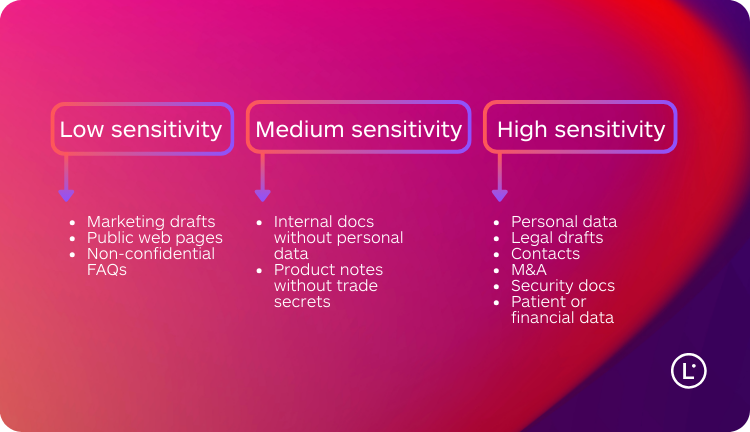
- Low sensitivity: marketing drafts, public web pages, non-confidential FAQs
- Medium sensitivity: internal docs without personal data, product notes without trade secrets
- High sensitivity: personal data, legal drafts, contracts, M&A, security docs, patient or financial records
This is where data privacy translation becomes practical: you protect high-sensitivity content with strict retention, access controls, and review, while keeping everyday work fast.
What compliance requirements matter most (GDPR, sector rules, data residency)?
Compliance is usually less about “AI” and more about data processing. If you operate under GDPR, you need clarity on lawful basis, cross-border transfers, retention, deletion, and vendor roles (processor vs controller).
In regulated sectors like healthcare or finance, the safest default is to translate only what you must, minimize sensitive fields, and require documented controls (access, logging, deletion). When in doubt, confirm requirements with your compliance team.
How do you implement secure translation workflows in a company?
 Secure implementation is a mix of vendor choice and internal discipline.
- Vendor due diligence: validate retention, deletion, no-training, access controls, audit logs, and data residency
- Internal policy: define what can be translated, where, and by whom
- Training: teach teams how to handle sensitive content and how to use privacy features correctly
- Review process: add human review for high-stakes or legally binding content
If you want a decision framework, see when to use AI translation vs human translation.
How does Lara Translate support privacy-focused translation workflows?
Lara Translate supports privacy-focused workflows with two translation modes: Learning Mode and Incognito Mode. Incognito Mode is designed for maximum privacy when you do not want content stored or used for model improvement.
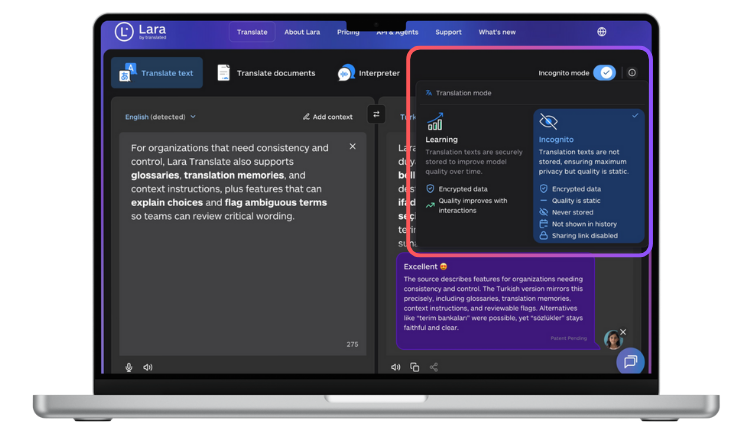
For organizations that need consistency and control, Lara Translate also supports glossaries, translation memories, and context instructions, plus features that can explain choices and flag ambiguous terms so teams can review critical wording.
If you translate business files, Lara Translate supports 60+ file formats for document translation workflows, so teams can keep the structure and reduce manual fixes.
Try Lara Translate’s secure workflow
Test Lara Translate with your content and use privacy controls designed for sensitive workflows.
What’s next for privacy-preserving AI translation?
Security in AI translation is moving toward stronger governance, clearer retention controls, and privacy-by-design approaches. Expect more enterprise platforms to provide stronger auditability, better region controls, and clearer documentation that helps security teams approve workflows faster.
Are AI translation services secure for confidential documents?
They can be, but only if you treat secure translation as a workflow, not a feature. Choose a vendor with clear retention and no-training terms, enforce access controls, and define what content is allowed in which tool. For high-risk content, add human review and minimize sensitive fields.
Why it matters
Translation is now part of everyday business operations, which means sensitive content will inevitably be translated. If teams use the wrong tool or unclear settings, you risk retention, unauthorized access, and compliance exposure. A clear vendor checklist and internal policy turn AI translation into a scalable workflow instead of a hidden liability.
Thank you for reading 💜
As a thank you, here’s a special coupon just for you:
IREADLARA26.
Redeem it and get 10% off Lara PRO for 6 months.
If you already have a Lara account, log in here to apply your coupon.
If you are new to Lara Translate, sign up here and activate your discount.
FAQs
Are AI translation services secure for confidential documents?
They can be secure if the vendor provides a clear data retention policy, deletion controls, a no-training option, access controls, and audit logs. If any of these are unclear, do not use the tool for confidential content.
What makes AI translation secure for confidential business documents?
Security comes from governance and controls: encryption in transit, strict retention and deletion, role-based access controls, audit trails, and documented vendor terms that prevent unauthorized storage or use of your content.
How do GDPR-focused translation tools differ from standard platforms?
They typically provide clearer documentation on data processing, retention, deletion, and cross-border transfers, plus features that help enforce user rights and internal governance. Always validate the vendor’s terms with your compliance team.
What are the main risks of using free translation tools for business?
The biggest risks are unclear retention, weak access controls, and vague terms about how submitted content is handled. For confidential documents, use a platform designed for enterprise workflows with documented controls.
How should businesses evaluate an AI translation vendor’s security?
Start with retention and no-training guarantees, then check access controls, audit logs, deletion options, data residency, and security documentation. Use a checklist and require written answers before rollout.
This article is about
- How to answer the question “are AI translation services secure for confidential documents?” using vendor controls and internal policy
- The most common security risks in AI translation, including retention, access, and governance gaps
- What to look for in a privacy-focused translation or enterprise AI translation platform, including deletion controls, audit logs, and data residency
- Practical implementation steps for a secure confidential translation workflow, including data classification and review processes
- How Lara Translate supports privacy controls like Learning Mode vs Incognito Mode, plus consistency features like glossaries and TMs
Have a valuable tool, resource, or insight that could enhance one of our articles?
Submit your suggestion
We’ll be happy to review it and consider it for inclusion to enrich our content for our readers! ✍️
Useful articles
- Scaling AI localization with existing assets
- AI translation file formats: avoiding typical formatting mistakes
- AI translation accuracy: what to measure and why