

Why it matters
Generic machine translation has hit a ceiling for professional use. Teams that keep treating it as a plug-and-play solution are accumulating quiet costs: inconsistent terminology in regulated markets, brand voice that drifts across languages, and human reviewers spending most of their time fixing the same predictable errors. The 2026 generation of AI translation tools is not faster MT. It is a fundamentally different architecture that separates high-confidence content from content that needs expert attention, and routes each accordingly.
|
TL;DR
|
What are the biggest AI translation trends in 2026?
 Six capabilities are reshaping how professional translation works this year: real-time speech translation, custom domain models, multimodal translation, automatic post-editing, quality estimation, and consensus-based translation. Not all of them are relevant to every team. The sections below break down what each one solves, what the evidence says, and where the practical limits are.
Real-time speech translation fixes live communication delays
Here is a problem most global teams have accepted as normal: your colleagues need to collaborate across languages during live meetings, but waiting for human interpreters slows everything down and kills spontaneity. Real-time speech translation is changing that fast. Industry forecasts suggest that by the end of 2026, over 90% of global hybrid events will include live speech translation or captioning (Kudo.ai). That reflects actual deployment in enterprise environments, not just vendor projections. Current systems handle multiple speakers, filter background noise, and maintain context across a conversation. Some platforms now process translation locally on-device, which eliminates the data privacy concern that blocked enterprise adoption for years. The technology still performs best on general business vocabulary in widely spoken languages. Highly specialized or jargon-heavy discussions, think patent litigation or pharmaceutical regulatory submissions, still benefit from trained human interpreters. What this means in practice: speech translation is moving into standard conferencing platforms. Your video tools increasingly ship with native translation features. Dedicated language technology apps still outperform them on terminology customization and brand voice consistency, but the gap is narrowing.Custom domain models prevent terminology mistakes
Generic translation engines make costly mistakes. A legal term translated incorrectly creates liability. Medical terminology errors endanger patients. Product descriptions that sound awkward in the target market lose sales. That is not a new problem, but it is one that custom AI translation models are now solving reliably at scale. Instead of training on general web content, domain-specific models study curated corpora of expert translations in a single field. The result is accurate technical terms, consistent regulatory language, and company-specific vocabulary that stays stable across large content volumes. Research shows 55% of large enterprise clients now require domain-specific translation models (MachineTranslation.com). For regulated industries, the cost of poor terminology outweighs the cost of customization many times over. The implementation workflow is straightforward: you upload your translation memories and glossaries, define your brand voice guidelines, and set quality thresholds for different content types. The system adapts its output to your parameters while maintaining processing speed. This is exactly how Lara Translate’s glossary management and context instructions work: you define the domain, audience, and preferred terms, and those parameters apply across every translation in your workflow.Multimodal translation unifies fragmented media workflows
You need to localize a product video. Previously that meant three separate workflows: one team handles subtitles, another tackles voice dubbing, a third deals with on-screen text. Each handoff creates delays and compounding error risk. Multimodal translation systems address this workflow fragmentation by processing multiple media types together in a single pipeline. New systems generate subtitle translations synced to audio timing, apply voice cloning for dubbing, and handle lip-syncing adjustments. For images and documents containing text, they detect text regions, translate content, and regenerate the asset with localized text in place. What used to require coordinating three separate vendors now runs through unified platforms. Lara Translate handles image-to-image translation and supports audio file translation via API, alongside 70+ document formats including PDF with OCR. For marketing teams managing multilingual campaigns, the time-to-market reduction is real. Less coordination overhead. Fewer handoff errors. Faster iteration cycles when copy changes late in the process.Automatic post-editing cuts repetitive manual review
Your translation team is spending hours fixing the same recurring mistakes in machine translation output. Consistent terminology errors. Predictable formatting problems. Repetitive grammatical issues in the same language pairs. It is tedious work, and it pulls experts away from complex translations that actually need human judgment. Automatic post-editing (APE) uses quality prediction models to evaluate each translation segment and identify what is likely to need revision. When systematic errors appear, APE applies learned corrections. The edited output goes back through quality prediction for verification. High-confidence content proceeds to publication. Uncertain material routes to human translators. The loop runs without manual intervention. The results hold up under scrutiny. Farfetch, the luxury fashion marketplace, documented a 5x speedup after implementing APE alongside quality prediction (ModelFront case study). Conchita Laguardia, who leads AI and localization at Farfetch, noted that depending on the language pair, teams can achieve substantial increases in MT autoapproval rates without sacrificing quality. That is the whole point: more content approved automatically, less time spent on predictable fixes. Translation volume grows faster than available translators. APE is how teams scale operations without proportionally scaling headcount or review costs.Try Lara Translate in your own workflow
Test Lara Translate on a real client text and see how it handles your terminology, context, and formatting.
Quality estimation routes content to the right reviewer
Every piece of translated content forces the same decision: review it, or publish it. Send everything to human reviewers and your pipeline stalls. Automate everything and quality problems slip through. Quality estimation (QE) resolves that trade-off by evaluating translation reliability without requiring human review first. QE systems analyze linguistic patterns, contextual coherence, and terminology consistency to assign confidence scores per segment. High-confidence segments proceed automatically. Uncertain translations are flagged for human attention. When QE runs alongside APE, you get a closed-loop system: errors are detected, corrections are generated, the fix is re-evaluated, and only content below quality thresholds escalates to a human reviewer. Translation management systems now include built-in quality estimation as a standard feature rather than an add-on. You see confidence scores, flag problems, and route content based on predicted quality rather than blanket automation rules. That shift from “automate everything” to “automate intelligently” is one of the defining characteristics of how professional teams are operating in 2026.Consensus translation reduces single-engine errors
Relying on a single translation engine means you have no independent check on its output. When it makes an error, nothing catches it before human review. Consensus-based translation addresses this by running content through multiple independent AI systems and analyzing where outputs agree. When multiple engines independently produce the same translation, confidence in that output increases. Where engines disagree, the segment likely needs human review or represents a genuinely difficult translation decision. Research shows this approach reduces errors by 18-22% compared to single-engine output (Technology.org). Implementation connects to multiple translation APIs, submits identical source content to each, compares results, and surfaces consensus translations while flagging disagreements. Some platforms automate this entirely, presenting unified output based on multi-engine agreement. The marginal cost of running content through multiple engines is usually negligible. For legal contracts, regulatory communications, safety instructions, and medical information, the error reduction justifies it immediately.How Lara Translate fits into 2026 translation workflows
Several of the trends above have direct counterparts in how Lara Translate is built. Here is where that matters in practice.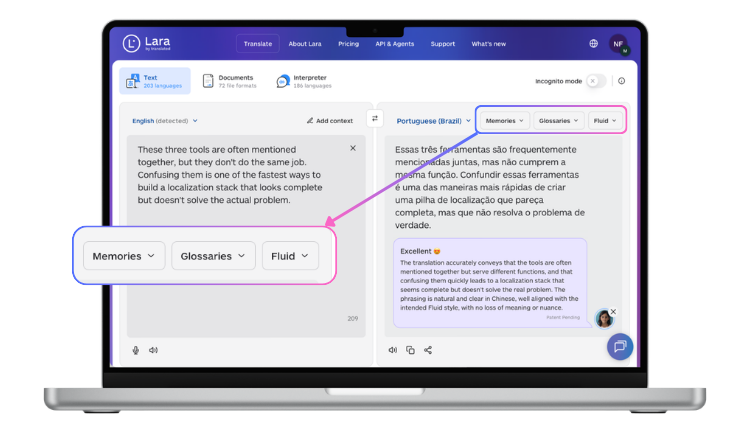
Customer service teams handling multilingual support tickets
When customers contact support in their language, you need translations fast and accurate. Generic language models struggle with industry-specific terminology and often introduce inconsistencies across ticket threads. Lara Translate processes translations in seconds, supporting over 200 languages across 42,230+ language pairs, trained on 25 million human-translated documents with expert annotations. Your support team gets consistent, accurate translations that maintain your technical vocabulary without manual glossary enforcement per agent.Marketing campaigns launching across markets simultaneously
You’ve built the product announcement. Now you need it in 15 languages by tomorrow, and it needs to sound right in each market, not just correct. Lara Translate’s three translation styles, Faithful for technical precision, Fluid for natural readability, and Creative for brand-forward content, let you specify the right register for each content type. Context instructions handle the rest: audience, tone, domain, preferred terms.Legal teams translating confidential contracts
You cannot send sensitive documents through systems that store your data for model training. Lara Translate’s Incognito Mode prevents any data storage or use for training. All processing stays in the EU. For documents that are not confidential, Learning Mode lets the system improve from your corrections over time, building domain accuracy as you work.Development teams building automated localization workflows
Your systems need to work together without custom integration for each connection. Lara Translate supports API and MCP integration for seamless connection into existing tools and platforms. The Lara Translate Agent automates localization tasks including project management and file preparation, coordinating with other AI systems through standardized protocols. Full technical documentation is at developers.laratranslate.com.Human translators shift to higher-value work
Here is what is actually changing for translation professionals: automation handles the repetitive work, which frees human experts to focus on decisions that require judgment. Linguists increasingly function as quality supervisors and domain experts rather than performing every translation manually. They define quality benchmarks, curate training data for custom models, validate specialized terminology, and decide which content needs full human translation versus automated processing with targeted review. The skill requirements are evolving fast. Effective translation professionals now combine linguistic expertise with data literacy, understanding of AI system capabilities, and the ability to articulate quality requirements that inform system configuration. Consider a pharmaceutical company launching a new drug. Machine translation handles initial drafts of technical documentation, patient information leaflets, and regulatory submissions across 30 countries. Human translators review the output, but they are not starting from scratch. They verify medical accuracy, confirm regulatory compliance, and adapt information for cultural context. Their expertise concentrates on the content where errors carry serious consequences, not on routine segments that the system handles reliably.
That is not a diminished role. It is a more leveraged one.
Consider a pharmaceutical company launching a new drug. Machine translation handles initial drafts of technical documentation, patient information leaflets, and regulatory submissions across 30 countries. Human translators review the output, but they are not starting from scratch. They verify medical accuracy, confirm regulatory compliance, and adapt information for cultural context. Their expertise concentrates on the content where errors carry serious consequences, not on routine segments that the system handles reliably.
That is not a diminished role. It is a more leveraged one.
Matching technology to content type: a practical framework
The teams getting real value from AI translation in 2026 are not the ones using the most tools. They are the ones matching the right capability to the right content type. Here is how that logic works in practice. High-volume, time-sensitive content with lower quality risk (internal communications, support documentation, user-generated content moderation): automated translation with human oversight works well. Your team reviews machine-translated output quickly, catching major errors while letting minor imperfections pass where they carry no business consequence. Brand-critical and regulated content (marketing campaigns, legal documents, customer-facing product copy): human translation with AI assistance delivers better outcomes. Your translators use AI for first drafts and terminology suggestions, then apply human judgment for brand voice, cultural nuance, and creative adaptation. The AI handles the scaffolding; the human handles the decisions. Mixed-content workflows: most organizations use a tiered approach. Product descriptions get automated translation with spot-checking. Marketing headlines get human translation. Technical specifications use automated translation with domain expert review. The tier does not need to be the same for every content type in your organization. The question is not whether to use AI translation. It is how to integrate it within workflows that maintain quality standards while meeting business objectives. That framing, matching capability to content risk, is what separates teams with real efficiency gains from teams that automate everything and then wonder why quality has declined.Thank you for reading 💜
As a thank you, here’s a special coupon just for you: IREADLARA26.
Redeem it and get 10% off Lara PRO for 6 months.
If you already have a Lara account, log in here to apply your coupon. If you are new to Lara Translate, sign up here and activate your discount.
FAQs
What are the main AI translation trends in 2026 that businesses should watch?
Six capabilities are reshaping translation workflows this year: real-time speech translation for live meetings, custom domain models for specialized terminology, multimodal systems that handle video and image text together, automatic post-editing that corrects recurring errors before human review, quality estimation that routes content intelligently between automation and human review, and consensus-based translation that cross-checks outputs across multiple engines. For most business teams, the highest-impact starting point is domain customization. Generic engines handle common language pairs well enough, but they break down on legal, medical, or technical content where precise terminology matters. Pairing a specialized model with quality estimation and targeted human review for high-stakes segments covers most production scenarios without requiring the full stack at once. The goal is not to deploy everything. It is to match each capability to the content types where it solves a real problem.How do custom AI translation models differ from general translation engines?
Custom models train on professionally translated content within specific industries rather than general web text. That means accurate specialized terminology, consistent regulatory language, and reliable company-specific vocabulary that stays stable across large content volumes. General engines lack domain expertise, which makes them unreliable for technical, legal, or medical content where a single wrong term carries real consequences. The practical difference is not subtle: in a legal contract or a pharmaceutical regulatory submission, the wrong term is not an inconvenience, it is a liability. Custom models solve for exactly that failure mode. Lara Translate supports domain customization through glossaries, context instructions, and translation memories that apply consistently across your entire workflow.What is automatic post-editing and how does it help translation teams?
Automatic post-editing (APE) detects and corrects systematic errors in machine translation output before human review. It identifies recurring problems, such as terminology inconsistencies or predictable grammatical patterns in a given language pair, applies learned corrections, and re-evaluates the fixed output against quality predictions. Content that meets the quality threshold proceeds automatically. Segments that do not are escalated to a human reviewer. This matters because translation teams spend a disproportionate amount of time on fixes that a system could handle, pulling experts away from the complex, high-judgment work that actually requires them. Farfetch documented a 5x speedup after implementing APE alongside quality prediction while maintaining output quality. The gain compounds as the system learns your content patterns over time.Is real-time speech translation reliable enough for business use in 2026?
Current systems deliver sufficient reliability for hybrid events, customer service operations, and internal meetings, particularly for general business vocabulary in widely spoken language pairs. Industry data suggests over 90% of global hybrid events will include live speech translation or captioning by the end of 2026, reflecting actual enterprise deployment rather than just vendor projections. Highly specialized discussions, such as patent proceedings, clinical trials, or regulatory hearings, still benefit from trained human interpreters who understand domain-specific nuance and can handle ambiguity in real time. The right approach is to test with your actual content types and language pairs before full deployment. For general business communication across major languages, the technology is ready.How does Lara Translate compare to general-purpose AI for translation tasks?
Lara Translate is built specifically for translation workflows, which means it is optimized for accuracy, terminology consistency, and document format handling in ways that general-purpose AI is not. It is trained on 25 million human-translated documents with expert annotations, supports 200 languages across 42,230+ language pairs, and handles 70+ file formats including localization-specific formats. General AI tools offer broad versatility but often show inconsistent quality on non-English language pairs, weaker terminology control, and no document format preservation. For professional translation workflows, the differences compound quickly: a general AI tool might produce a readable translation of a marketing email, but it will not preserve your glossary terms, maintain your brand voice consistently across 15 markets, or handle your XLIFF files without breaking the markup.Further reading
- What are the top 15 most powerful AI translation tools for professional use?
- Best business tools 2025: our complete guide to powering your growth
Have a valuable tool, resource, or insight that could enhance one of our articles? Submit your suggestion
We’ll be happy to review it and consider it for inclusion to enrich our content for our readers! ✍️