

Modern students and researchers face a major challenge: accessing academic knowledge published in dozens of languages while maintaining accuracy, integrity, and scholarly standards. Universities worldwide produce high-value research, yet language barriers continue to restrict access, slow down literature reviews, and reduce diversity in academic thinking.
AI translation for students has become a transformative solution. Unlike older machine translation tools, modern academic-grade AI systems deliver contextual understanding, preserve scientific terminology, and support proper attribution. They help students work faster without compromising academic rigor.
This guide explains how AI translation is reshaping student research, how to use these tools responsibly, and when platforms like Lara Translate make a measurable difference in academic work.
TL;DR
|
Why AI Translation for Students matters
Academic research is global, yet language barriers still limit equitable access to knowledge. AI translation lets students engage with worldwide research, run deeper literature reviews, and collaborate internationally. Tools like Lara Translate make academic translation precise, structured, and integrity-aligned.
Is AI translation allowed in universities?
Most universities allow the use of AI translation tools, but only when students use them transparently, responsibly, and without misrepresenting the work as human-produced translation. Policies vary by institution, yet the general rule is consistent: AI translation is permitted as long as the student cites original sources, acknowledges translation assistance when required, and demonstrates independent understanding of the material.
AI translation is treated like any academic aid—similar to dictionaries, writing assistants, or data-processing tools. Students should always check their university’s guidelines, especially for theses or dissertations, and follow faculty recommendations on how to document and verify translated content.
How does AI translation help students access international research?
AI translation gives students immediate access to academic papers, theses, datasets, journals, and methodological studies published in hundreds of languages. Instead of relying on outdated translations or limiting research to English-only sources, students can explore contemporary findings from universities worldwide.

Key benefits:
-
Instant access to global papers without waiting for manual translation.
-
Accurate handling of academic terminology, discipline-specific vocabulary, and formulas.
-
Consistent tone and structure, preserving citations, headings, tables, charts, and research components.
-
More comprehensive literature reviews, integrating perspectives from multiple academic cultures.
This expanded access strengthens research design, reveals gaps overlooked in English-only analyses, and helps students stay current in fast-moving fields like AI, medicine, and economics.
• Translating a Spanish economics paper into English while keeping formulas intact.
• Reading a French climate-change study during a literature review.
• Understanding a German engineering methodology chapter that has never been published in English.
How can students use AI translation while maintaining academic integrity?
AI translation supplements academic work — it does not replace critical thinking, verification, or proper attribution.
Academic integrity with AI translation means acknowledging the original source, verifying key concepts, and citing properly while using translation tools transparently.
To maintain academic integrity:
-
Verify key concepts using subject-matter dictionaries or native speakers.
-
Cite original sources, not just translated versions.
-
Acknowledge AI translation assistance when required by institutional guidelines.
-
Cross-check terminology across multiple tools when accuracy is critical.
-
Demonstrate personal understanding rather than pasting translated text as-is.
Universities increasingly publish guidelines for responsible use, recognizing that transparent translation workflows enhance (not weaken) academic rigor.
• Citing the original Japanese research article while acknowledging AI translation assistance.
• Verifying medical terminology from a Korean clinical study using a specialized dictionary.
• Checking ambiguous passages in a translated psychology paper by comparing results across multiple tools.
How does AI translation support study abroad programs and global academic collaboration?
Students studying abroad or collaborating internationally benefit significantly from real-time translation.
AI translation enables:
-
Access to local academic resources, textbooks, papers, and archives.
-
Participation in research projects hosted by international institutions.
-
Cross-border collaboration between student teams, regardless of language.
-
Understanding of lectures, conference presentations, and symposiums delivered in foreign languages.
-
Integration of local government reports, cultural documents, or historical archives into graduate-level research.
This democratizes participation in global academic life and allows non-native English speakers to contribute equally to international research.
Platforms like Lara Translate extend this advantage: supporting 200+ languages, they allow students from any region to access global knowledge on equal footing.
How should students choose an AI translation tool?
Choosing the right AI translation tool depends on what kind of academic work you need to do. Students working with long-form research, STEM terminology, or citation-heavy documents require accuracy, formatting fidelity, and terminology control. Others may simply need quick comprehension of foreign-language sources or fast text translation for assignments.
Here’s what students should evaluate before choosing a tool:
1. Purpose of translation
-
Reading comprehension?
-
Translating research papers or theses?
-
Working with technical, legal, or medical terminology?
2. Language requirements
Some tools support 30–50 languages, others support 200+. If your research spans global perspectives, broader coverage is essential.
3. Preservation of academic structure
Tables, formulas, citations, footnotes, and layout must remain intact to avoid academic errors.
4. Terminology accuracy
Tools with glossaries and translation memories ensure consistent scientific vocabulary across documents.
5. Integrity and transparency support
Look for tools that flag ambiguity, show reasoning, or allow you to document translation workflows.
6. Ease of use
Students need fast, intuitive workflows—not complex integration pipelines.
Below is a feature matrix comparing the most relevant AI translation tools for students, including academic accuracy, language coverage, tone control, document support, and ease of use.
AI Translation Tools for Students, Feature Matrix
Legend:
⭐ = weak | ⭐⭐ = decent | ⭐⭐⭐ = good | ⭐⭐⭐⭐ = very good | ⭐⭐⭐⭐⭐ = excellent
| Tool | Academic Accuracy | Language Coverage | Terminology Control | Formatting & Layout Preservation | Ease of Use | Best For |
| Lara Translate | ⭐⭐⭐⭐⭐ | ⭐⭐⭐⭐⭐ (200+ languages) | ⭐⭐⭐⭐⭐ (Glossaries + TMs + ambiguity flags) | ⭐⭐⭐⭐⭐ | ⭐⭐⭐⭐⭐ | Research papers, theses, technical fields, academic precision |
| DeepL | ⭐⭐⭐⭐ | ⭐⭐⭐ (~30 languages) | ⭐⭐⭐ | ⭐⭐⭐⭐ | ⭐⭐⭐⭐ | Humanities, essays, general academic writing |
| Google Translate | ⭐⭐⭐ | ⭐⭐⭐⭐⭐ | ⭐⭐ | ⭐⭐ | ⭐⭐⭐⭐⭐ | Quick checks, browsing foreign sources, basic multilingual access |
| Microsoft Translator | ⭐⭐⭐ | ⭐⭐⭐⭐ | ⭐⭐⭐ | ⭐⭐⭐ | ⭐⭐⭐⭐ | Students in Office environments (Word, PowerPoint) |
| Smartcat | ⭐⭐⭐⭐ | ⭐⭐⭐⭐ | ⭐⭐⭐⭐ | ⭐⭐⭐⭐⭐ | ⭐⭐⭐ | Hybrid AI + human review workflows |
| Amazon Translate | ⭐⭐⭐ | ⭐⭐⭐⭐ | ⭐⭐⭐ | ⭐⭐⭐ | ⭐⭐ | Technical, engineering or large-scale batch translation |
Why is Lara Translate a strong AI translation tool for academic work?
Lara Translate provides academic-grade translation built around precision, consistency, and contextual understanding.
Academic benefits include:
-
200+ supported languages, enabling access to global research ecosystems.
-
Context and tone control, ideal for formal academic writing.
-
Accurate terminology handling, essential for STEM, medicine, economics, and humanities.
-
Translation memories and glossaries, maintaining consistent terminology across long projects such as theses.
-
Ambiguity flags and explanations, helping students verify and understand complex passages.
-
Preserved formatting, including tables, citations, figures, equations, and structural elements.
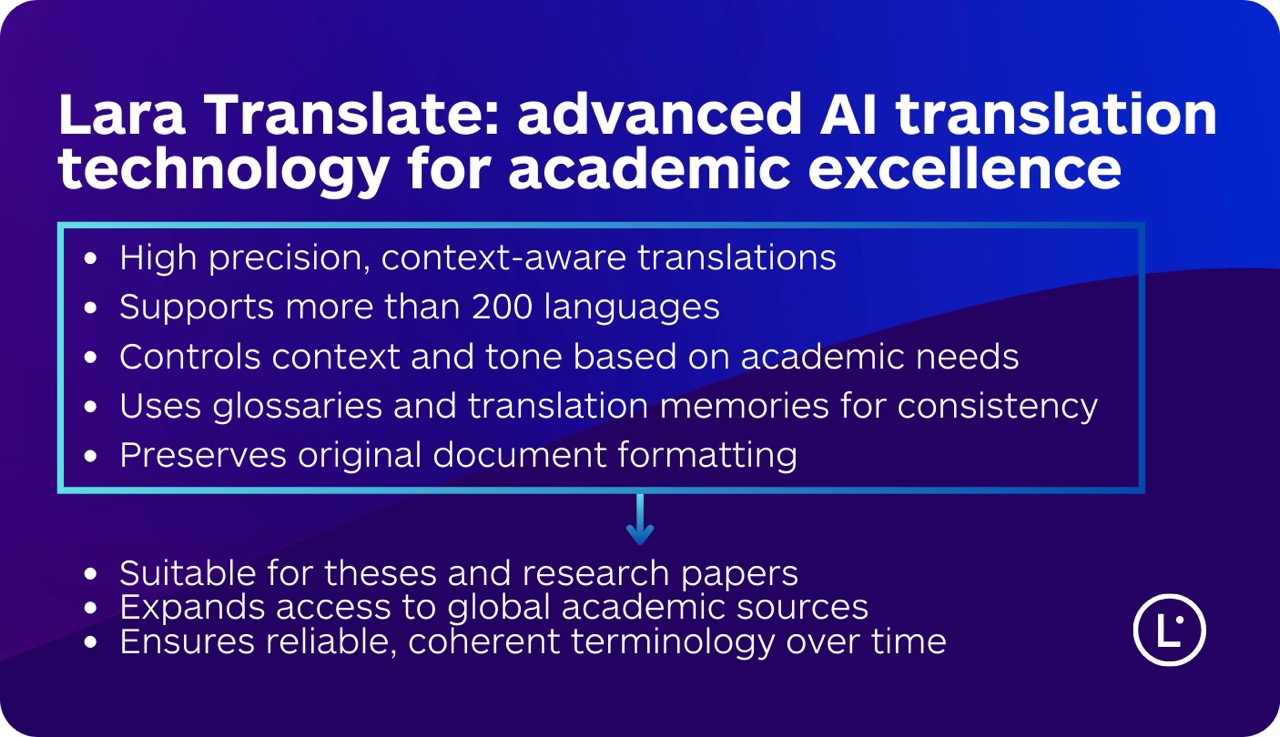
These capabilities make Lara Translate a reliable companion for academic research that requires precision, structure, and transparency.

What are the best practices for using AI translation in academic research?
Students using Lara Translate can apply custom glossaries and translation memories to keep terminology consistent across their thesis, dissertation, or long research project.
1. Prepare before translating
-
Identify which sources matter most.
-
Prioritize peer-reviewed or high-credibility materials.
-
Build terminology lists for critical concepts.
2. Verify translation quality
-
Cross-reference technical terms.
-
Compare unclear sections across different translation tools.
-
Confirm numerical or methodological information manually.
3. Involve human oversight
-
Consult native speakers or language experts for crucial passages.
-
Seek advisor approval when using translated content in major submissions.
4. Document your workflow
-
Save original sources.
-
Track which tools were used for translation.
-
Make documentation available for academic audits if needed.
5. Integrate translation into your research plan
-
Allocate time for verification, revision, and synthesis.
-
Treat translated content as raw material, not as the final academic argument.
Can AI translation handle specialized academic fields like STEM, medical, or legal research?
Yes—but each field requires careful verification due to terminology complexity and contextual nuance.
STEM research
AI translation helps students interpret:
-
formulas
-
specifications
-
technical descriptions
-
scientific methodologies
STEM terminology is highly standardized, making it well suited for AI translation when paired with custom glossaries.
Example (STEM): Translating a German engineering standards document while keeping formulas, units, and diagrams consistent.
Medical and clinical research
Medical terms carry life-or-death precision; mistranslations can distort diagnoses or protocols.
Students should:
-
verify terms with medical dictionaries
-
cross-check pharmacological and anatomical vocabulary
-
consult experts for critical passages
Example (Medical): Reading a French clinical trial summary and verifying medication names using an official pharmacology index.
Legal and policy research
Legal terminology changes by jurisdiction and culture.
Students should focus on:
-
understanding the legal system behind the material
-
verifying meaning with legal scholars or native practitioners
-
documenting interpretation choices
Example (Legal): Translating an Italian constitutional commentary while cross-checking jurisdiction-specific terminology with a legal expert.
Humanities and social sciences
Here nuance matters more than literal meaning.
Students should:
-
check cultural and historical context
-
validate metaphors, idioms, and culturally embedded concepts
-
treat translation as interpretive work, not mechanical transfer
Example (Humanities): Translating a Chinese philosophy paper and analyzing how metaphorical concepts shift across cultural contexts.
Overall: AI translation is powerful, but specialized fields require extra scrutiny.
FAQs
Is AI translation accurate enough for academic research?
Often yes, especially with advanced tools like Lara Translate.
Accuracy depends on the language pair, field, and complexity.
Critical passages must always be verified.
How should students cite materials translated with AI?
Cite the original source, then acknowledge translation support according to institutional guidelines.
Can AI translation handle technical terminology?
Yes—contextual models and custom glossaries help maintain terminology precision, especially in STEM and medical fields.
What are the main limitations of AI translation in academia?
Potential misinterpretations of:
-
cultural nuance
-
metaphors
-
legal or medical subtleties
-
emerging technical terminology
How can students ensure academic integrity when using AI translation?
Be transparent, cite correctly, verify terminology, and demonstrate personal understanding.
This article is about
-
How AI translation for students makes global academic research accessible.
-
How to maintain academic integrity while using translation technology.
-
How tools like Lara Translate support technical precision in academic work.
-
Best practices and workflows for using AI translation responsibly.
-
How AI translation supports study abroad, collaboration, and specialized fields.
Have a valuable tool, resource, or insight that could enhance one of our articles? Submit your suggestion