

How can startups use AI translation to test new markets?
Every startup founder dreams of global reach, but most stumble when it comes to localization. For resource strapped teams, this creates a classic catch 22: you need revenue to justify localization costs, but you need localization to unlock that revenue in the first place.s.
AI translation for startups has fundamentally changed this equation. Modern AI translation tools enable faster testing and validation approaches that can help startups explore international markets without the traditional time and budget investments. This is about creating a framework that helps you validate market demand from the very beginning and iterate based on real user feedback, rather than striving for perfect translations on day one.
TL;DR
|
Why startups need a different approach to AI translation
Enterprise localization strategies often require significant upfront investments that may not suit startup constraints. While established companies can afford comprehensive market research and professional translation teams, startup localization with AI needs a different mindset: speed over perfection, validation over completeness, and agility over comprehensiveness..
The startup advantage lies in your ability to move fast and learn quickly. AI translation for startups is a way to build a fast, lightweight validation framework that reveals which markets truly merit investment, helping teams allocate resources wisely and use human translators where their expertise creates the most value.
Consider a traditional startup localization approach: extensive market research, comprehensive professional translations, and complete localized marketing campaigns before launch. This path can consume significant runway without validated learning about whether customers in those markets actually want your product.
AI translation for startups flips this model. Instead of extensive upfront research, you create rapid market tests. Instead of perfect translations, you launch with “good enough” versions that let real users tell you what matters. Instead of building complete localized experiences, you focus on the minimum viable localization that drives meaningful engagement.
This approach can work well for growing companies that want to test multiple markets simultaneously during their early growth phases, helping identify expansion opportunities based on actual user behavior rather than theoretical market research.
5 phase startup localization validation framework
Phase 1: Market signal detection
Before investing any resources in translation, you need to understand where demand exists. AI translation for startups begins with identifying organic signals that suggest market interest.
Start by analyzing your current user base. Even if your product is only available in English, look for international visitors in your analytics. Check support tickets and social media mentions in other languages. These organic signals often reveal markets you hadn’t considered.
Use free tools to validate basic market size and competition. Google Trends can show you search volume for your key terms in different languages and countries. Social media listening tools can reveal conversations about your problem space in various markets.
The goal here isn’t comprehensive market research—it’s identifying 3-5 markets that show genuine organic interest without any localization effort on your part. These become your first candidates for AI translation for startups validation.
Phase 2: Rapid MVP localization
Once you’ve identified promising markets, the next step is creating minimal viable localizations. This doesn’t mean translating everything—it means translating just enough to validate whether users in that market engage with your core value proposition.
Focus on your highest-impact content first: landing pages, key product features, and signup flows. Skip the lengthy legal pages, detailed help documentation, and secondary features. The goal is to create enough localized experience that users can understand and experience your core value.
AI translation shines here because you can iterate quickly and at low cost.. Start with automated translations for basic content testing, then refine based on user feedback and behavior analytics. This approach lets you test multiple markets simultaneously without breaking your budget.
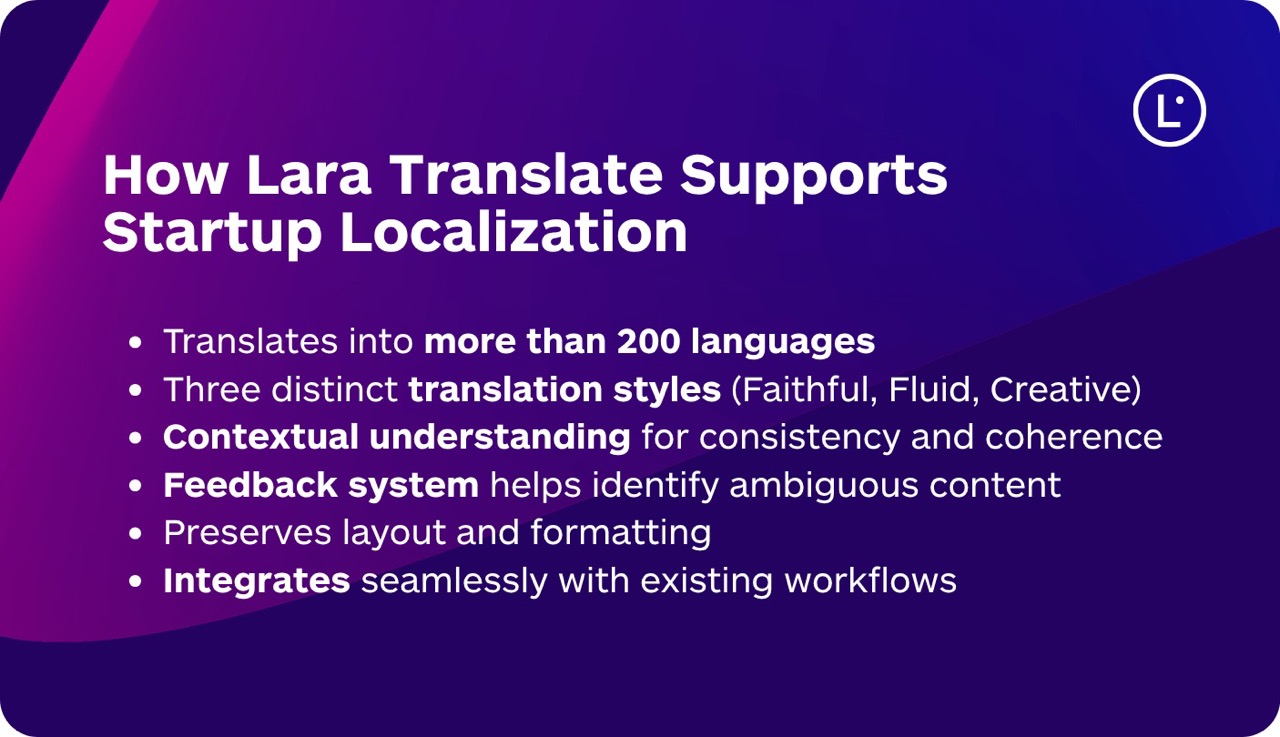
Modern AI translation platforms for startups like Lara Translate address these exact needs. Lara translates into more than 200 languages and offers three distinct translation styles—Faithful for technical content, Fluid for general communications, and Creative for marketing materials—allowing startups to maintain a consistent brand voice across markets while adapting to local preferences.
For resource-constrained startups, Lara’s contextual understanding capabilities prove particularly valuable. The platform analyzes entire documents to ensure consistency and coherence, while its feedback system helps identify ambiguous content that might confuse international users. When startups need to translate documents while preserving layout and formatting, Lara Translate maintains visual integrity—crucial for pitch decks, product specifications, and marketing materials that represent your brand to potential investors or customers in new markets. The platform integrates seamlessly with existing workflows, allowing startup teams to scale their localization efforts without disrupting their development cycles. For the most current list of supported languages, check the documentation.
For startups, this means you can translate pitch decks, landing pages, and product UIs into multiple languages in minutes, keep your layout intact, and still control tone and terminology with styles, glossaries, and translation memories.
Phase 3: User feedback integration
This phase separates successful AI translation for startups initiatives from failed ones. You’re not just measuring conversion rates—you’re actively collecting qualitative feedback about language, cultural fit, and user experience.
Implement feedback mechanisms in the local language (simple micro surveys, a ‘Was this helpful?’ widget, or a feedback link in your emails). Simple surveys, chat widgets, and email follow-ups can provide invaluable insights about translation quality, cultural relevance, and feature priorities. This step can provide crucial context about user behavior that purely quantitative metrics might miss.
Create channels for users to report translation errors or suggest improvements. This crowdsourced approach not only improves your translations but also builds community engagement with users who feel invested in helping you succeed in their market.
The feedback you collect during this phase directly informs your localization market research for future expansion phases. Real user feedback is infinitely more valuable than theoretical market analysis when making resource allocation decisions.
Phase 4: Iterative refinement
Based on user feedback and engagement metrics, you’ll refine your localized experiences. This is where the agile nature of AI translation for startups becomes crucial—you need to iterate quickly based on what you’re learning.
Focus your refinement efforts on the markets showing the strongest signals. Don’t try to perfect translations in markets where you’re seeing low engagement—instead, double down on markets where users are responding positively but providing feedback for improvement.
Implement a systematic approach to translation improvements. Create a feedback loop where user-reported issues are prioritized based on their potential impact on conversion and user experience. This helps you optimize for business outcomes, not just translation accuracy.
Understanding the impact of localization on brand perception becomes critical during this phase. As you refine your translations, pay attention to how changes affect user trust, brand affinity, and overall perception in different markets.
Phase 5: Scale decision framework
The final phase involves making data-driven decisions about which markets deserve additional investment and which should be deprioritized. AI translation for startups provides the data foundation for these crucial scaling decisions.
Develop clear criteria for market progression. This might include metrics like user engagement rates, conversion rates, customer acquisition costs, and lifetime value in different markets. The goal is to identify markets where initial validation suggests strong potential for sustainable growth.
Create a tiered approach to market investment. Markets showing strong validation signals get professional translation review, localized customer support, and market-specific feature development. Markets showing moderate interest continue with AI translation for startups approaches while you collect more data. Markets showing poor engagement are deprioritized or abandoned.
This framework helps you avoid the common startup trap of spreading resources too thin across too many markets. Instead, you’re using AI translation for startups as a systematic validation tool that guides strategic resource allocation decisions.
Technical implementation: building your AI translation stack
Choosing the right AI translation platform
Lara Translate supports around 200 languages, handles 55 different file formats, lets teams use glossaries and translation memories, and explains its choices while flagging ambiguous terms.
Not all AI translation for startups solutions are created equal. Your platform choice significantly impacts both your short-term validation ability and long-term scaling potential.
Look for platforms that offer API access for seamless integration with your existing product stack. The ability to programmatically handle translations means you can automate much of the localization process and integrate translation workflows directly into your development and deployment cycles.
Consider platforms that provide context-aware translation capabilities. AI translation for startups can be more effective when the technology can understand business context behind your content, not just linguistic translation. This becomes especially important for product messaging, feature descriptions, and marketing copy where context significantly affects meaning.
Lara Translate exemplifies the kind of platform that works well for startup needs. Beyond its ability to translate in more than 200 languages, it offers contextual control and style adaptation features that let startups maintain consistency as they scale.
The platform’s feedback system helps identify potential ambiguities before they affect user experience, while its document translation capabilities preserve layouts—essential for maintaining professional presentation across markets. Built on over a decade of translation research and trained on real professional translations, Lara Translate provides the reliability that startups need when representing their brand internationally.
Integration strategies
Your AI translation for startups implementation should integrate seamlessly with your existing development workflow. Avoid solutions that require massive changes to your codebase or deployment processes—you need something that enhances your current capabilities without creating technical debt.
Implement translation as a layer in your application architecture, not as a bolt-on feature. This approach helps ensure that as you scale, translation capabilities can grow naturally with your product rather than becoming an increasingly complex maintenance burden.
Consider how translation fits into your content management workflow. The best AI translation for startups implementations include content creators in the translation process, allowing them to provide context and review translations before they go live. This human-in-the-loop approach significantly improves translation quality while maintaining the speed advantages of AI.
Quality assurance automation
Build automated quality checks into your AI translation for startups workflow. This includes basic checks like character encoding, text length validation, and placeholder preservation, as well as more sophisticated checks for tone consistency and brand voice alignment.
Create a feedback loop between user reports and translation quality improvements. When users report translation issues, those reports should automatically feed back into your quality assurance process to prevent similar issues in future translations.
Implement basic A/B tests for critical translations, especially headlines, call to action buttons, and onboarding flows. For high-impact content like landing pages and call-to-action buttons, test multiple translation variations to optimize for conversion rather than just linguistic accuracy. This data-driven approach to translation optimization aligns perfectly with startup culture and methodology.
Measuring success: localization KPIs for startups
Validation metrics
Traditional localization metrics often focus on translation quality and linguistic accuracy. AI translation for startups requires a different set of metrics focused on business validation and growth potential.
Track user engagement metrics by language and market. Look at time on site, pages per session, and feature adoption rates across different localized versions. These metrics tell you whether users are actually finding value in your localized experiences, not just whether they can understand them.
Monitor conversion rates through your entire funnel by market. Focusing only on top-of-funnel metrics like traffic and signups can miss crucial insights about how localization affects user activation, retention, and revenue generation.
Measure user feedback quality and volume. Markets where users provide constructive feedback about translations, features, and user experience can be valuable indicators for assessing market engagement. This qualitative data can provide insights into long-term market viability.
Growth indicators
Identify leading indicators of organic growth in different markets. This might include social media sharing, word-of-mouth referrals, and organic search traffic growth. AI translation for startups that successfully tap into market demand may see these organic signals as early indicators of market potential.
Track customer acquisition costs and lifetime value by market. Even if initial conversion rates are lower in some localized markets, the long-term economics might be more favorable due to lower competition or higher customer loyalty.
Monitor competitive positioning in each market. AI translation for startups can help identify opportunities in markets where global competitors may not have invested heavily in localization, potentially providing first-mover advantages.
Resource optimization metrics
Measure the efficiency of your localization efforts. Track metrics like translation cost per user acquired, time from market identification to launch, and resource requirements for market maintenance. AI translation for startups implementations can improve efficiency as you refine your processes.
Monitor the correlation between translation investment and business outcomes. This helps you optimize your resource allocation between AI translation, professional translation review, and market-specific feature development.

Track technical debt related to localization. As you scale across markets, ensure that your AI translation for startups implementation isn’t creating maintenance overhead that slows down product development or increases technical complexity.
Implementing effective multilingual SEO strategies becomes crucial for measuring organic growth success in different markets. The right SEO approach can amplify the impact of your translation efforts by ensuring localized content ranks well in target markets.
Common pitfalls with AI translation for startups
Over-investing too early
A common challenge with AI translation for startups is treating it like traditional localization and over-investing before validation. It’s important to resist the urge to perfect translations or build comprehensive localized experiences until you’ve validated genuine market demand.
Start with minimal viable localizations and scale based on user response. Some successful startups have discovered their best markets were ones they initially considered secondary, while markets they expected to perform well showed poor engagement despite significant investment.
Ignoring cultural context
AI translation for startups can be more effective when combined with basic cultural awareness. While you don’t need deep cultural expertise upfront, completely ignoring cultural context can lead to translations that are linguistically correct but culturally inappropriate.
Invest time in understanding basic cultural norms around communication style, business practices, and consumer behavior in your target markets. This knowledge helps you interpret user feedback and engagement metrics more accurately.
Scaling too broadly
The temptation with AI translation for startups is to test every possible market because the marginal cost seems low. However, each additional market requires attention, customer support resources, and ongoing maintenance. Scale thoughtfully rather than broadly.
Focus on markets where you can provide ongoing value and support. It’s generally better to succeed in three markets than to provide poor experiences in ten. Quality of localized experience can be more important than quantity of markets served.
Getting started: your first 30 days
Week 1: market signal analysis
Begin your AI translation for startups journey by analyzing existing data for international interest signals. Review analytics for international traffic, support requests in other languages, and social media mentions from non-English speaking users.
Create a simple scoring system for market attractiveness based on organic signals, market size, and strategic fit with your product. This doesn’t need to be sophisticated—you’re looking for obvious opportunities, not comprehensive market analysis.
Set up basic tracking to monitor international user behavior. This includes language preference detection, geographic conversion rate analysis, and feature usage patterns by country.
Week 2: technical foundation
Choose your AI translation for startups platform, like Lara Translate, and set up basic integration. Start with simple text translation for key landing pages and user interface elements.
Implement feedback mechanisms that allow users to report translation issues or provide suggestions. This creates the foundation for continuous improvement and user engagement.
Create a content prioritization framework that identifies which text elements have the highest impact on user experience and business outcomes. Focus your translation efforts on these high-impact elements first.
Week 3: initial market tests
Launch basic localized experiences in your top 2-3 target markets. Keep scope minimal—focus on core user journeys and essential product information.
Begin collecting user feedback through surveys, support channels, and direct outreach. The goal is understanding user response to both translation quality and overall product-market fit in different markets.
Monitor engagement metrics and user behavior in localized markets compared to your English baseline. Look for patterns that suggest stronger or weaker market potential.
Week 4: iteration and refinement
Analyze results from your initial market tests and identify clear winners and losers. Double down on markets showing strong engagement signals and pause investment in markets showing poor response.
Refine translations based on user feedback and behavioral data. Focus improvements on elements that directly impact conversion and user activation rather than trying to perfect every translation.
Plan your next month’s testing based on what you’ve learned. This might include testing additional markets, expanding localization in successful markets, or pivoting to different approaches based on user feedback.
FAQs: AI translation for startups
How much should a startup budget for AI translation initiatives?
Start with a modest monthly budget for testing a few key markets using AI translation for startups platforms. Focus on covering basic translation costs and feedback collection tools. Scale investment based on validated market response rather than market size assumptions, allowing successful markets to guide your resource allocation.
Can AI translation replace professional translators entirely for startups?
Not for final production content, but AI translation for startups is excellent for market validation and initial user testing. Use AI for rapid validation, then invest in professional review for markets showing strong potential. The goal is speed-to-insight, not perfect translations.
How quickly can a startup see results from AI translation efforts?
Startups can typically see initial validation signals within a few weeks of implementing AI translation for startups testing. Market preferences and user engagement patterns can emerge relatively quickly, providing data for informed resource allocation decisions. Results will vary based on market conditions and implementation approach.
Which markets should startups prioritize when testing with AI translation?
Focus on markets showing organic interest signals in your analytics, rather than theoretical market size. AI translation for startups can be particularly effective when testing markets where users are already trying to engage with your English content, indicating genuine demand.
How does AI translation integrate with existing product development workflows?
The best AI translation for startups implementations integrate through APIs and automated workflows that don’t require significant changes to existing development processes. Look for solutions that enhance your existing capabilities rather than requiring separate content management systems, with platforms like Lara Translate designed exactly for this purpose.
This article is about:
- AI translation for startups validation frameworks and implementation strategies
- Building cost-effective localization processes for resource-constrained teams
- Market validation techniques using automated translation technologies
- Measuring localization success through startup-focused KPIs
- Avoiding common pitfalls in early-stage international expansion

Have a valuable tool, resource, or insight that could enhance one of our articles? Submit your suggestion
Useful articles
- Top 100+ AI Tools to Boost Productivity
- 9 Powerful Translation Memories Best Practices: The Final Guide
Why it matters
For most startups, the real risk is not “bad translation,” but spending precious runway localizing the wrong markets. A lean AI translation framework lets you validate demand in multiple countries without committing full localization budgets from day one. With the right stack, tools like Lara Translate turn translation into a fast learning loop, so you can focus human effort and budget only where the data proves there is real opportunity.