

Cross-functional business teams now work across borders, time zones, and languages every day. Legal documents need rapid review by international partners, marketing campaigns must be adapted for multiple markets, and technical documentation must support global development teams. In this context, traditional translation workflows quickly turn into bottlenecks that slow decisions, launches, and collaboration.
AI translation for business teams can remove much of this friction, helping organizations keep their pace while they expand internationally. The real question is not whether to use AI translation, but how to implement AI translation for business teams in a way that respects each department’s requirements for accuracy, tone, and confidentiality instead of forcing everyone into a generic, one-size-fits-all tool.
Why it matters: if you simply plug in generic MT everywhere, you risk legal misunderstandings, off-brand marketing, and confusing technical docs. If you design AI translation workflows around legal, marketing, and engineering needs, you can speed up reviews, campaigns, and releases without lowering quality or professional standards.
TL;DR
|
Why do traditional translation workflows slow business teams?
Modern business teams work in environments where speed and accuracy are both non-negotiable. Legal teams face tight deadlines for contract reviews and regulatory compliance. Marketing teams need to launch coordinated campaigns across several markets at the same time. Engineering teams rely on immediate access to technical specifications and documentation updates from global colleagues.

Slow, project-based processes
Traditional translation workflows usually depend on manual requests, purchase orders, and project management steps. Turnaround times are often measured in days or weeks, which clashes with time-sensitive opportunities, urgent legal reviews, and synchronized product releases. By the time the translation comes back, the window to act may already be closing.
Confidentiality and risk management
Different teams also handle different types of sensitive information. Legal documents include client data and strategic clauses. Marketing content anticipates product launches and pricing strategies. Technical documentation exposes proprietary algorithms and implementation details. Routing all of this through slow, external workflows increases operational risk and makes it harder to control who sees what, and when.
Where AI translation for business teams fits in
AI translation for business teams can remove much of this delay by providing instant, in-workflow translations that still respect quality and security standards. The key is to implement AI in a way that matches each function’s needs, instead of forcing every document through the same generic, one-size-fits-all process.
How can legal teams use AI translation safely and accurately?
Why legal translation is so sensitive
 Legal teams have some of the strictest requirements for accuracy and confidentiality. Contract language, regulatory compliance documents, and intellectual property filings must be precise because even small errors can trigger financial losses, regulatory issues, or disputes.
Terms like “consideration,” “warranty,” and “indemnification” are not just generic words; they are legal concepts that can change meaning from one jurisdiction to another. AI translation for legal teams has to respect these definitions and keep them consistent across clauses, annexes, and related documents.
Where AI translation adds value for legal teams
As businesses expand internationally, the volume of legal content explodes: M&A deals involve thousands of contracts, international partnerships add due diligence and compliance packs, and patents require multi-jurisdictional filings. AI translation can help by:
- Producing fast first drafts for standard clauses and boilerplate sections.
- Keeping recurring terms and definitions consistent across large document sets.
- Reducing manual copy-paste work for multilingual reviews and negotiations.
Well-implemented systems can identify critical legal terms and apply consistent translations, reducing the risk of contradictory interpretations that could create legal vulnerabilities.
| Use AI translation for | Keep human review for |
|---|---|
| Standard NDAs and template clauses | Bespoke contracts and heavily negotiated terms |
| Low-risk internal memos and summaries | Regulatory filings and compliance submissions |
| High-volume due diligence documents for initial review | IP filings, licensing agreements, and jurisdiction-specific clauses |
Keeping humans in the loop for high-stakes content
AI translation works best for legal teams when it is part of a controlled workflow, not a replacement for lawyers. Complex regulatory requirements, local case law, and jurisdiction-specific nuances still require review by legal professionals familiar with the target legal system.
- Use AI to speed up first drafts and standard language.
- Require expert legal review for any document that will be signed, filed, or presented to regulators.
- Document which content types can be auto-translated and which must always go through human approval.
This hybrid model lets legal teams benefit from AI efficiency while keeping final responsibility and judgment firmly in human hands for high-stakes legal content.
How should marketing teams use AI translation without losing brand voice?
What marketing teams need from AI translation
 AI translation for marketing content has to do more than convert words. It needs to preserve brand voice, cultural relevance, and emotional impact across languages and markets. Ads, landing pages, and social posts rely on rhythm, wordplay, and references that don’t always survive a literal translation.
This means your AI setup should support:
- Clear tone-of-voice rules (formal, playful, expert, etc.).
- Brand terminology lists for products, features, and taglines.
- Room for adaptation, not only one-to-one translation.
Balancing speed with creative quality
Modern campaigns move quickly: product launches, seasonal offers, and reactive content often need same-day adaptation across multiple markets. Traditional translation workflows are too slow for this pace, especially when you need frequent updates, A/B tests, or localized social media replies.
AI translation helps by:
- Producing fast drafts for headlines, descriptions, and captions.
- Generating multiple localized variants for A/B testing.
- Supporting always-on channels like social, CRM, and support content.
Keeping brand voice consistent across markets
Brand teams need to know that voice, terminology, and key messages stay consistent while still adapting to local culture. This calls for comprehensive approaches to reaching global audiences with translated content
that maintain brand integrity across markets instead of creating fragmented, “almost on-brand” variations.
- Document tone-of-voice and do/don’t examples for each language.
- Define fixed phrases (taglines, product names) that must not be changed.
- Set review rules for hero assets like homepages, TV spots, and major campaigns.
| Use AI translation for | Keep human review for |
|---|---|
| Drafts of ads, emails, and social captions | Global brand campaigns and hero creatives |
| Long-tail content (blog posts, FAQs, support docs) | Taglines, slogans, and high-impact headlines |
| Local variants for A/B testing and experiments | Content on homepages, pricing pages, and key funnels |
Scaling volume without losing the human touch
The volume and variety of marketing content keep growing: websites, email journeys, paid ads, social posts, video scripts, and interactive experiences all need localization. AI translation lets marketing teams scale this work without multiplying budgets linearly.
- Let AI handle volume and generate on-brand drafts at speed.
- Reserve human copywriters and reviewers for high-visibility and nuanced content.
- Continuously refine guidelines and examples as you learn what resonates in each market.
With this setup, AI does the heavy lifting, and your marketers focus on what they do best: shaping messages that feel local, human, and true to your brand in every language.
How can AI translation keep technical documentation accurate and up to date?
What technical teams need from AI translation
 Engineering and technical teams rely on documentation where precision directly affects product behavior and sometimes user safety.
API references, software docs, and engineering manuals must be correct in every language, not just “good enough.”
AI translation for technical documents has to:
- Respect domain-specific terminology (APIs, parameters, error codes, parts).
- Keep variable names, code snippets, and UI labels intact where needed.
- Avoid introducing ambiguity that could change how someone implements or configures a system.
Dealing with frequent releases and constant updates
Technical content changes with every release: new features, deprecations, configuration options, and troubleshooting steps. Traditional translation workflows struggle with this pace because they treat docs as “projects” instead of a continuous stream of updates.
AI translation helps by:
- Translating incremental changes (diffs, new sections) instead of whole manuals.
- Updating localized docs in parallel with mainline development.
- Reducing the lag between code changes and updated documentation in all languages.
Version control, consistency, and technical accuracy
Version control and consistency are critical when you ship in multiple languages. Teams need to know that all localized docs match the current version of the product and that terminology is stable across releases and repositories.
Understanding how to use AI translation effectively for technical content helps you build workflows where:
- Terminology is defined once and reused across APIs, UIs, and manuals.
- Docs tie into your codebase or design system, so labels and messages stay aligned.
- Critical changes (security, compliance, safety) are flagged for extra review.
| Use AI translation for | Keep human review for |
|---|---|
| API docs, SDK guides, and changelog entries | Safety-critical procedures and compliance documentation |
| Developer tutorials and how-to articles | Release notes for major launches and breaking changes |
| Internal troubleshooting guides and runbooks | External manuals that affect legal liability or warranty |
Supporting global teams without slowing them down
Distributed engineering teams need real-time access to accurate information in their own language. AI translation for technical documents lets them read specs, configuration steps, and troubleshooting flows without waiting for a formal translation round.
Modern systems are designed to keep the precision and consistency that technical content requires, while supporting fast updates. They can preserve code blocks, technical diagrams, and
procedural accuracy
as they adapt content to local technical writing norms and language conventions.
How does Lara Translate support legal, marketing, and engineering teams?
Lara Translate gives legal, marketing, and engineering teams one AI translation platform that respects their different needs: precise modes for contracts and technical docs, more fluid and creative modes for business and marketing content, support for 200+ languages, context-aware translations, and integrations with the tools they already use.
One platform for cross-functional business teams
Lara Translate is built to serve multiple departments at once, instead of forcing everyone into a generic, one-size-fits-all tool. Teams can work through a simple web interface for ad hoc documents, or through APIs and SDKs for automated workflows.
The platform supports more than 200 languages, so legal, marketing, and engineering teams can work with partners, customers, and colleagues in most major markets without rebuilding separate translation setups for each region.
- Legal teams: translate contracts, addenda, and compliance docs while keeping structure and terminology intact.
- Marketing teams: adapt campaigns, landing pages, and emails for multiple markets in parallel.
- Engineering teams: keep technical documentation, API references, and changelogs aligned across languages.

Try Lara Translate in your own team
Test Lara Translate on a real case text and see how it handles your terminology, context, and formatting.
Translation styles for different types of content
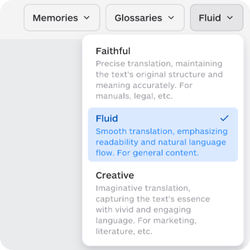 Lara Translate’s quality approach is built around three translation styles that map directly to common business use cases:
- Faithful: maximizes accuracy and preserves structure, ideal for legal documents, technical specs, and compliance content.
- Fluid: produces clear, natural-sounding text for internal communication, support content, and general business documents.
- Creative: adapts tone and phrasing so marketing copy, brand messages, and campaigns feel native in each market while keeping core brand identity.
This lets each team choose the most suitable behavior for each document instead of compromising between “too literal” and “too loose.”
Contextual analysis for consistent communication
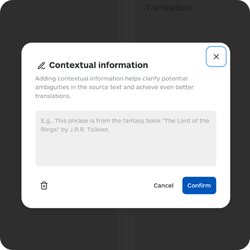 Lara Translate includes contextual analysis, so translations are not generated in isolation. The system can consider whole documents or sets of related files, which helps maintain consistent terminology and tone across contracts, product pages, and technical docs.
- Legal: the same defined terms and clauses are rendered consistently across annexes and related agreements.
- Marketing: product names, slogans, and key messages stay aligned across channels and campaigns.
- Engineering: the same parameter, feature, or component is described consistently throughout documentation.
| Team | Typical content | Recommended style |
|---|---|---|
| Legal | Contracts, policies, compliance documents, NDAs | Faithful |
| Marketing | Campaign copy, landing pages, emails, social content | Creative (for campaigns), Fluid (for informational content) |
| Engineering | Technical documentation, API references, release notes | Faithful or Fluid, depending on audience |
Integrations and workflows for real-world use
Lara Translate fits into existing tech stacks, so teams do not have to rebuild their workflows from scratch. Development teams can use SDKs for Python, Node.js, Java, PHP, and Go to embed translation into their applications, pipelines, and documentation systems. Non-technical teams can work directly in the web interface or through connectors as they become available.
- Legal teams: speed up contract review and compliance checks while keeping control over sensitive documents.
- Marketing teams: ship multilingual campaigns and pages faster, with styles tuned to each type of asset.
- Engineering teams: keep technical docs and product content aligned with every release in all supported languages.
Together, these capabilities let cross-functional teams share one translation platform while still meeting their own standards for accuracy, tone, and security.
Discover Lara’s integrations
Use Lara Translate in your usual workflow thanks to Lara’s existing integrations and plugins.
How do you implement AI translation across legal, marketing, and engineering?
Start from each team’s workflows and risks
Successful implementation begins with understanding what each department does, what is at stake, and where delays or errors hurt most. Legal, marketing, and engineering all use language differently, and their quality and risk thresholds are not the same.
- Legal: high risk, low tolerance for ambiguity, strong security requirements.
- Marketing: high visibility, strong need for brand consistency and cultural fit.
- Engineering: high complexity, need for technical accuracy, and version alignment.

Implementation checklist for legal teams
Legal teams usually need the strictest controls. Implementation should focus on accuracy, confidentiality, and auditability, plus workflows where lawyers stay in control of final decisions.
- Choose a platform with strong encryption, access controls, and clear data-handling policies.
- Integrate with document management or contract lifecycle tools where possible.
- Define which document types can be machine-translated and which always need full human review.
- Use AI to draft or pre-translate standard clauses and low-risk documents, then have lawyers refine them.
- Document how AI tools can empower rather than replace human translators, so legal teams see AI as support for their work, not a threat to quality or control.
Implementation checklist for marketing teams
Marketing implementations should emphasize creativity, brand consistency, and measurable impact across markets. AI needs guidance to stay on-brand while adapting to local culture.
- Set up tone-of-voice guidelines and term lists per language and market.
- Use creative modes for campaigns and more neutral modes for informational content.
- Define which assets can be published after light review and which require full copy review.
- Align AI translation with your multilingual SEO strategies, so localized pages rank and convert, not just “exist” in multiple languages.
Implementation checklist for engineering teams
Engineering teams need AI translation that respects technical detail and slots into existing development and documentation tools.
- Prioritize platforms with robust APIs and support for your documentation formats and tooling.
- Connect AI translation to your docs platform, version control, or CI/CD so updates flow automatically.
- Protect code snippets, identifiers, and UI strings that must not be translated.
- Adopt AI document translation approaches that handle large volumes and frequent updates without breaking structure or layout.
| Team | Top priorities | Key safeguards |
|---|---|---|
| Legal | Accuracy, confidentiality, and clause consistency | Secure platform, clear review rules, audit trail |
| Marketing | Brand voice, cultural fit, speed to market | Style guides, terminology lists, and review for hero assets |
| Engineering | Technical accuracy, version alignment, automation | APIs, doc integrations, rules for non-translatable elements |
Cross-functional standards, change management, and training
To avoid each department building its own translation “island,” you need shared standards and a bit of change management. This makes AI translation predictable and trustworthy across the company.
- Create shared glossaries, style guides, and quality levels that apply across legal, marketing, and engineering.
- Define when AI-only is acceptable, when light review is enough, and when full expert review is mandatory.
- Run training sessions so teams understand what AI translation can and cannot do, and how to give it better input.
- Collect feedback from users and adjust rules, instructions, and integrations over time.
With this approach, AI translation becomes a common layer that supports legal, marketing, and engineering, rather than three separate experiments that drift apart over time.
How can business teams scale AI translation workflows?
Automate workflows by content type
As international activity grows, the main challenge is volume: more contracts, more campaigns, more technical docs. Doing everything manually (emailing files, copy-paste, ad hoc requests) does not scale.
- Set up rules that route legal, marketing, and technical content into different AI translation flows.
- Apply appropriate styles, glossaries, and instructions automatically per content type.
- Trigger translation when events happen (e.g., contract created, campaign approved, release shipped).
Integrate AI translation into existing systems
Scaling is much easier when teams never have to leave the tools they use every day. Instead of adding a new “translation portal,” connect AI translation to existing platforms:
- Legal: contract lifecycle tools, DMS, e-signature workflows.
- Marketing: CMS, marketing automation, campaign managers, social tools.
- Engineering: docs platforms, issue trackers, CI/CD pipelines, code or content repos.
When translation is part of these systems, it becomes a natural step in each process rather than an extra project to manage.
Use tiered quality levels instead of “one-size-fits-all.”
Not all content needs the same level of review. To scale, define clear QA tiers and apply them consistently:
| Content type | Owner | Suggested QA level |
|---|---|---|
| Critical contracts, regulatory filings | Legal | AI + full legal review |
| Hero campaigns, homepages, key funnels | Marketing | AI + expert copy review |
| Internal docs, FAQs, long-tail pages | Mixed | AI + spot checks |
| Internal troubleshooting guides, release notes drafts | Engineering | AI-only (with escalation path if issues are found) |
Monitor performance and improve over time
Once workflows are running, scaling means learning from real usage rather than setting everything in stone. Teams should monitor:
- Translation quality (error types, corrections, user feedback).
- Turnaround times and bottlenecks by content type and team.
- Cost per word or per project compared to previous setups.
- Adoption and satisfaction among legal, marketing, and engineering users.
Use these insights to adjust instructions, QA tiers, and integrations. Over time, this turns AI translation into a reliable, scalable layer of your global operations instead of a patchwork of ad hoc tools and processes.
What’s next for AI translation in business teams?
Deeper integrations across the business stack
AI translation is becoming a built-in layer of everyday tools rather than a separate destination. Expect tighter connections with:
- CRM systems: multilingual sales, support, and customer success workflows.
- Project and work management: global projects where docs, tasks, and comments can be read in any language.
- Collaboration tools: chat, tickets, and knowledge bases translated on the fly with context.
For cross-functional teams, this means less friction: they stay in their usual tools while translation happens in the background.

Stronger compliance and governance expectations
Regulations around data privacy, security, and industry-specific rules are tightening. Translation platforms will need to show:
- Clear data residency and retention policies.
- Granular access controls and audit logs.
- Options to separate highly sensitive content from general workloads.
Business teams should choose solutions that can adapt to new compliance requirements without requiring a full migration every few years.
More specialized and role-aware translation
AI translation quality will keep improving, but the biggest gains for business teams will come from specialization:
- Legal-flavored output for contracts and compliance.
- Marketing-aware output for brand voice and persuasion.
- Technical-aware output that respects code, schemas, and specs.
This allows one platform to serve multiple departments while still speaking their language.
Planning for cost, scale, and long-term value
As usage grows, translation spend will shift from “nice-to-have” to a strategic line item. Teams will need to:
- Forecast costs based on content volume, markets, and quality tiers.
- Measure savings versus traditional translation and internal manual work.
- Decide when to add languages, integrations, or higher quality levels.
Treating AI translation as part of core infrastructure – with clear ownership, metrics, and roadmap – helps business teams stay ahead of both growth and complexity, instead of constantly playing catch-up.
Thank you for reading 💜
As a thank you, here’s a special coupon just for you:
IREADLARA25.
Redeem it and get 10% off Lara PRO for 6 months.
If you already have a Lara account, log in here to apply your coupon.
If you are new to Lara Translate, sign up here and activate your discount.
FAQs
How can legal teams ensure AI translation maintains the accuracy required for contracts and compliance documents?
Use AI translation for drafts and routine legal documents, then require human legal review for anything that will be signed or filed. Choose an enterprise-grade platform with strong security and consistent handling of legal terminology, so lawyers can validate key clauses instead of manually translating everything.
What should marketing teams consider when using AI translation for marketing content to maintain brand voice?
Start with clear brand guidelines, tone-of-voice rules, and terminology lists for each market, then use AI translation to generate fast, on-brand drafts. Modes like Lara Translate’s Creative style work well for campaigns and hero assets, with human copywriters refining final versions for high-visibility content.
How can engineering teams maintain technical accuracy when implementing AI translation for technical documents?
Pick an AI translation solution that respects technical terminology, preserves code examples, and supports your documentation formats and version control. Engineering teams can use precise modes like Lara Translate’s Faithful style and its SDKs (Python, NodeJS, Java, PHP, Go) to plug translation into dev and docs workflows, keeping safety-critical content under human review.
Which security measures should business teams prioritize when implementing AI translation for business teams?
Look for strong encryption, secure API access, clear data residency and retention policies, and detailed audit logs. Legal, marketing, and engineering teams should all be confident that confidential contracts, campaign plans, and proprietary technical information are protected and not reused to train generic models.
How can different business departments coordinate their AI translation efforts effectively?
Create shared glossaries, style guides, and quality levels that apply across legal, marketing, and engineering, then apply them through a common AI translation platform. Features like Lara Translate’s contextual analysis help keep terminology and tone consistent across document sets, so international partners and customers receive clear, coherent communication from every team.
This Article is About
-
How to implement AI translation for business teams across legal, marketing, and engineering without lowering quality, security, or brand standards.
-
How legal teams can use AI translation safely for contracts, compliance documents, and IP while keeping lawyers in control of high-stakes decisions.
-
How marketing teams can scale multilingual campaigns with AI translation while protecting brand voice, cultural fit, and multilingual SEO performance.
-
How engineering teams can keep technical documentation accurate, consistent, and up to date in multiple languages across fast release cycles.
-
How to choose and roll out a platform like Lara Translate – using translation styles, context, integrations, and shared glossaries – to build scalable, cross-functional AI translation workflows.
Have a valuable tool, resource, or insight that could enhance one of our articles?
Submit your suggestion
We’ll be happy to review it and consider it for inclusion to enrich our content for our readers! ✍️