

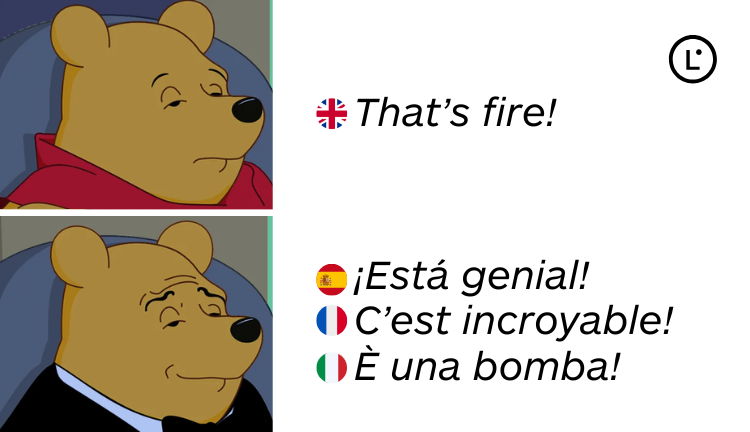
Slang moves fast. One week it is “that’s fire”, the next it is something else. If your brand translates informal language literally, you can end up sounding awkward, rude, or out of touch in minutes.
This guide explains how AI slang translation works across social media translation, chat translation, and other informal channels. You will learn what makes slang hard, when AI performs well, where it fails, and how to get translations that preserve intent and tone.
Short answer
AI can translate slang well when it understands intent (hype, irony, reassurance), audience (region, age, community), and channel (TikTok caption vs support chat). If you do not provide that context, many systems default to literal wording that misses tone. For public posts, ads, and moderation, add context and use human review for high-risk content.
TL;DR
|
Why is slang and informal language harder to translate?
Slang is harder than formal text because it changes quickly, varies by region, and often means something different from the literal words. The same phrase can signal hype, sarcasm, teasing, reassurance, or disrespect depending on who says it and where it appears.
Many translation systems were historically trained on more structured writing, so they are less reliable on fast, messy inputs like chat messages, memes, and short social captions. Without context, they often choose safer but unnatural wording that loses the original vibe.
Informal communication also shifts register inside the same thread. People mix formal and casual tone, switch languages mid-sentence, use abbreviations, and rely on shared references that are not spelled out.
Slang signals and what to do
Use this as a quick decision aid for informal language translation.
How do translation systems handle conversational and chat translation?
 Good chat translation treats a conversation as a connected thread, not isolated sentences. Informal chat includes abbreviations, incomplete grammar, and references to earlier messages, so systems perform better when they can track topic continuity and resolve pronouns and implied meaning.
Messaging also forces speed. Users expect near-instant output, which increases the chance of mistakes when a phrase is ambiguous. That is why context and clear intent become the most valuable inputs you can provide.
Code-switching is common in international communities. A robust system should detect language shifts inside a message and translate only what needs translation, without flattening the original voice.
What makes social media translation uniquely difficult?
In social media translation, creators compress meaning into short text, emojis, hashtags, and platform-native phrasing. Slang often depends on the post format and the community norms of that platform.
Character limits matter. Translations often get longer, so systems have to preserve meaning while staying compact. If you are translating captions or replies, it can be better to choose a shorter equivalent rather than a literal but wordy translation.
Hashtags are both language and distribution. Translating them literally can reduce relevance, so many teams keep branded hashtags unchanged and adapt only descriptive tags when there is a clear local equivalent.
How does AI translate colloquial expressions?
 Colloquialisms and idioms rarely mean what their words say. Phrases like “spill the tea” or “hit different” require intent detection and cultural mapping. Strong systems look beyond single words and infer meaning from the surrounding text and the expected tone.
This works best for established expressions and common colloquial translation patterns. It is less reliable for brand-new slang, inside jokes, or hyper-local usage. When the stakes are high, ask for multiple options and run a quick native review.
How do tone-aware systems preserve the original vibe?
Tone-aware translation aims to preserve the social intent of a message: friendly, playful, supportive, direct, or strict. In informal language, tone is often the point. That is why the “best” translation is frequently the most natural one, not the closest literal one.
Cultural norms differ. What feels warm in one language can feel too intense or too familiar in another. The safest approach is to specify the target audience and choose a register that matches the brand voice for that market.
How can businesses translate slang safely and still sound native?
If you translate informal content for a brand, your goal is not maximum literal accuracy. Your goal is message intent, tone, and trust. Use this mini checklist before you hit publish.
- Set the channel: TikTok caption, Instagram comment, WhatsApp support, Discord moderation, or in-app chat.
- Set the audience: country and region, community type, and expected register.
- Set the intent: hype, apology, reassurance, teasing, warning, strict moderation, or customer care.
- Mark what must not change: product names, brand hashtags, legal phrases, or community rules.
- Ask for 2–3 options: one neutral, one more slangy, one more brand-safe.
- Review high-risk content: sarcasm, sensitive topics, cultural references, or anything that could be screenshotted.
Social post checklist
- Do: Keep it short, choose natural equivalents, preserve the vibe.
- Do: Keep branded hashtags, adapt descriptive tags only when useful.
- Avoid: Niche slang if you are not sure it exists in the target market.
Ad copy checklist
- Do: Prefer clarity over “cool”. Brand trust beats trend slang.
- Do: Ask for a brand-safe option that keeps the same emotional pull.
- Avoid: Sarcasm unless the market fit is proven and reviewed.
Support reply checklist
- Do: Use a friendly-professional tone. Mirror the user lightly; do not overdo slang.
- Do: Keep key info explicit. Informal messages still need clear steps.
- Avoid: Ambiguous slang that could be read as dismissive.
Community moderation checklist
- Do: Be direct and consistent. Use the same terms for rules every time.
- Do: Specify what behavior is not allowed, and what happens next.
- Avoid: Humor in warnings. It can land as disrespect across cultures.
What role do professional translators play for informal content?
Professional translators add cultural judgment that is hard to automate. They can spot when a slang phrase will sound unnatural, too intense, or socially misaligned, and they can propose equivalents that keep the same intent for the target audience.
They are especially valuable for public-facing content such as campaigns, brand community posts, and moderation policies, where tone mistakes can affect trust. For fast workflows, many teams use AI first, then human review for high-risk items.
What should businesses look for in AI tools for slang translation?
Look for tools that handle context well, support consistent terminology, and allow a workflow that matches your volume and risk level. For informal content, the best tool is usually the one that lets you define audience and tone, not the one that only promises generic accuracy.
If you translate at scale, prioritize integrations and quality control so informal language translation fits into your existing content and support workflows without extra manual steps.
How does Lara Translate handle slang and informal language?
Informal content breaks when the system does not know the audience, region, and intent. Lara Translate helps teams translate conversational content by letting you provide context that guides tone and meaning, instead of defaulting to literal wording.
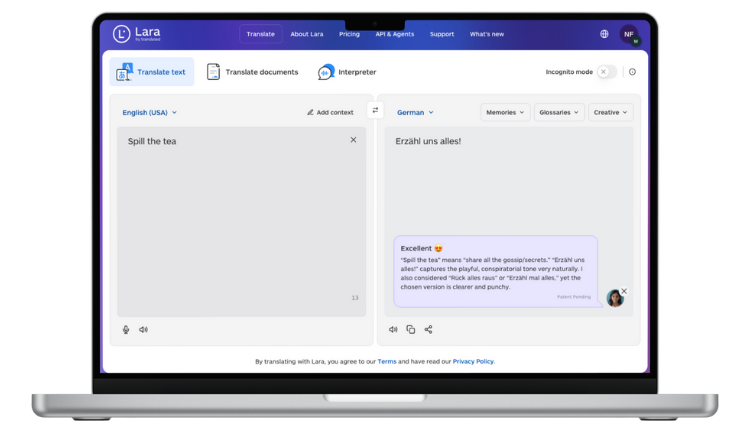
For brand consistency, Lara Translate supports glossaries and translation memories so recurring community terms, product nicknames, and preferred phrasing stay consistent across markets. It can also explain choices and flag ambiguity, which helps when slang has multiple plausible meanings and you need a safer option.
Test slang translation with real context
Paste a caption or chat thread and add platform, audience, and intent. Compare a neutral option vs a more slangy option.
What future improvements will matter most for slang translation?
The biggest improvements will come from faster adaptation to new language trends, stronger modeling of audience and register, and better handling of multimodal context when meaning depends on images, videos, and memes.
We should also expect better workflows that make it easy to request multiple tone options and route high-risk outputs to human review, especially for brand-facing social and community content.
Thank you for reading 💜
As a thank you, here’s a special coupon just for you:
IREADLARA26.
Redeem it and get 10% off Lara PRO for 6 months.
If you already have a Lara account, log in here to apply your coupon.
If you are new to Lara Translate, sign up here and activate your discount.
Why it matters
Slang is where brands either sound native or painfully off. A small tone mistake can turn a friendly message into something that feels rude, cringe, or culturally unaware. Getting AI slang translation right protects trust, improves engagement, and keeps your global voice consistent across fast-moving channels.
FAQs
Can AI translate slang accurately?
Yes, but it performs best when you provide audience, region, platform, and intent.
Why does slang often get translated literally?
Because the system lacks context and chooses word-level meaning instead of social intent.
What is the safest approach for social media translation?
Use a natural local equivalent or a clear neutral option, and avoid niche slang unless you are sure it fits the market.
When should humans review informal translations?
Review public campaigns, sarcasm-heavy posts, sensitive topics, and moderation decisions.
How do I improve chat translation quality?
Translate within the thread and provide the prior message context so intent and references are clear.
This article is about
- How AI slang translation works across social media and chat channels
- Why informal language is harder than formal text for machine translation
- A practical checklist for businesses translating casual, conversational content
- How tone-aware translation preserves intent and brand voice
- How Lara Translate supports context-driven informal language translation
Have a valuable tool, resource, or insight that could enhance one of our articles?
Submit your suggestion
We’ll be happy to review it and consider it for inclusion to enrich our content for our readers! ✍️