

Marketing teams expanding globally often ask a practical question: Can AI translation preserve brand voice and cultural nuance in marketing localization? Yes, but results depend on your workflow, not just the tool. When you provide clear context (audience, intent, tone) and apply terminology rules (glossaries and approved phrasing), AI can scale localization without turning your messaging off-brand. For high-impact assets, add lightweight human review and transcreation where needed.
Modern AI translation for marketing localization has evolved beyond word-for-word conversion. Professional-grade platforms can use context, brand guidance, and structured workflows to produce publish-ready drafts across channels. The fastest teams combine AI efficiency with human oversight for core messaging and sensitive markets. Here’s why that hybrid approach works.
TL;DR
|
Short answer
AI can preserve brand voice in marketing localization when you guide it with context, apply terminology rules, and add human review for Tier-1 assets. Use AI for scale and variants. Use transcreation and local review for brand-critical and culturally sensitive content.
Can AI translation handle marketing localization today?
AI marketing translation systems use neural networks trained on large volumes of translated content to model meaning, tone, and context. For marketing, the goal is not just accuracy. It is preserving intent and producing copy that feels native to the audience. That is why marketing localization often needs creative adaptation rather than literal translation.

The technology has evolved rapidly in recent years. Leading AI localization platforms support multiple content types, from social media to landing pages and full campaign bundles. With the right guidance, they can maintain consistent terminology and recognizable voice across markets.
Some platforms also provide transparency features, such as highlighting ambiguous terms, suggesting alternatives, or explaining translation choices. Treat these as decision support. They can surface risks, but they do not replace local expertise for sensitive markets.
Advanced engines can adapt their approach by recognizing content type. A product description, a promotional email, and a paid ad headline should not be treated the same. When you provide context (audience, intent, offer, and tone), AI tends to produce more on-brand, on-target drafts.
Neural machine translation can also help preserve sentiment and intent, especially when you guide it with examples and constraints. This matters for marketing campaigns where emotion, clarity, and trust drive engagement.
The best results come from combining AI with simple guardrails: clear inputs, terminology control, and a short review pass for high-impact assets. This turns AI from a “translator” into a scalable localization workflow.
When do you need transcreation instead of translation?
The difference between transcreation and translation matters most in marketing. Translation focuses on meaning. Transcreation aims for the same impact in a new culture, even if the words change. That usually applies to headlines, slogans, CTAs, and brand positioning.
AI tools increasingly offer creative modes that can generate strong first drafts, variations, and localized alternatives. Still, for campaigns where the brand promise is on the line, human creative oversight remains the safest choice.
A practical way to decide is to classify assets by risk and visibility, then match the workflow accordingly.
| Asset type | Best approach | Human needed? | Notes |
|---|---|---|---|
| Slogans, taglines, hero headlines | Transcreation | Yes | Aim for equivalent impact, not equivalent words. |
| Paid ads headlines and CTAs | AI variants + local review | Often | Generate 3 to 5 variants per market, then test. |
| Emails, landing pages, product pages | Localization | Tier-1 only | Review claims, tone, and formatting. |
| Help center, documentation, evergreen content | Faithful translation | Sometimes | Prioritize clarity and consistency over creativity. |
The most effective approach is hybrid: leverage AI for drafts and volume, then apply human transcreation for core brand messages and emotionally loaded content.
How do you localize brand voice across languages with AI?
 Brand voice localization is hard because personality traits shift across cultures. What sounds confident in one market may read as arrogant in another. A strong workflow starts with structured guidance: approved terminology, tone rules, do-not-translate lists, and examples of what “good” looks like.
The best teams treat brand voice as a system. They maintain a simple style guide per market that covers formality, pronouns, punctuation preferences, taboo phrasing, and CTA conventions. AI can apply those rules consistently when the inputs are clear.
Finally, set up a feedback loop with local reviewers. Use their edits to refine glossaries and guidance so the AI improves over time. This is how brand voice stays consistent without slowing down global execution.
How can AI localize marketing campaigns at scale without losing consistency?
AI-powered campaign localization helps marketing teams adapt multi-asset campaigns across markets in parallel. Instead of translating one page at a time, modern workflows handle campaign bundles, including social posts, landing pages, ad sets, and emails.
The scalability advantage is clear when campaigns are time-sensitive. AI can process hundreds of assets quickly, but quality holds only when you define content hierarchies. Prioritize human review for Tier-1 assets (home page, top ads, flagship email sequences). Use AI automation for supporting content.
A/B testing becomes easier too. AI can generate multiple localized variations so teams can test messaging per market and optimize based on performance data. Over time, this improves both translation quality and campaign outcomes.
What features should creative translation tools have for marketing teams?
Creative translation tools for marketing go beyond text conversion. Look for features that support how marketing work actually happens:
- Context controls: audience, intent, tone, and channel guidance.
- Terminology control: glossaries, approved phrasing, do-not-translate lists, and translation memories.
- Variant generation: multiple headline and CTA options for testing.
- Workflow and collaboration: roles, approvals, revision history, and reviewer feedback loops.
- File support and layout preservation: translate real assets without rebuilding formatting.
Real-time preview can be helpful for design-heavy assets, especially when expansion and contraction affect layout. If your tool supports it, use previews to catch overflow and readability issues before publishing.
Why use Lara Translate for professional marketing localization?
Lara Translate is a professional-grade AI translation engine designed for teams localizing marketing content at scale. Trained on more than 25 million professional translations and informed by expert linguistic input, it is built for content where context, tone, and cultural nuance shape performance.
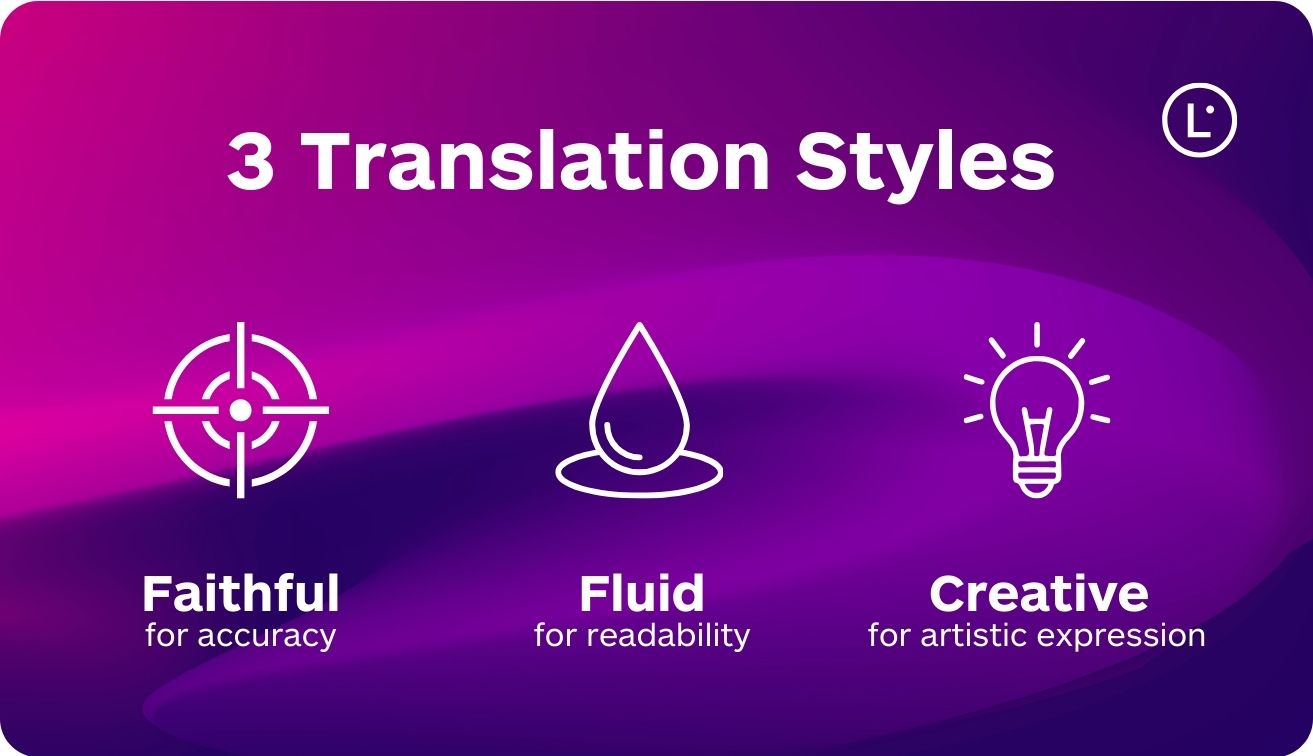
Instead of focusing only on linguistic accuracy, Lara Translate lets teams guide translation tone and intent based on content goals. Translation styles help match output to the asset, from technically precise copy to more fluid or creative marketing materials. See translation styles.
Operationally, Lara Translate supports a wide range of file types used in marketing workflows, with layout preservation to reduce handoffs between localization and design. See supported file formats.
Consistency is a constant challenge in multilingual marketing. Lara Translate includes terminology and glossary management to help keep brand terms stable across markets. It can also surface ambiguous phrasing and explain translation choices so teams can review and standardize decisions.
Security and privacy matter for campaign work, especially before launch. Encrypted processing and optional Incognito Mode help teams localize sensitive materials with appropriate data protection controls.
Broad language coverage enables marketing teams to extend localization efforts to established and emerging markets without juggling multiple tools. Combined with scalable workflows, this supports high-volume localization while keeping brand voice consistent.
What quality assurance keeps AI-localized marketing safe?
Quality assurance is what turns fast translations into reliable localization. Use automated checks for consistency and formatting, then apply human review where risk is highest.
- Brand consistency: glossary terms, product naming, tone, and CTA conventions.
- Claims and compliance: regulated wording, pricing, guarantees, legal disclaimers.
- Cultural risk: idioms, humor, sensitive topics, and local norms (use local reviewers for Tier-1 markets).
- UX and layout: text length, readability, truncation, and link correctness.
Run regular quality audits by asset type and market, then update your guidance and glossary. This is the fastest way to improve output quality over time.
How should marketing teams implement AI translation step by step?
Adoption works best when it is staged. Start with low-risk assets, learn what guidance improves output, then expand to campaign bundles.
- Define context: market, audience, offer, channel, and desired tone.
- Set constraints: glossary terms, do-not-translate list, and approved phrasing.
- Pick the right style: faithful for clarity, fluid for natural marketing copy, creative for variants and transcreation drafts.
- Generate variants: create 2 to 5 options for headlines and CTAs per market.
- Review Tier-1 assets: human review for brand-critical and culturally sensitive content.
- QA pass: layout, links, compliance claims, and tone checks.
- Measure and improve: track performance, collect reviewer edits, and refine guidance.
With a clear hierarchy and feedback loop, AI translation becomes a durable localization capability. It helps teams move faster while protecting brand integrity across markets.
The impact of localization on brand perception goes beyond language. It shapes trust, clarity, and conversion. That is why tooling decisions should support a complete localization strategy, not just faster translation.
If you are planning an expansion, use a language prioritization framework so effort maps to ROI. Here is a strategic guide to prioritizing languages.
Scale your marketing localization with Lara Translate
Use Lara Translate on real marketing assets to see how it supports brand consistency and high-volume workflows.
FAQs
Can AI translation services effectively handle marketing content localization?
Yes, AI can localize marketing content effectively when you provide context, control terminology, and review Tier-1 assets. Tools like Lara Translate support marketing workflows with translation styles, glossary controls, and scalable file translation across 200+ languages.
What’s the difference between basic translation and transcreation for marketing?
Translation preserves meaning. Transcreation preserves impact, often rewriting headlines, slogans, and CTAs for a new culture. Use transcreation for brand positioning and high-visibility campaigns.
How do I maintain brand voice consistency across multiple languages?
Use a glossary, examples, and tone rules, then apply local review for priority markets. Lara Translate supports terminology control, ambiguity detection, and style guidance to keep voice consistent across channels and file types.
Can AI handle campaign localization at enterprise scale?
Yes. AI can process large campaign bundles quickly. The key is content hierarchy: human review for Tier-1 assets, automation for supporting content, plus QA checks for layout, links, and claims.
What quality assurance measures are essential for AI translation in marketing?
At minimum: brand glossary checks, claims and compliance review, cultural risk review for sensitive markets, and layout validation. Add regular audits and feedback loops so guidance improves over time.
Thank you for reading 💜
As a thank you, here’s a special coupon just for you:
IREADLARA26.
Redeem it and get 10% off Lara PRO for 6 months.
If you already have a Lara account, log in here to apply your coupon.
If you are new to Lara Translate, sign up here and activate your discount.
Why it matters
When you expand globally, speed is not the only goal. Consistency and intent are. A workflow that combines AI scale with brand constraints and lightweight human review helps marketing teams launch faster without shipping off-brand messaging that quietly kills performance.
This article is about
- Whether AI can preserve brand voice in marketing localization, and what conditions make it work.
- When to use transcreation instead of translation for slogans, headlines, and CTAs.
- How to localize brand voice with glossaries, tone rules, and feedback loops.
- How to scale campaign localization with content hierarchies and A/B-tested variants.
- What QA checks matter most to protect brand, compliance, and layout.
Have a valuable tool, resource, or insight that could enhance one of our articles?
Submit your suggestion
We’ll be happy to review it and consider it for inclusion to enrich our content for our readers! ✍️