Legal teams often need fast, precise translations for contracts, filings, policies, and client communications, without losing legal meaning, confidentiality, or formatting. General-purpose tools can struggle with defined terms, jurisdiction-specific phrasing, and document structures that carry legal significance. AI translation for legal documents can help, but only if it is paired with the right controls and a defensible review process.
TL;DR
|
In this guide, you will find a practical shortlist of tools and a clear checklist to pick the right legal document translation software based on risk tolerance, workflow needs, and the types of documents your law firm handles.
What are the best AI legal translation tools for law firms in 2025?
Short answer
The best choice depends on your matter type. For fast, controlled legal drafts with terminology consistency, look for tools with glossaries, translation memories, formatting preservation, and clear privacy controls. For scanned documents, prioritize OCR support. For filings and signable contracts, keep a defined human review step.
| Tool | Best for | Key strengths |
|---|---|---|
| Lara Translate | Controlled legal drafting and review | Faithful style, explain choices, glossaries/TMs, privacy modes, 50+ file formats |
| DeepL Pro | EU language-heavy teams | Strong output quality, glossaries, document translation, API |
| X-doc.ai | High-volume legal and regulatory content | Batch workflows, OCR for scans, terminology controls |
| Smartcat | AI plus human review collaboration | Collaboration, glossaries/TMs, reviewer feedback loops |
| Trados Studio / memoQ (both integrated with Lara) | Translator-grade legal workflows | QA checks, terminology management, repeatable consistency |
How should law firms evaluate legal translation tools?
- Meaning control: Does the tool preserve defined terms and keep wording close to the source when needed?
- Terminology consistency: Can you enforce a glossary and reuse approved clauses with a translation memory?
- Formatting integrity: Does it keep numbering, tables, and structure in DOCX and PDFs?
- Scanned documents: If you handle scans, is OCR available and reliable for your languages?
- Security and retention controls: Can you choose a privacy mode that matches the matter requirements?
- Workflow fit: Can it integrate via API, and does it support review and approvals?
What does professional legal translation require?
AI translation for legal documents should behave differently from consumer translation. Legal accuracy requires precise meaning preservation, consistent terminology across document sets, and awareness of jurisdiction-specific wording. It also requires structured review workflows so legal professionals can verify clauses before using them in real matters.
Security is not optional when handling confidential information. Accurate legal translation services should provide strong encryption, clear retention and deletion options, and controls that let you align tool usage with attorney-client confidentiality expectations and internal policy.

Consistency across large document sets depends on terminology management and translation memory capabilities. AI contract translation platforms should help you keep defined terms, procedural language, and boilerplate clauses uniform across languages and across versions.
If you want a practical checklist for day-to-day work, see 6 tips for translating legal documents.
Which specialized AI legal translation platforms are worth considering?
DeepL Pro
DeepL Pro is widely adopted by legal professionals, particularly for European languages. It supports document translation (including Word, PDF, and PowerPoint) and offers glossary features to help keep legal terms consistent. DeepL also offers API access for integration into legal workflows.
- Best for: fast drafts and internal review when you need strong output quality.
- Watch for: always confirm retention and confidentiality settings match your matter policy.
X-doc.ai
X-doc.ai focuses on legal and regulatory content and is built for high-volume document workflows. It supports OCR for scanned documents, batch processing, and terminology management. If you rely on any vendor accuracy claims, validate them with representative samples from your own practice area.
- Best for: batches of legal and regulatory documents, including scans.
- Watch for: verify OCR quality and consistent terminology in your target jurisdictions.
Smartcat
Smartcat supports a hybrid approach that combines AI translation with human review workflows. Its collaboration features can help distributed legal teams and external linguists review and edit the same content while using glossaries and translation memories for consistency.
- Best for: collaborative review and post-editing workflows.
- Watch for: define roles and approvals clearly to avoid uncontrolled edits on sensitive text.
Sonix
Sonix specializes in transcription and translation, which can be useful for multilingual legal interviews, evidence review, and transcript workflows. It includes collaboration and editing tools and is often used where audio and text workflows overlap.
- Best for: transcription-first legal workflows that also require translation.
- Watch for: jurisdiction-specific terminology and names that require careful review.
Which CAT tools support legal translation workflows?
Trados Studio
Trados Studio is a long-standing CAT (computer-assisted translation) tool used by professional translators, including legal specialists. It offers advanced translation memory, terminology management, and QA checks that help maintain consistency across complex legal projects and long document sets.
memoQ
memoQ provides a strong collaborative environment for legal translation projects. Teams can share glossaries and translation memories in real time, run QA checks for terminology consistency, and integrate with document management workflows used in legal operations.
Phrase
Phrase is an enterprise translation management system built for scalable workflows and approvals. It is useful when legal teams need structured routing, review steps, and reporting across high volumes of multilingual content.
What other AI-powered legal translation options should you know?
BeringAI
BeringAI is designed for legal, patent, and regulatory translation. It supports workflows tailored to different document types and emphasizes structure preservation, which is valuable when formatting and numbering are critical.
Microsoft Translator
Microsoft Translator integrates into the Microsoft ecosystem, which can be convenient for legal teams working heavily in Word, Outlook, and other Microsoft tools. It supports real-time translation and document workflows and can fit teams that prioritize Microsoft-native deployment patterns.
Tomedes
Tomedes combines AI translation with human review services for legal content. This approach can help when you need a clear path from an AI draft to a verified final text for complex projects.
For a broader shortlist, you can also explore 7 best tools to translate legal documents.
Why is Lara Translate a strong fit for legal document translation?
Legal work needs speed, but also control. Lara Translate is built to support controlled multilingual drafting with terminology consistency, formatting preservation, and transparency features that help legal teams review and validate output before using it in practice.
Try Lara Translate with your legal content
Test Lara Translate on real texts and see how it preserves legal meaning, terminology, and structure.
Legal drafting control, with transparency
When accuracy matters, Lara Translate’s faithful translation style is designed to keep wording close to the source while preserving structure and meaning, which is particularly useful for contracts, policies, filings, and technical appendices.
To support legal review, Lara Translate can explain translation choices so teams can understand and validate key decisions before relying on a draft.
Terminology management for consistent clauses
Legal teams can enforce preferred terminology with legal glossary creation, including terms that should remain untranslated. This helps keep defined terms consistent across documents and across versions.

With translation memories, legal teams can reuse previously approved clauses and maintain identical boilerplate language across related documents, improving consistency and reducing review time.
Document fidelity and privacy controls for sensitive matters
Legal formatting often carries meaning, from numbering and headings to exhibits and tables. Lara Translate preserves structure across Word documents, text-based PDFs, presentations, spreadsheets, and 50+ additional file formats commonly used in legal work.
For confidentiality requirements, Lara Translate supports different translation modes, including incognito and learning modes, so teams can align tool behavior with matter policy and internal guidance.
Global reach for multilingual legal work
Legal matters often include more than primary documents. Lara Translate can support entire matter files, including decks, policy PDFs, schedules in spreadsheets, CSVs, and email exports.
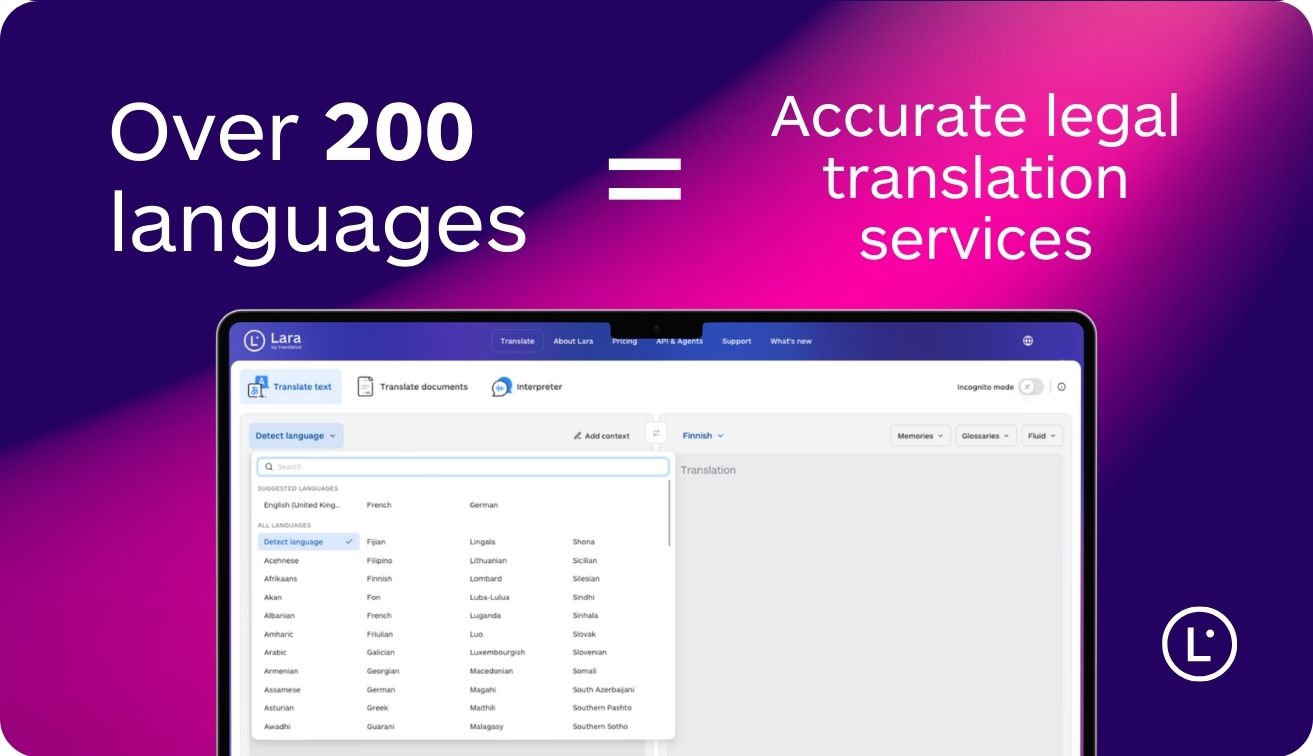
With support for over 200 languages, legal teams can address multilingual needs across jurisdictions while keeping terminology consistent across matter documentation.
How do you implement AI translation in a legal workflow?
A defensible implementation of law firm translation solutions starts with a clear matter-based policy. Decide which document types can be translated for internal review, which require human legal linguist review, and which must follow certified or sworn processes.
- Step 1: Classify document risk (internal review draft vs signable vs filing).
- Step 2: Lock terminology (glossary, defined terms, non-translatable items).
- Step 3: Translate with formatting preservation (DOCX, PDF, PPTX, XLSX as needed).
- Step 4: Review with a checklist (defined terms, numbers, dates, names, jurisdiction phrases).
- Step 5: Store and audit according to your privacy mode and retention rules.
The goal is not to remove review. It is to reduce manual effort, increase consistency, and speed up multilingual workflows while keeping accountability.
Thank you for reading 💜
As a thank you, here’s a special coupon just for you:
IREADLARA26.
Redeem it and get 10% off Lara PRO for 6 months.
If you already have a Lara account, log in here to apply your coupon.
If you are new to Lara Translate, sign up here and activate your discount.
FAQs
How accurate is AI translation for legal documents?
Accuracy varies by language pair, document type, and writing style. For most teams, AI works well for first drafts and internal review, but high-stakes clauses, filings, and signable contracts should be reviewed by a qualified legal linguist.
What security controls should law firms look for?
Look for encryption, clear retention and deletion options, access controls, and a privacy mode you can align with matter policy. Confirm where data is processed and what is stored before translating sensitive client content.
Can AI tools preserve legal formatting in Word and PDFs?
Some platforms can preserve structure such as headings, numbering, tables, and layout in common formats. Always test with a representative sample file before adopting a tool across matters.
Do we need glossaries and translation memories for legal work?
Yes. Glossaries help keep defined terms consistent, and translation memories help reuse approved clauses and boilerplate across versions and related documents.
How should a legal team evaluate AI contract translation quality?
Run a controlled pilot using real templates. Check defined terms, dates and numbers, parties and names, jurisdiction-specific phrasing, and consistency across related documents. Then lock a review workflow before scaling.
This article is about
- A 2025 shortlist of AI translation for legal documents tools for law firms and legal teams
- How to evaluate legal translation tools by security, terminology control, OCR, and formatting preservation
- A practical guide to choosing AI contract translation workflows with defensible review steps
- How legal document translation software supports multilingual matter files beyond contracts
- Implementation tips for law firm translation solutions that balance speed with risk management
Have a valuable tool, resource, or insight that could enhance one of our articles?
Submit your suggestion
We’ll be happy to review it and consider it for inclusion to enrich our content for our readers! ✍️
Useful articles
- AI Translation in Regulated Industries: Legal Risks and Ethical Dilemmas
- Key benefits of AI translation for business growth in 2025