

Many startup teams experience significant pressure to move fast and compete globally from day one. When your business documents need to speak multiple languages—whether you’re presenting to international investors, onboarding global talent, or entering new markets—traditional translation approaches may not align with startup speed requirements.
AI document translation appears to offer advantages that could help startups maintain their momentum while expanding internationally. However, not all AI document translation solutions deliver the precision and formatting consistency that critical business documents require. The difference between a generic translation tool and a specialized solution can determine whether your pitch deck impresses investors in Tokyo or confuses them in Frankfurt.
This comprehensive guide explores five proven strategies for implementing AI document translation within startup workflows, ensuring your essential documents maintain their impact across languages and cultures while preserving professional formatting that builds credibility with stakeholders worldwide.
Why traditional translation may not suit startup teams
Startup teams appear to operate in a fundamentally different environment than established enterprises. Speed to market, limited resources, and constant iteration may create unique translation challenges that traditional methods struggle to address effectively.
Traditional translation services typically require weeks for turnaround, involve complex project management overhead, and can cost thousands of dollars per project. For a startup validating product-market fit across multiple markets simultaneously, these constraints may make traditional translation challenging to implement.
Moreover, startup documents often evolve rapidly. Your pitch deck may change after every investor meeting, your product documentation updates with each release, and your legal policies may require constant refinement. AI document translation appears to enable this iterative approach by providing immediate translations that can evolve with your documents.
The formatting complexity of modern business documents presents another challenge. A pitch deck with embedded charts, financial projections, and custom graphics may benefit from PDF translation with layout preservation—something that basic translation tools may struggle to handle effectively.
Strategy 1: translate pitch deck materials with context preservation
Your pitch deck represents your startup’s most critical communication tool when seeking international investment. Every slide should ideally convey not just information, but the compelling narrative that drives investment decisions. AI document translation for pitch decks may benefit from specialized approaches that attempt to maintain both linguistic accuracy and visual impact.
Successful pitch deck translation typically goes beyond word-for-word conversion. Context preservation appears important when translating market size data, financial projections, and competitive positioning. Numbers and percentages may need to adapt to local formatting conventions, while maintaining the underlying mathematical accuracy that investors expect.
When preparing to translate pitch deck content, startups should prioritize creating comprehensive context documentation. This includes glossaries of company-specific terminology, explanations of market positioning, and clarification of any industry jargon that might not have direct equivalents in target languages.

Advanced AI document translation platforms may be able to leverage this contextual information to produce translations that could resonate with local investment communities. For instance, when translating a pitch deck for German investors, the AI system might adapt American-style ROI presentations to match German financial reporting conventions while preserving the core value proposition.
The visual elements of pitch decks present unique challenges for translation. Charts, graphs, and infographics often contain embedded text that must be extracted, translated, and reinserted while maintaining visual hierarchy and design consistency. This requires PDF translation with layout capabilities that can handle complex formatting without destroying the professional appearance that makes pitch decks effective.
Strategy 2: navigate startup legal translation requirements
Legal documentation represents perhaps the most challenging area for AI document translation in startup environments. Employment contracts, terms of service, privacy policies, and compliance documentation typically need to achieve high accuracy while adapting to local legal frameworks.
Startup legal translation often differs from enterprise legal translation because startups may lack established legal departments with translation expertise. Founders frequently find themselves responsible for helping to oversee that critical legal documents meet local requirements across multiple jurisdictions simultaneously.
The regulatory landscape for startups operating internationally requires constant document updates. When privacy regulations change in the European Union, or employment laws shift in Canada, startup legal translation systems must accommodate rapid updates without requiring complete retranslation from scratch.
AI document translation systems designed for legal content can identify critical legal terms and ensure consistent translation throughout document sets. This prevents the costly errors that occur when legal concepts are translated differently across related documents, creating potential compliance vulnerabilities.
However, startup teams must understand the limitations of AI in legal contexts. While AI document translation can handle routine legal document translation efficiently, complex regulatory compliance and jurisdiction-specific nuances still require human legal expertise. The optimal approach combines AI efficiency with targeted human review for critical legal elements.
Strategy 3: streamline product documentation with smart formatting
Product documentation serves as the bridge between your startup’s innovation and global user adoption. Whether you’re documenting API specifications, user guides, or technical specifications, your documentation quality may directly impact international user experience and developer adoption.
AI document translation for product documentation should ideally preserve technical accuracy while adapting to local technical writing conventions. Code examples, API endpoints, and configuration instructions may need specialized handling to help them remain functional across languages.
The iterative nature of startup product development means documentation changes frequently. Traditional translation approaches create bottlenecks that slow product releases when documentation updates require weeks for translation completion. AI document translation enables continuous documentation localization that keeps pace with development cycles.
Smart formatting preservation may become crucial when translating technical documentation with complex structures. Code blocks, syntax highlighting, numbered procedures, and interactive elements should ideally remain functional after translation. This may benefit from AI translation file formats capabilities that understand technical documentation structures.
Modern AI document translation systems can maintain links between related documentation sections, ensuring that cross-references and internal navigation remain accurate after translation. This prevents the broken user experiences that occur when translated documentation contains dead links or incorrect cross-references.
Strategy 4: implement scalable document workflows
Startup teams may benefit from translation workflows that scale efficiently as document volume increases and international operations expand. Building scalable AI document translation workflows could help prevent operational bottlenecks that might slow international expansion as your startup grows.
Effective workflow design begins with document categorization systems that route different document types through appropriate AI document translation processes. Pitch decks require different handling than legal contracts, and product documentation needs different validation than internal communications.
Integration capabilities determine whether AI document translation becomes a seamless part of your startup’s operations or creates additional work overhead. The most effective solutions integrate directly with existing document management systems, project management tools, and collaboration platforms that startups already use.

Quality assurance processes should ideally balance speed with accuracy requirements. Startups may benefit from the flexibility to apply different quality levels to different document types—applying rigorous review to legal documents while enabling rapid translation for internal communications.
Version control may become important when managing translated documents across multiple markets. Your AI document translation workflow should ideally track relationships between source documents and translations, enabling efficient updates when source content changes.
For startups planning international expansion, understanding when to use AI translation vs human translation helps optimize resource allocation and ensures appropriate quality levels for different document types.
Strategy 5: leverage advanced PDF translation with layout preservation
PDF documents remain central to startup operations, from financial projections and legal agreements to product specifications and marketing materials. These documents often contain complex layouts with embedded graphics, custom fonts, and precise formatting that must be preserved during translation.
Advanced PDF translation with layout preservation enables startups to maintain professional document presentation across languages without requiring expensive design recreation. This capability becomes essential when dealing with documents that combine text, graphics, and data visualization elements.
Financial documents present particular challenges for PDF translation with layout accuracy. Spreadsheet-style layouts, financial tables, and chart annotations should ideally maintain numerical accuracy while adapting to local formatting conventions. Currency symbols, decimal separators, and date formats may benefit from automatic localization without manual intervention.
Technical diagrams and flowcharts within PDF documents often contain embedded text that may need translation while maintaining visual relationships between elements. Advanced AI document translation systems appear designed to identify text within graphics and handle translation while preserving spatial relationships and visual hierarchy.
The legal compliance requirements for certain PDF document types may require precise reproduction of original layouts. Regulatory submissions, compliance reports, and legal filings often have strict formatting requirements that should not be altered during translation without creating potential compliance issues.
How Lara Translate transforms document translation for startups
Contemporary translation technology designed specifically for startup environments has evolved to meet the unique demands of fast-scaling companies. Lara Translate exemplifies this evolution, providing startup teams with advanced AI document translation capabilities that translate into more than 200 languages through both the interface and API access. This extensive linguistic coverage enables startups to pursue market opportunities globally without language constraints limiting their expansion strategies. For the complete and updated inventory of available languages, teams should consult the official language documentation.
The platform’s sophisticated approach to translation quality centers on three specialized styles that address different business communication requirements. The Faithful style ensures technical precision for documentation and specifications, while the Fluid style optimizes general business communications for natural readability. The Creative style adapts marketing content and brand messaging to resonate with local audiences while maintaining core brand identity across international markets.
Lara Translate’s contextual analysis capabilities represent a significant advancement for resource-limited startup teams. Rather than processing documents sentence by sentence, the system evaluates complete documents to maintain thematic consistency and logical flow throughout translated materials. This comprehensive approach prevents the fragmented communication that often results from basic translation tools, while the platform’s intelligent feedback mechanisms highlight potentially ambiguous content before it reaches international audiences.
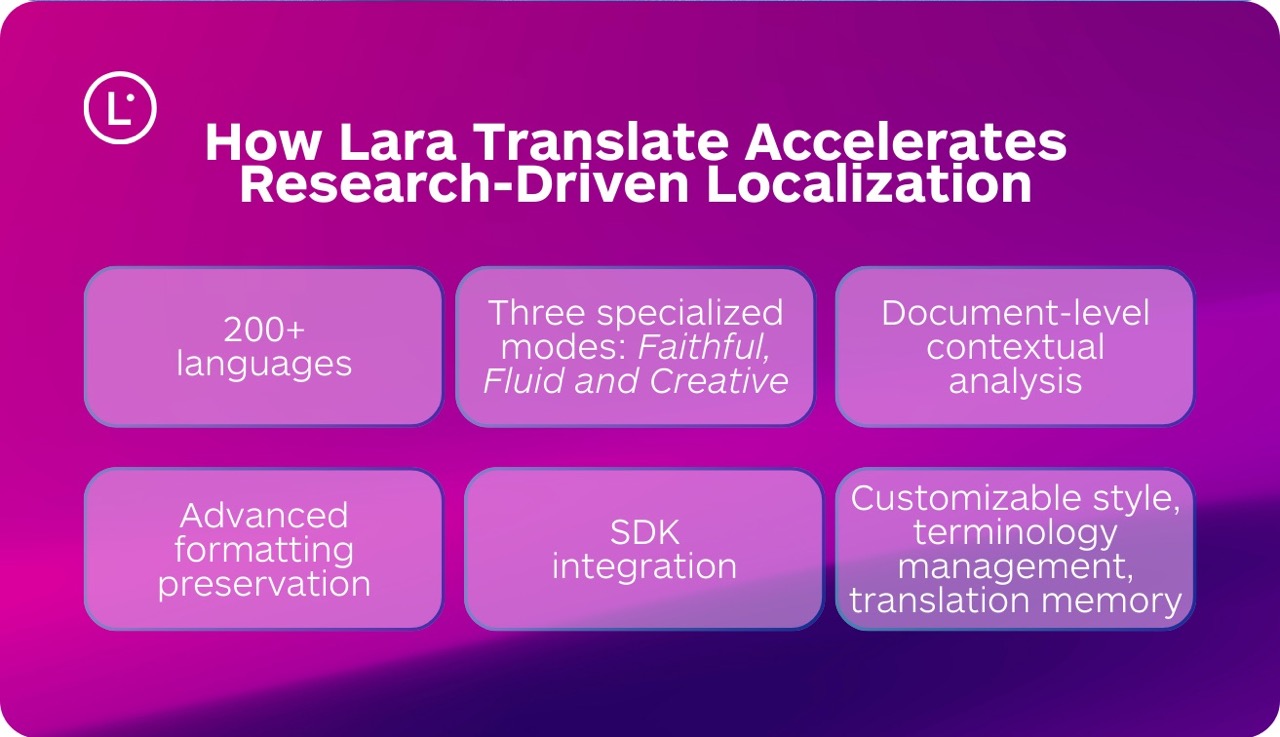
Visual document integrity presents a critical challenge when startups need to maintain professional presentation standards across languages. Lara Translate’s advanced formatting preservation ensures that complex layouts, embedded graphics, and design elements remain intact during translation—particularly essential for investor presentations, technical specifications, and marketing materials that represent startup brands to critical stakeholders in international markets.
The platform’s integration architecture accommodates existing startup technology stacks without requiring workflow disruption or tool replacement. Development teams can implement translation capabilities through comprehensive SDK support across multiple programming languages, while business teams can access translation features through intuitive interfaces that require minimal technical expertise.
For startup operations, this technological foundation translates into practical advantages: investor pitch materials can be adapted for international markets within minutes rather than weeks, product interfaces can support global user bases from launch, and marketing content can be localized while preserving brand voice and visual consistency through customizable style controls, terminology management, and translation memory systems.
Building translation workflows that scale with growth
As startups evolve from early-stage validation to scale-up operations, translation requirements often become increasingly complex and important to business success. Building workflows that accommodate this growth trajectory may help prevent translation bottlenecks from limiting international expansion opportunities.
Successful scaling may benefit from understanding the relationship between startup localization strategies and technical implementation. Early-stage startups typically need flexibility and speed, while growth-stage companies may require consistency and process optimization.
Document governance becomes crucial as teams grow and document creation becomes distributed across multiple departments. Establishing clear guidelines for when translation is required, what quality levels apply to different document types, and how updates should be managed prevents costly mistakes and ensures consistent international communications.
Integration planning should anticipate future tool adoption and workflow complexity. The AI document translation systems that startups choose should accommodate future integration with customer relationship management systems, document management platforms, and collaboration tools that become necessary as teams grow.
Quality assurance processes must evolve with business complexity while maintaining the speed advantages that make AI document translation attractive to startups. This often involves implementing tiered review processes where critical documents receive additional human review while routine communications rely on AI-only translation.
Implementing AI translation validation frameworks
Effective AI document translation may benefit from systematic approaches to quality validation that balance accuracy requirements with startup speed needs. AI translation validation frameworks can provide structured approaches to helping achieve translation quality without creating operational bottlenecks.
Validation frameworks could address different document criticality levels with appropriate review processes. Legal documents and regulatory submissions may benefit from comprehensive human review, while internal communications and routine correspondence might rely on automated quality checks and spot verification.
Terminology consistency validation ensures that company-specific terms, product names, and technical concepts are translated consistently across all documents. This prevents confusion among international stakeholders and maintains brand consistency across markets.
Cultural adaptation validation goes beyond linguistic accuracy to ensure that translated content resonates appropriately with target audiences. This includes reviewing cultural references, idiomatic expressions, and contextual appropriateness that AI systems might not fully understand.
Performance metrics tracking enables continuous improvement of AI document translation quality and workflow efficiency. Startups should monitor translation speed, accuracy rates, revision requirements, and user satisfaction to optimize their translation processes over time.
Future-proofing your translation strategy
The rapidly evolving landscape of AI translation technology may benefit startups that build translation strategies that can adapt to emerging capabilities and changing business requirements. Future-proofing may involve choosing platforms and processes that provide flexibility for growth and technological advancement.
Technology platform selection could prioritize API-first architectures that enable integration with future tools and services. Startups may benefit from avoiding translation solutions that lock them into proprietary systems or limit their ability to adapt workflows as business needs evolve.
Workflow automation capabilities should extend beyond basic document translation to encompass approval processes, quality assurance, and distribution management. This comprehensive approach prevents translation from becoming a bottleneck as document volume and complexity increase.
International compliance requirements continue evolving, particularly in areas of data privacy, security, and regulatory reporting. Startup translation strategies should accommodate these changing requirements without requiring complete system overhauls or process redesign.
Budget planning for translation services may benefit from accounting for scaling costs and evolving requirements. Understanding the cost implications of different AI document translation approaches could help startups make informed decisions about when to invest in enhanced capabilities or additional languages.
FAQs
How accurate is AI document translation for critical business documents?
Modern AI document translation systems appear to achieve professional-quality accuracy for most business document types. However, critical legal documents and regulatory submissions should include human review to help achieve complete accuracy and compliance with local requirements.
Can AI document translation preserve complex formatting in PDFs and presentations?
Advanced AI document translation platforms appear designed to maintain complex layouts, embedded graphics, and formatting structures in PDF documents and presentations. The key may be choosing solutions specifically designed for PDF translation with layout preservation rather than basic text translation tools. For example, Lara Translate‘s advanced formatting preservation capabilities aim to maintain visual integrity across complex document types, making it particularly suitable for investor presentations and technical documentation that require professional appearance across languages.
What should startups consider when choosing between different AI document translation providers?
Startups should evaluate language coverage, integration capabilities, security features, and pricing models. Priority should be given to platforms offering API access, multiple quality tiers, and the ability to handle various document formats while maintaining formatting integrity. Platforms like Lara Translate, which translates into more than 200 languages and offer specialized translation modes (Faithful, Fluid, Creative) for different content types, demonstrate the comprehensive approach startups should seek in their translation solutions.
How can startups ensure translation consistency across multiple documents and departments?
Implementing centralized glossaries, style guides, and translation memory systems helps maintain consistency. Many AI document translation platforms offer these features natively, enabling automatic consistency checking and terminology management across all translated content. Lara Translate‘s contextual analysis capabilities, for instance, evaluate complete documents to maintain thematic consistency and terminology coherence across different document types and departments, which proves particularly valuable for maintaining brand voice across international communications.
Is it cost-effective for startups to use AI document translation instead of human translators?
AI document translation typically appears to cost significantly less than human translation services while potentially delivering comparable quality for most business documents. The cost savings may enable startups to translate more content and enter more markets than would be possible with traditional translation budgets.
This article is about
- Essential strategies for implementing AI document translation in fast-moving startup environments while maintaining professional quality and formatting consistency
- Specialized approaches for translating critical startup documents including pitch decks, legal policies, and product documentation with appropriate quality and compliance considerations
- Scalable workflow design principles that enable translation processes to grow efficiently with startup expansion and increasing document volume requirements
- Advanced PDF translation with layout preservation techniques that maintain professional document presentation across languages without expensive design recreation
- Comprehensive evaluation criteria for selecting AI document translation platforms that integrate effectively with startup technology stacks and operational requirements
Have a valuable tool, resource, or insight that could enhance one of our articles? Submit your suggestion