

What is AI document translation for startups?
It means using AI tools to translate your core business files (pitch decks, legal docs, product documentation, PDFs) into multiple languages quickly, while keeping meaning, tone, and layout intact.
Many startup teams feel pressure to move fast and compete globally from day one. When your pitch decks, legal documents, and product files need to work in multiple languages – whether you are presenting to international investors, onboarding global talent, or entering new markets – traditional translation workflows often cannot keep up with startup speed.
AI document translation for startups helps teams keep that momentum while expanding internationally, but not every solution is built for critical business documents. Many generic tools struggle with precision, tone, and layout. The difference between a basic translator and a specialized AI document translation solution can be the difference between a pitch deck that convinces investors in Tokyo and one that confuses them in Frankfurt.
This guide explores five practical strategies for implementing AI document translation inside startup workflows, so your essential documents keep their impact across languages and cultures while preserving the professional formatting that builds credibility with stakeholders worldwide.
TL;DR
|

Why are traditional translation methods too slow for startups?
Startup teams operate in a fundamentally different environment than established enterprises. Speed to market, limited resources, and constant iteration create translation needs that classic agency workflows struggle to serve effectively.
Traditional translation services often assume long lead times, fixed scopes, and complex project management. Turnaround can take weeks, coordination requires multiple stakeholders, and each project can cost thousands of euros or dollars. For a startup testing product–market fit in several markets at once, these constraints make traditional translation hard to justify.
On top of that, startup documents rarely stay still. Your pitch deck changes after every investor meeting, product documentation updates with each release, and legal policies need regular refinement as the business evolves. AI document translation lets you keep up with this pace by providing near-instant translations that evolve with each new version instead of restarting projects from scratch.
The formatting complexity of modern business documents adds another layer of difficulty. A pitch deck packed with charts, financial projections, and custom graphics needs PDF translation with layout preservation, so the translated version still looks investor-ready. Basic translation tools often fail here, breaking layouts and forcing teams to redo design work manually.
Strategy 1: How should startups translate pitch decks with AI?
Translate pitch deck materials with context preservation

Your pitch deck is one of your startup’s most critical communication tools when you seek international investment. Every slide should carry not only facts but a clear, convincing narrative. AI document translation for startups can do this well only if you plan for context, numbers, and layout together.
| Element | What to localize | What to keep consistent |
|---|---|---|
| Market & problem | Examples, references, and wording that fit the local context. | Core problem statement and positioning. |
| Financials | Number formats, date formats, and currency display. | Underlying numbers and logic. |
| Traction & metrics | Explanations and labels for each metric. | Actual KPIs and definitions. |
| Visuals & layout | Embedded text in charts, diagrams, and callouts. | Slide structure, hierarchy, and design system. |
Before translation: prepare context for the AI
- Create a mini context brief:
- Target audience (e.g., “early-stage German VCs focused on B2B SaaS”).
- Company one-liner and short product description.
- Glossary for product names, proprietary terms, and internal labels.
- Preferred tone (formal/informal, direct / more diplomatic).
- Clarify your market positioning:
- How do you define the market size (TAM/SAM/SOM).
- Who your main competitors are and how you describe them.
- Any jargon that should stay in English or keep the original term.
During translation: protect narrative, numbers, and structure
- Preserve the storyline: make sure the AI follows slide order and keeps the same “hook → problem → solution → traction → ask” structure.
- Adapt formatting, not meaning:
- Use local decimal separators and thousands separators.
- Adjust date formats and currency labels where needed.
- Keep the underlying financial math identical in every language.
- Use layout-aware translation:
- Choose a tool that supports PPTX or PDF translation with layout preservation.
- Translate text inside charts, diagrams, and infographics, then reinsert it in place.
- Keep font hierarchy, alignment, and spacing consistent so the deck still looks “designed,” not patched.
After translation: run a quick investor-focused review
- Story check: does the translated deck clearly answer “what you do,” “for whom,” and “why now”?
- Numbers check: are all metrics, percentages, and financials consistent with the source version?
- Design check: are any labels cropped, overlapping, or missing in charts and callouts?
Done well, AI document translation for pitch decks gives you investor-ready versions for each market in hours instead of weeks, without sacrificing clarity, credibility, or visual impact.
Strategy 2: How can startups handle legal translation with AI safely?
Navigate startup legal translation requirements

Legal documentation is often the most demanding area for AI document translation in startup environments. Employment contracts, terms of service, privacy policies, and compliance documentation all need high accuracy while adapting to local legal frameworks. A single mistake can create real risk for the business.
Startup legal translation differs from enterprise legal translation. Many startups do not have established legal departments with in-house translation expertise. Founders and operations leaders often end up responsible for ensuring that critical legal documents meet local requirements across several jurisdictions at once.
The regulatory landscape for startups operating internationally changes frequently. When privacy rules evolve in the European Union or employment laws shift in Canada, your documents must follow. A good setup for
legal document translation lets you update the source once, then push consistent updates across all languages without redoing everything from scratch.
Well-designed AI document translation systems for legal content can:
- Identify and consistently apply key legal terms across contracts, policies, and annexes.
- Reduce inconsistencies that appear when similar clauses are translated differently in related documents.
- Speed up updates when you roll out new versions of terms, DPAs, or internal policies.
At the same time, it is important to understand the limits of AI in legal contexts. AI can handle routine legal document translation efficiently, but complex regulatory compliance and jurisdiction-specific nuances still require human legal expertise.
The safest model is simple: AI for drafts and alignment, lawyers for final approval and high-risk content.
For AI document translation for startups, this hybrid approach gives you the best of both worlds: fast, scalable legal drafts that keep pace with the business, and expert review where it truly matters for risk and compliance.
Strategy 3: How can startups streamline product documentation with AI?
Streamline product documentation with smart formatting
 Product documentation is the bridge between your startup’s innovation and global user adoption. Whether you are documenting API specifications, user guides, or technical specs, documentation quality directly affects international user experience and developer adoption.
For startups, AI document translation for product documentation has two main jobs:
- Preserve technical accuracy: terminology, parameters, and constraints must remain precise in every language.
- Respect technical writing conventions: headings, structure, and examples should feel natural to local readers.
Code examples, API endpoints, and configuration instructions often need special treatment. You usually want:
- Code blocks to stay untouched or only partially localized (e.g., comments, not syntax).
- Endpoints and parameter names to remain consistent with the product, not auto-translated.
- Command-line snippets and configuration files to stay valid after translation.
The iterative nature of startup product development means your documentation changes frequently. Traditional translation approaches create bottlenecks when every minor update requires a new project and weeks of turnaround. In contrast, AI document translation enables continuous localization: you update the source, trigger translation, and keep docs aligned with each release.
Smart formatting preservation is crucial for technical content. You want:
- Code blocks and syntax highlighting to remain intact and readable.
- Numbered procedures and bullet lists to keep their structure.
- Notes, warnings, and callouts should be clearly marked and correctly styled.
- Inline UI labels and button names to be consistent with the product interface.
This is where dedicated AI translation file formats capabilities that understand technical documentation structures
make a difference. Instead of treating your docs as raw text, they respect markup, code fences, and layout, so the translated version stays usable and clean.
Modern AI document translation systems can also help maintain relationships within your documentation set. They can keep:
- Cross-references pointing to the right sections in each language.
- Internal navigation (anchors, “see also” links) aligned with translated headings.
- Consistent terminology across guides, tutorials, and API references.
The result is simple: your global users and developers see documentation that feels native, remains technically correct, and stays in sync with your product – without slowing down your release cycle.
Strategy 4: How can startups build scalable AI document workflows?
Implement scalable document workflows
 As your startup grows, translation requests usually spread across teams and tools. Without a clear workflow, AI document translation for startups can turn into ad-hoc tasks, duplicated work, and inconsistent quality. A scalable setup avoids this by defining how each document type moves from draft to translated version.
Start with simple document categories
Instead of one generic process, group documents by use case and risk level:
- Investor-facing: pitch decks, board packs, financial summaries.
- Legal & compliance: contracts, terms, policies, regulatory docs.
- Product & technical: release notes, API docs, user guides.
- Marketing & website: landing pages, emails, campaigns, help center.
- Internal communications: internal memos, training materials, ops docs.
Apply different quality levels per category
| Document type | Recommended approach |
|---|---|
| Legal & compliance | AI + full human legal review before anything goes live. |
| Investor decks & board material | AI + targeted review for key sections (story, numbers, risks). |
| Product & technical docs | AI + light review by product or support teams. |
| Marketing & website | AI + editorial review for tone and brand voice. |
| Internal communications | AI-only for speed, unless the content is highly sensitive. |
Integrate with the tools your team already uses
Scalable workflows keep translation inside your existing ecosystem instead of adding extra platforms to check. Ideally, your AI document translation solution should:
- Connect to your document storage (e.g., Drive, OneDrive, SharePoint).
- Plug into project tools (Notion, Jira, Asana) where work is tracked.
- Support your CMS or help center for direct publish flows.
When translation is integrated, “send to AI, get back translated version” becomes a normal step in your process, not a separate side project.
Use lightweight version control across languages
As soon as you have multiple markets, version control matters. Your workflow should make it easy to:
- See which language versions exist for each source document.
- Track when the source has changed and which translations are out of date.
- Trigger re-translation or partial updates instead of recreating everything.
For startups planning international expansion, it is also important to decide when to use AI translation vs human translation. High-risk content (legal, regulatory, major investor material) should include human experts, while most day-to-day documents can safely rely on AI with the right checks in place. Getting this mix right helps you control cost and risk without slowing down growth.
Strategy 5: Why does advanced PDF translation matter for startups?
Leverage advanced PDF translation with layout preservation
 PDF documents sit at the center of many startup operations: financial projections, legal agreements, product specs, investor reports, and marketing materials. These files usually contain complex layouts with embedded graphics, custom fonts, tables, and precise formatting that need to survive translation.
Advanced PDF translation with layout preservation lets you keep a consistent, professional look across languages without rebuilding every document by hand. This is especially important when text, graphics, and data visualizations all coexist on the same page.
Financial PDFs: keep numbers and layouts aligned
Financial documents are particularly sensitive. Spreadsheet-style layouts, financial tables, and chart annotations must stay readable and accurate while adjusting to local conventions. A good PDF translation workflow should:
- Preserve table structures, row/column alignment, and headers.
- Localize number formats (decimal and thousands separators) without changing values.
- Adapt currency symbols and date formats to local expectations.
- Keep chart labels and legends aligned with the underlying data.
Technical PDFs: translate diagrams without breaking them
Technical diagrams and flowcharts inside PDFs often include text embedded in shapes, arrows, and annotations. Advanced AI document translation systems can detect that text, translate it, and place it back while preserving spatial relationships and visual hierarchy. This way:
- Process diagrams remain easy to follow in every language.
- Architecture and system diagrams keep consistent terminology across labels.
- Callouts and notes stay attached to the right part of the graphic.
Legal and regulatory PDFs: match the original layout exactly
Some document types, especially in legal and regulatory contexts, have strict layout rules. Regulatory submissions, compliance reports, and legal filings often need to mirror the original structure closely. In these cases, PDF translation with precise layout preservation helps you:
- Maintain page and section structure required by regulators.
- Keep clause numbering and cross-references aligned with the original.
- Avoid accidental layout changes that could trigger questions or rejections.
For AI document translation for startups, getting PDFs right is less about flashy features and more about trust: investors, customers, and authorities should see translated PDFs that look just as reliable and professional as your original documents.
How does Lara Translate transform document translation for startups?
Contemporary translation technology designed for startup environments has evolved to match the pace of fast-scaling companies. Lara Translate exemplifies this shift by giving startup teams advanced AI document translation capabilities that work in more than 200 languages through both the web interface and API. This coverage lets startups go after global markets without treating language as a blocker.
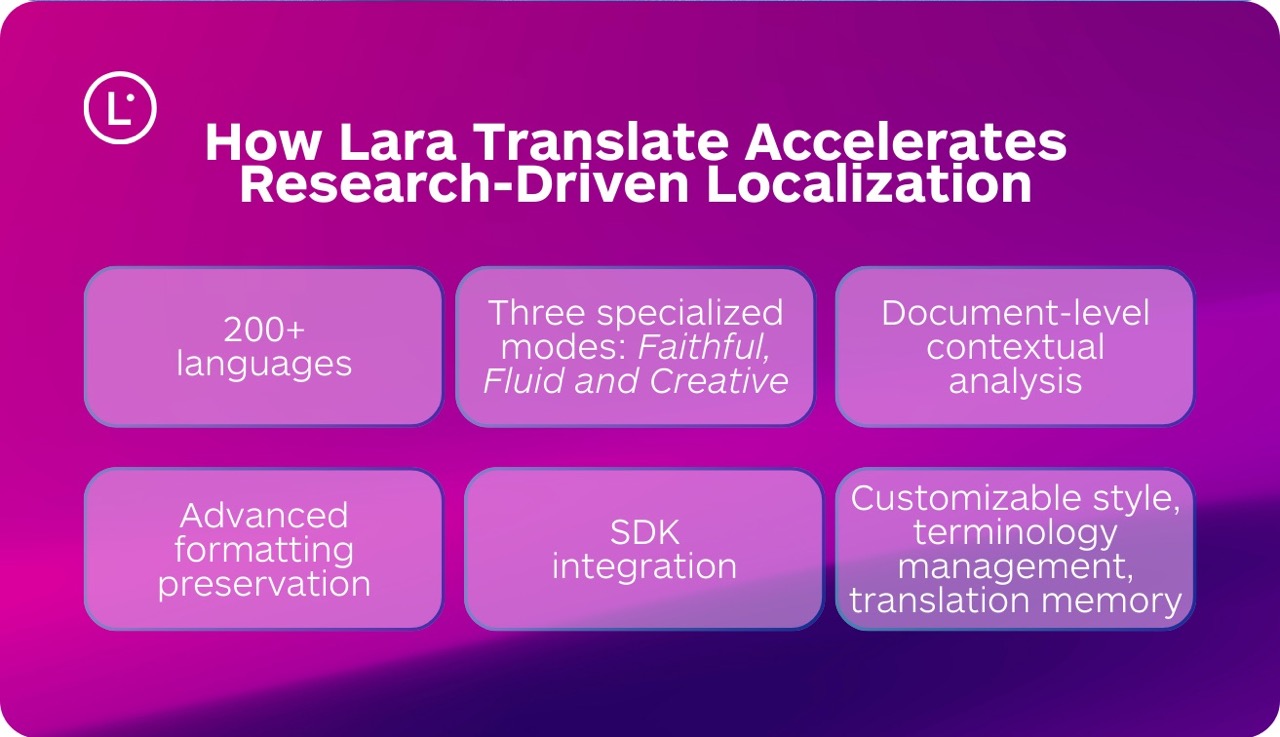
Lara Translate’s approach to quality is built around three specialized translation styles that map directly to typical startup content:
- Faithful: for technical precision in documentation, specs, and legal-adjacent content where every term matters.
- Fluid: for everyday business communication, decks, and internal docs that should read naturally in any language.
- Creative: for marketing copy and brand messaging that must resonate locally while preserving brand voice.
Lara Translate’s contextual analysis capabilities are particularly useful for resource-limited startup teams. Instead of translating sentence by sentence in isolation, Lara reads the full document to maintain thematic consistency and logical flow across sections. Intelligent feedback mechanisms highlight potentially ambiguous terms or phrases, so teams can clarify them before content goes out to investors, customers, or regulators.
Try Lara Translate in your own workflow
Upload a real pitch deck, policy, or product document and see how Lara Translate handles your context, terminology, and layout in seconds.
Visual document integrity is another critical area for startups. Investor decks, technical specs, and marketing materials need to look polished in every language. Lara Translate’s advanced formatting preservation keeps complex layouts, embedded graphics, and design elements intact during translation, so teams do not have to rebuild slides or documents after every language update.
The platform’s integration architecture is designed to fit into existing startup stacks instead of forcing teams to change tools. Development teams can add translation directly into products and workflows using SDK support across multiple programming languages, while non-technical teams work through an intuitive interface that makes document translation and review straightforward.
For startup operations, this foundation turns into clear, practical advantages:
- investor pitch materials can be adapted for new markets in minutes rather than weeks,
- product interfaces and documentation can support global user bases from the earliest releases, and
- marketing content can be localized at scale while preserving brand voice through customizable style controls, terminology management, and translation memory systems. In short, Lara Translate helps startups treat multilingual work as part of the normal workflow, not a separate, blocking project.
How can you build translation workflows that scale with startup growth?
As startups move from early validation to the scale-up stage, translation needs usually become more complex and more central to business success. More teams create content, more markets go live, and more document types require multilingual versions. If workflows don’t evolve, translation bottlenecks can quickly slow down international expansion.
Successful scaling starts with understanding the link between startup localization strategies and technical implementation. Early-stage startups typically need maximum flexibility and speed — quick drafts, fast experimentation, minimal process. Growth-stage companies need more consistency, clear ownership, and repeatable workflows that survive team changes.
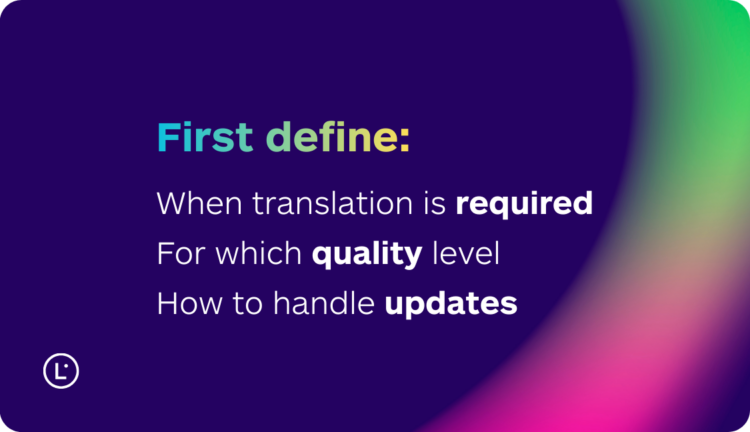
As more people create and edit documents, document governance becomes essential. You can reduce confusion and errors by defining:
- When translation is required, which document types must always be localized (e.g., investor updates, key product docs, legal policies)?
- Which quality level applies: AI-only, AI + light review, or AI + full expert review?
- How updates are handled: who triggers re-translation and how changes are communicated across teams and languages.
At the same time, integration planning should look ahead. The AI document translation system you choose should be able to:
- Connect later to your CRM, marketing automation, and support tools.
- Integrate with document management and knowledge base platforms.
- Fit into future workflow automation (e.g., CI pipelines, ticket systems, content ops tools).
Finally, quality assurance processes need to grow with the business without sacrificing speed. A common approach is:
- Tiered review: high-risk documents (legal, regulatory, major investor content) get human expert review; routine communications and internal docs use AI-only or spot checks.
- Feedback loops: teams can flag issues and feed improvements back into glossaries, style guides, and translation memories.
- Metrics: track turnaround time, review effort, and error rates so you can refine the workflow over time.
Done right, these elements turn translation from a series of one-off tasks into a structured capability that grows with your startup, supporting every new market and every new team without adding unnecessary friction.
How can startups validate AI document translation quality?
To make AI document translation for startups reliable at scale, you need a systematic way to check quality without blocking speed. This is where AI translation validation frameworks come in: they give you a structured way to decide what to review, how deeply, and by whom.
Match review depth to document risk
 Not every document needs the same level of scrutiny. A simple tiered approach helps:
- Tier 1 – Critical: legal documents, regulatory submissions, key investor materials.
- AI for speed and consistency.
- Full human review by legal or domain experts before publication.
- Tier 2 – Important: product docs, website copy, core marketing assets.
- AI for first pass.
- Targeted human review for key sections (value propositions, terminology, CTAs).
- Tier 3 – Routine: internal comms, drafts, exploratory content.
- AI-only with spot checks or lightweight automated QA.
Validate terminology and consistency
 A core part of any AI translation validation framework is terminology control. You want company-specific terms, product names, and technical concepts to be used consistently across:
- Pitch decks and investor materials.
- Product documentation and help center articles.
- Marketing campaigns and website pages.
This usually involves maintaining glossaries and translation memories, plus checking new translations against them during review.
Check cultural and contextual fit
 Linguistic accuracy is not enough if the content feels off in a target market. A lightweight cultural adaptation check can review:
- Idioms and informal expressions that may not work in the target language.
- Examples, references, and tone that might feel awkward or inappropriate.
- Calls to action and value propositions to confirm they resonate locally.
Track metrics and improve over time
 Finally, a validation framework should include basic performance tracking so you can refine your process. Useful metrics include:
- Turnaround time: how long it takes from source to approved translation.
- Revision rate: how often reviewers make substantial changes to AI output.
- Error patterns: recurring issues with certain terms, formats, or languages.
- Stakeholder feedback: internal teams or customers flagging clarity or tone issues.
With a clear AI translation validation framework in place, startups can keep the speed advantage of AI while systematically controlling risk and improving quality with each iteration.
How can startups future-proof their AI document translation strategy?
The landscape of AI document translation for startups moves quickly. New models, formats, and integration options appear every year. Future-proofing your translation strategy means building on platforms and processes that can adapt to new capabilities and changing business requirements, instead of locking you into a rigid setup.
On the technology side, it helps to prioritize API-first architectures that can integrate with future tools and services. This gives you freedom to connect translation to your CRM, support platforms, analytics stack, or CI/CD pipelines as your company matures — without switching providers or rebuilding your workflows.
Your automation should also go beyond basic “upload file → get translation.” A resilient strategy includes:
- Approval flows: routing high-risk content through the right reviewers before publication.
- Quality checks: terminology, formatting, and layout validation as part of the process, not an afterthought.
- Distribution: automatically pushing approved translations to the right channels (website, apps, help center, documentation portals).
International compliance requirements will continue to evolve, especially around data privacy, security, and regulatory reporting. Your translation setup should be able to respect data residency requirements, implement least-privilege access, and adapt to new rules without major system overhauls.
Finally, budget planning needs to reflect how translation scales with the business. Understanding the cost and impact of different approaches — AI-only, hybrid AI + human, or fully human — helps you decide when to invest in more languages, more markets, or deeper quality layers without unpleasant surprises.
In practice, a future-proof translation strategy is one that you don’t have to rethink every time you add a new market, product line, or compliance requirement. Instead, you adjust configuration, expand your automations, and keep growing on top of the same foundation.
Future-proof your translation workflow with Lara Translate
Connect Lara Translate to your real documents and see how it scales with your releases, markets, and teams — without changing the tools you already use.
Thank you for reading 💜
As a thank you, here’s a special coupon just for you:
IREADLARA25.
Redeem it and get 10% off Lara PRO for 6 months.
If you already have a Lara account, log in here to apply your coupon.
If you are new to Lara Translate, sign up here and activate your discount.
FAQs
How accurate is AI document translation for critical startup documents?
Accurate enough for most business documents when you give it context and terminology. For legal, regulatory, or major investor content, you should always add human review.
Can AI document translation preserve complex formatting in PDFs and presentations?
Yes, if you use tools built for layout preservation. They can keep tables, charts, and slide designs intact while translating the text.
What should startups look at when choosing an AI document translation provider?
Check language coverage, file formats, layout handling, security, pricing, and how well it integrates with your existing tools and workflows.
How can startups keep translations consistent across documents and teams?
Use shared glossaries, style guides, and translation memories, plus simple rules on which terms never change and who approves updates.
Is AI document translation cost-effective compared to human-only translation?
Yes. AI lets you translate much more content for the same budget. The best setup is usually AI-first, with human review only for high-risk documents.
This article is about
- How startups can use AI document translation to move fast globally without losing quality or layout.
- Practical strategies for translating pitch decks, legal docs, product documentation, and PDFs in a startup context.
- Designing scalable workflows and validation steps so translation keeps pace with growth and risk stays under control.
- The role of Lara Translate in handling 200+ languages, formats, and styles for startup teams.
- Deciding when AI is enough and when to add human review for high-stakes documents.
Have a valuable tool, resource, or insight that could enhance one of our articles?
Submit your suggestion
We’ll be happy to review it and consider it for inclusion to enrich our content for our readers! ✍️